Is Fir Essential Oil Sustainable? What a Label Cannot Tell You
No bottle of oil can be "sustainable" by label alone; the word describes a forest and a harvest, and the label shows neither. What you can ask of a fir oil is narrower and checkable: what material it comes from, and how much of the forest leaves with each kilogram. We do not call our oil sustainable and we hold no sustainability certification. This page sets out what we can say, what the forestry record shows about balsam fir, and the arithmetic of what distillation consumes.

Fir Needle Essential Oil
Our own Fir Needle Essential Oil, in sizes from 0.5 oz to bulk.
From $10.99
Shop Now →Why we do not use the word
The Federal Trade Commission's Green Guides say marketers should not make unqualified general environmental benefit claims, because such claims likely imply far-reaching benefits or no negative impact that a marketer is unlikely to substantiate (16 CFR 260.4). They require clear and prominent qualifying language that limits a claim to a specific benefit, and they say a minor benefit should not be suggested to be significant. The section as published does not mention the word "sustainable" itself, but its logic applies: a bare word invites the reader to assume the broadest meaning. So we make no such claim, and where the word appears here it describes other people's claims.
What we can say about our material
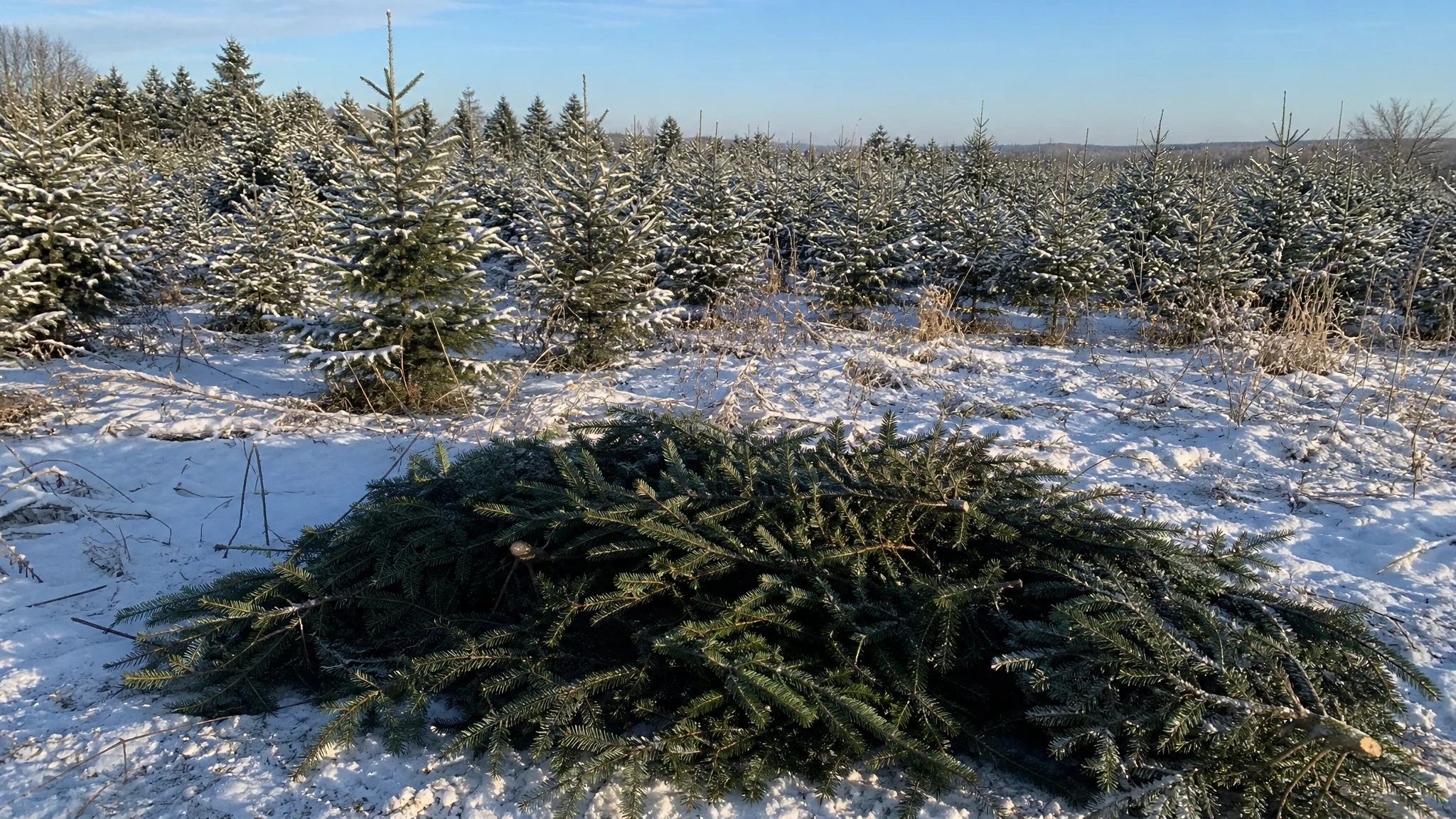
Our distillation page says the oil is balsam fir (Abies balsamea), made from young needles and fine twigs, from boughs cut in the cold months as a by-product of trimming for the seasonal greenery trade, bought from growers in the North American boreal forest. That is all we have to say about the source. We have not interviewed any grower and we say nothing about practices beyond that sentence. The COA we publish names Abies balsamea and the part used as leaf, and gives density and refractive index; it carries no origin or forest data.
That is a statement about the material, and it is a claim that has a checkable shape: by-product of trimming, not trees felled for oil. It is not a statement about the health of any forest. Treat it as a question to put to any supplier, including us, when you want evidence.
What the forestry record shows about balsam fir
The US Forest Service's Silvics of North America entry for balsam fir (Frank, 1990) is the standard reference. It supports a few points that matter for a bough harvest:
- The species is "very tolerant" of shade. Seeds germinate at light levels of only 10 percent of full sunlight, though seedlings need at least 50 percent for optimum growth.
- Regular seed production probably begins at 20 to 30 years, with good seed crops every 2 to 4 years. Maximum age is about 200 years.
- Pests set the pace more than harvesting does. The spruce budworm is "the most important by far" insect enemy, with perhaps as many as 11 vast outbreaks in eastern North America since 1704, and rootlet mortality can reach 75 percent after 3 consecutive years of defoliation. Rot begins around age 40, more than half of trees are infected by 70, and the pathological rotation is about 70 years.
- Heavy removal changes what grows back. On cutover land, the entry says bracken, raspberry and hardwood sprouts can dominate for 10 to 25 years after basal area drops by 50 percent or more. That figure describes stand-level cutting, not bough trimming, and we do not claim our source avoids it; it shows why "how much is taken" is the question and "is it natural" is not.
- On the use side, it calls balsam fir a favorite Christmas tree for more than 400 years (13.9 percent of the market in 1980, second to Scotch pine), and says wreath-making is a major holiday business in some areas because of needle retention, color and fragrance.
What the entry does not say matters as much. It does not mention essential oil, and it does not address bough cutting. Nothing in it tells you whether trimming boughs is better or worse for a tree than any other cut. Anyone who says so from this source is overreaching.
The greenery trade is big, and it is mostly not balsam fir
For scale, USDA's Economic Research Service, summarizing the 2022 Census of Agriculture, reports about 14.5 million Christmas trees cut, about 550,000 fewer than in 2017, grown on about 16,000 US tree farms, with sales of roughly 553 million dollars. More than half of the trees came from two states, Oregon and North Carolina. That is the whole cut-tree industry across species. It tells you the greenery trade exists and is large; it does not tell you how much balsam fir trim is available in the boreal forest, or what share of it goes to distillation.
How much needle does a bottle take?
We could not find a peer-reviewed yield for steam-distilled balsam fir needle oil, so we do not state one, and we would distrust any seller who does without a source. The one distillation yield we fetched is a different genus: a 2022 paper on pine needles (mainly Pinus massoniana) in BioResources, which reported 0.463% to 0.609% from 100 g of fresh needles in a lab setup. Treat the next sums as an illustration of scale, not as our yield.
| Size | Oil | Fresh needles at 0.609% | Fresh needles at 0.463% |
|---|---|---|---|
| 0.5 oz | 14.2 g | 2.3 kg | 3.1 kg |
| 25 lb | 11.3 kg | 1.9 tonnes | 2.4 tonnes |
| 400 lb | 181 kg | 29.7 tonnes | 39.2 tonnes |
Reasoning from those figures, a single 400 lb drum would consume tens of tonnes of needles, which is a different order of material from a wreath-maker's trimmings per tree. That is the right question to ask any supplier: how many kilograms of needle per kilogram of oil, and where does that needle come from at volume. We cannot answer it from a producer interview because there is none.
Questions that test any fir oil's origin claim
- Which species and which part, and does the document in your hand say so? Ours names Abies balsamea and the leaf, per the COA.
- Is the material a by-product of another harvest, or cut for the oil?
- Can the seller name the region and the season of cutting, and show a lot number tied to a distillation date? Our distillation page says lots carry distillation and bottling dates and a lot number.
- Is any third-party certification claimed, and by whom? We claim none.
For how the oil is distilled, see how fir needle oil is made; for varieties and sourcing in the buyer's guide, buying fir essential oil; and for the trees themselves, meet the firs.
None of this makes a verdict on any forest. It gives you a way to compare claims: a seller who names the material, the season, the lot and the yield has told you something you can check, and a seller who offers one adjective has not.
If you want to buy by the question above, the sizes run from 0.5 oz to 400 lb, and the same oil goes into each one.
Fir Needle Essential Oil
Fir Needle Essential Oil from our own shop, in sizes from 0.5 oz to bulk.
From $10.99
Shop Now →Sources & Further Reading
- USDA Forest Service, 1990. Silvics of North America: Balsam Fir (Abies balsamea), R. M. Frank. research.fs.usda.gov/silvics/balsam-fir
- USDA Economic Research Service. Charts of Note: 2022 Census of Agriculture, Christmas trees. ers.usda.gov/charts-of-note/110530
- US eCFR, current. 16 CFR 260.4, General environmental benefit claims (FTC Green Guides). ecfr.gov/16-CFR-260.4
- Xie J et al., 2022. Optimization of extraction process of pine needle essential oil by response surface methodology and its chemical composition analysis. BioResources 17(4):5890-5904. bioresources.cnr.ncsu.edu/40953