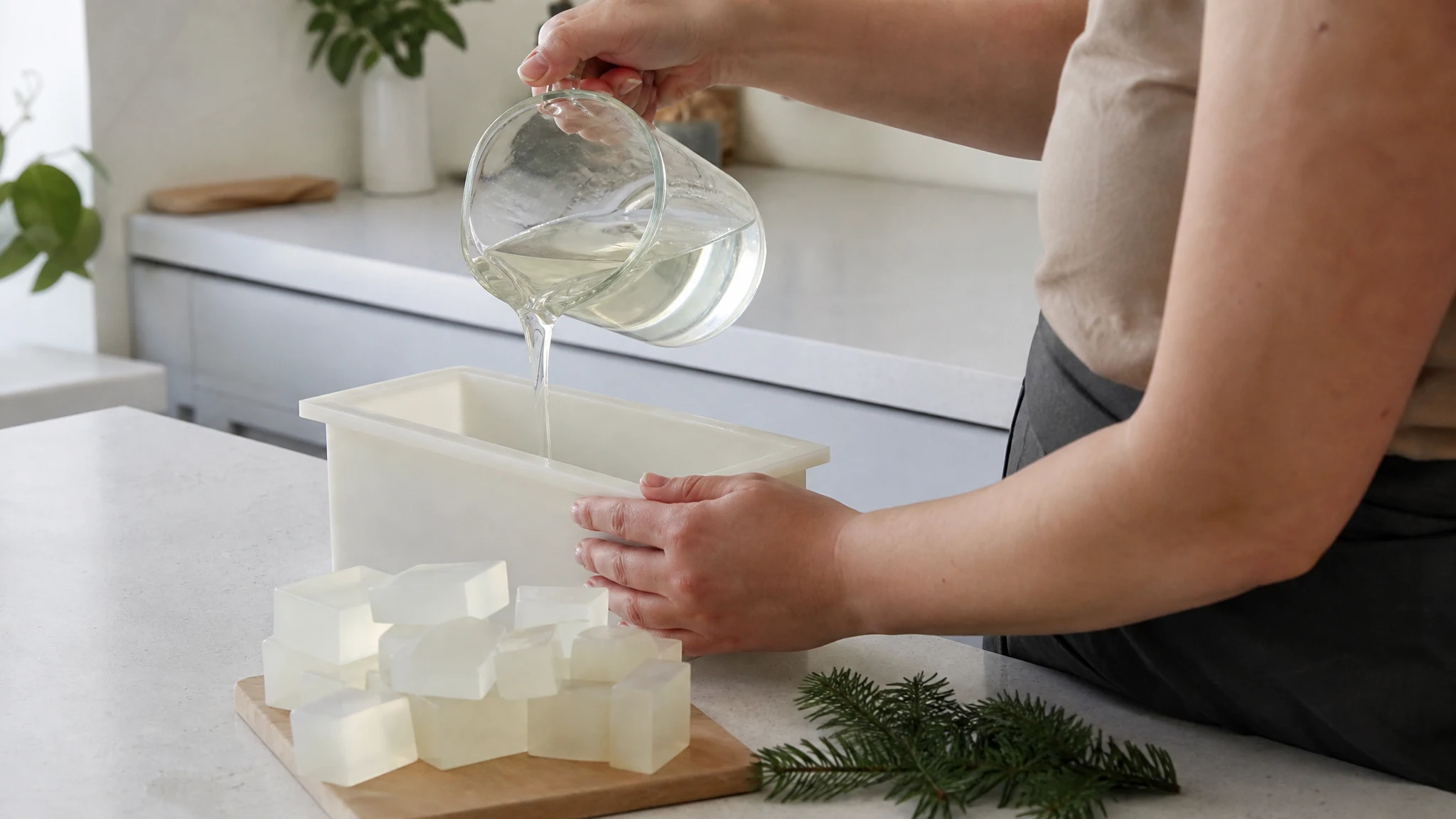
Fir Melt and Pour Soap: Rate, Temperature and Arithmetic
Melt-and-pour is the right first fir soap, because the lye work was done by the company that made the base, and the usage rate comes from that company, not from the oil. We recommend starting at 1% fir needle oil by weight, which is 4.54 g for a 454 g (1 lb) block of base. We have not made this soap; the recipe below is worked out from the cited data and arithmetic, so run a small batch first.

Fir Needle Essential Oil
Our own Fir Needle Essential Oil, in sizes from 0.5 oz to bulk.
From $10.99
Shop Now →Who should skip it
Skip melt-and-pour if you want to say you made the soap from scratch. A melt-and-pour block is a purchased base, and cold-process soap is a different craft with different risks, covered in our cold-process post. Also look at the ingredient list before you assume the product is legally "soap". One retailer lists the ingredients of a Stephenson No Sweat white base as aqua, sorbitol, sodium stearate, sucrose, propylene glycol, sodium laureth sulfate, sodium laurate and glycerin. FDA's soap test requires that the alkali salts of fatty acids be the only source of cleaning action; FDA says that if a product contains synthetic detergents, it is a cosmetic, not a soap. Reasoning from that list, a bar made on that base is probably a cosmetic, and cosmetic labelling rules would apply. Confirm for your base and your state with a regulatory consultant; we sell oil, not legal advice.
What you need, and where it comes from
We sell only the fir needle oil. The base, mould, scale and anything else come from a soap-making supplier. You need a base of your choice, a mould, a heatproof jug, a thermometer and a scale reading to 0.01 g. The scale matters more than any other item: a pound of base takes about 4.5 g of oil, and a 0.1 g error is a 2% change in the scent level.
The number: four sources, one cautious answer
| Source | What it says | What it covers |
|---|---|---|
| Stephenson, Crystal NS guide (2020) | "Use up to 2% additives" | The base maker; fragrance counts among additives; no separate fragrance figure in the guide |
| Voyageur page for a Stephenson No Sweat base | Total additives at most 3%, fragrance at most 1% | A retailer's page that attributes its guidance to Stephenson; differs from the 2% in Stephenson's own guide |
| Wholesale Supplies Plus guide | 3% for fragrance and essential oil; IFRA rate overrides it | A supplier's general rule, 0.4 oz per 16 oz of base |
| Tisserand Institute | 2% to 4% for bath and wash-off products, soap included | A skin-contact range for any essential oil, not tied to a base |
The sources disagree because they answer different questions. The base maker is protecting colour, clarity and stability; the Tisserand range is about skin; the supplier's 3% is a general guideline across oils. Our position: use the lowest base-specific figure you can verify, which is 1%, and note that it sits at or under the skin range. If 1% smells faint, the fix is not 3%. The base maker's ceiling is a ceiling, and the Voyageur page warns that excess additives may affect colour, clarity and stability of the finished bars.
The arithmetic
Our certificate gives a relative density of 0.924 at 20 C, so 1 g of oil is 1.08 mL. A drop is roughly 0.046 g (about 20 per millilitre), though it varies by dropper, so weigh.
| Base weight | 0.5% | 1% | 2% |
|---|---|---|---|
| 100 g test cup | 0.50 g | 1.00 g | 2.00 g |
| 454 g (1 lb) | 2.27 g | 4.54 g (4.91 mL) | 9.08 g |
| 680 g (six 4 oz bars) | 3.40 g | 6.80 g (7.36 mL) | 13.60 g |
Worked example for six 4 oz bars: weigh 680 g of base after cutting it up. At 1%, weigh 6.80 g of oil. If your mould makes eight smaller bars from the same 680 g, nothing changes in the oil; each bar simply holds less of the batch.
The formulation, untested
- Cut the base into small cubes so it melts evenly. Stephenson's guide says to melt gradually, so it melts evenly and does not boil over.
- Melt in short microwave bursts or a water bath. Stephenson's guidance, as quoted by the retailer, is to heat to about 75 C (149 F), stirring until uniform, and to avoid boiling, because overheating may darken the soap and affect its clarity.
- Weigh the oil into a small cup while the base melts.
- Let the base cool toward the base maker's pouring range. For that Stephenson base the retailer page gives 68 to 72 C (154 to 162 F); the Wholesale Supplies Plus guide says below 140 F (60 C). That is an 8 to 12 C difference between two sources, and reasoning from vapour pressure, the cooler end loses less scent. Check your base's own sheet.
- Stir the oil in gently, pour into the mould, and let it set undisturbed.
Stephenson's Crystal NS guide describes that base as specifically formulated for humid conditions and suitable for unwrapped bars. Reasoning from that, a base not sold that way may draw moisture in humid rooms and beads of moisture may form on the surface, so check whether yours says it is suited to unwrapped storage and wrap if it does not.
A small test before the real batch
Pour two 100 g cups: one with 0.50 g of oil and one with 1.00 g. Keep everything else the same, and sniff both at day 1 and day 7. Choose the lower one that you like. Then patch test a finished bar on your own skin, as our product-page safety copy says, before giving any away. If the scent is gone within a week even at 1%, that is a retention problem, taken up in the scent-retention guide.
What goes wrong
- Too hot. The soap may darken, and the oil is lost faster. Fir's lighter constituents have high vapour pressures; alpha-pinene is 4.75 mmHg at 25 C against 0.6 for bornyl acetate (NIH PubChem, Haz-Map and HSDB data). This is inference for our oil, since our certificate carries no composition.
- Too much oil. Past the base maker's figure you risk the colour, clarity and stability problems the base maker names.
- Old oil. Our own page says oxidised conifer oils are more likely to irritate. Buy it fresh, use it up, store it capped, cool and dark; plan on 1 to 2 years.
- Making it for others. FDA's small-business sheet says that if you make or market cosmetics you carry the legal responsibility for safety and labelling. Ingredient naming is in the labeling guide.
Keep the claims on the label to scent. FDA decides cosmetic versus drug by intended use, and its examples of cosmetic use include making the user smell nice. The wider order of decisions is in the formulating guide, and a bar like this is one of the items in the holiday gifts post.
Weigh the oil, write the base's batch number and ours on the same note, and make the two-cup test before the full block.
Fir Needle Essential Oil
Fir Needle Essential Oil from our own shop, in sizes from 0.5 oz to bulk.
From $10.99
Shop Now →Sources & Further Reading
- Stephenson Group, 2020. Crystal NS (No Sweat) product guide V2.5. stephensonpersonalcare.com/crystal-ns
- Voyageur Soap and Candle. Stephenson No Sweat White Melt and Pour Soap (page citing Stephenson processing guidance and ingredients). voyageursoapandcandle.com
- Wholesale Supplies Plus. Getting started scenting MP soap base. wholesalesuppliesplus.com
- Tisserand Institute (R. Tisserand), undated. Recommended dilutions. tisserandinstitute.org/safety/dilution
- FDA, 2024. Frequently asked questions on soap (current as of 20 August 2024). fda.gov/cosmetics
- FDA, 2024. Is it a cosmetic, a drug, or both? (Or is it soap?) (current as of 11 September 2024). fda.gov/cosmetics
- FDA, 2025. Small businesses and homemade cosmetics fact sheet (current as of 18 November 2025). fda.gov/cosmetics
- NIH PubChem, alpha-pinene (CID 6654) and bornyl acetate (CID 93009), vapour pressure sections. pubchem.ncbi.nlm.nih.gov/compound/6654