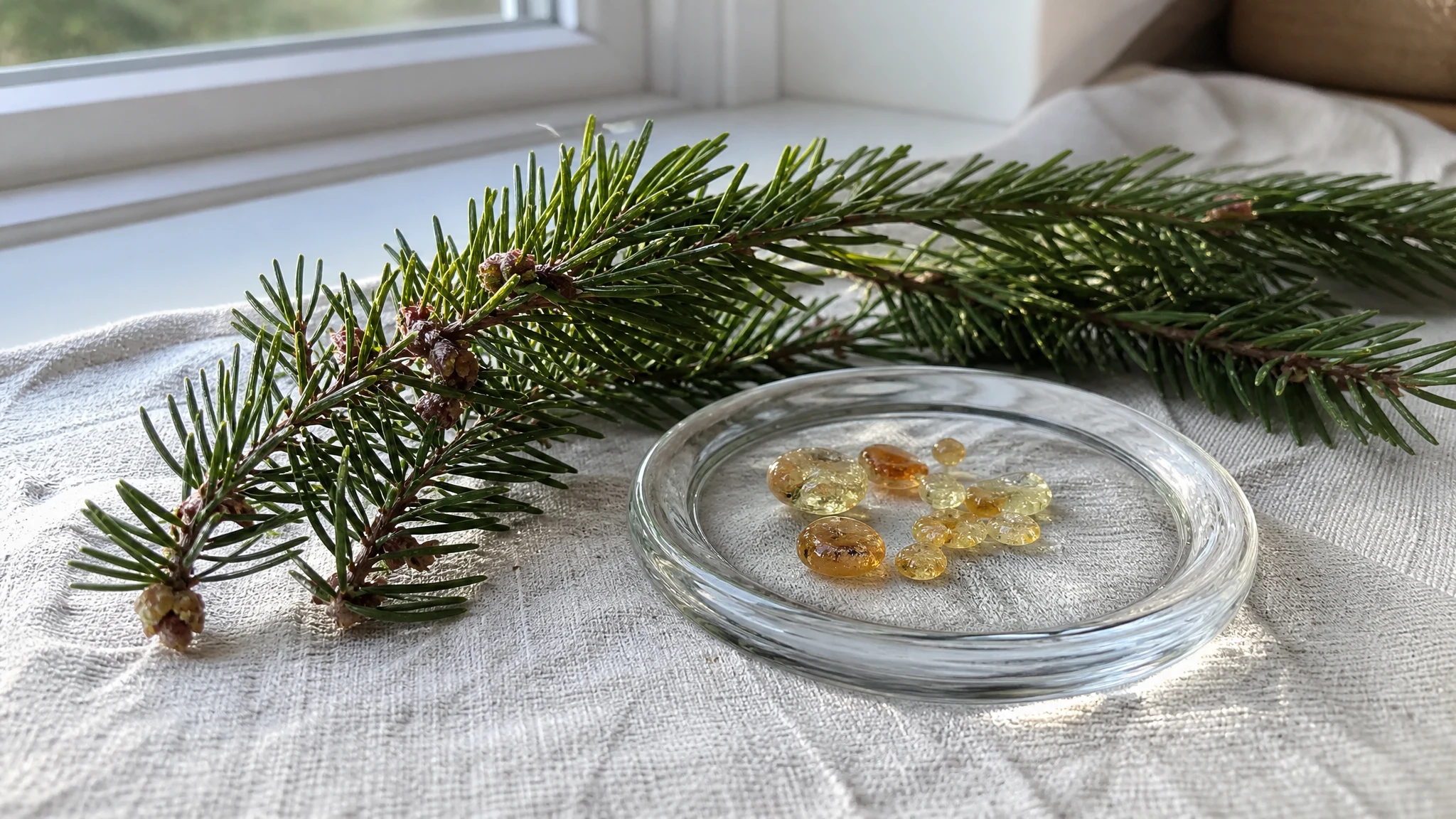
Fir Needle Oil vs Balsam Fir Absolute vs Canada Balsam
"Balsam fir" on a label can mean three different materials: a steam-distilled needle oil, a solvent-extracted absolute, or the sticky resin tapped from the bark that is called Canada balsam. They share a tree and very little else. We sell only the first, a steam-distilled fir needle oil, and the rest of this post is about telling the three apart on paper, because the paper is usually all you have before you order.

Fir Needle Essential Oil
Our own Fir Needle Essential Oil, in sizes from 0.5 oz to bulk.
From $10.99
Shop Now →Start with the numbers each material carries
Our published certificate of analysis for batch FIRAIUABUNC010A names Abies balsamea, part used leaf, steam distilled, with a relative density of 0.924 and a refractive index of 1.468, both at 20 C. That is all it reports: there is no constituent table, acid value or flash point on it. Set that beside the other two materials, using the best primary figures we could read:
| Steam-distilled needle oil (ours) | Needle absolute (one maker's sheet) | Canada balsam (1911 pharmacopoeia) | |
|---|---|---|---|
| Made from | Needles, steam distilled | Needles, solvent extraction then ethanolic purification | Resin collected from blisters in the bark |
| Form | Brown liquid (our COA) | Pasty, green brown | Thick pale yellow liquid |
| Density | 0.924 at 20 C | Not given on the sheet | Specific gravity about 0.987 to 0.994 |
| Refractive index | 1.468 at 20 C | Not given | 1.518 to 1.521 |
| Acid value (mg KOH/g) | Not on our COA | 100 to 160 | 84 to 87 |
| Stated shelf life | 1 to 2 years (our product page) | 24 months | Not stated |
The absolute column is the Biolandes technical data sheet for its fir balsam absolute, version dated 25 July 2024, which also says "only for industrial use" (Biolandes, 2024). The Canada balsam column comes from The British Pharmaceutical Codex, 1911, as reproduced online; it is a century-old reference, and the entry we read gives no measurement temperature, so do not compare its figures with a modern COA to the third decimal (Pharmaceutical Society of Great Britain, 1911). Both sheets describe different lots from different makers, and neither is our oil.
The useful reading: a refractive index near 1.52 and a density near 0.99 mark a resin, not a needle oil. Our oil's 1.468 and 0.924 sit inside the ranges our COA lists as its standard (1.445 to 1.488 and 0.888 to 0.958), and well away from the resin figures. If a supplier's sheet for a "fir balsam" has numbers in the resin range, you are not looking at the material we sell.
Material one: steam-distilled needle oil
Steam passes through the needles and carries the volatile fraction over; the water is separated off and what floats is the oil (our post on how fir needle oil is made walks through the process). Only what is volatile at steam temperature comes through. Pichette and colleagues (2006) analysed an Abies balsamea essential oil by GC-MS and found it more than 96 percent monoterpenes, with beta-pinene (29.9 percent), delta-3-carene (19.6 percent) and alpha-pinene (14.6 percent) as the main components (Pichette et al., 2006). That is one oil from one study. It is a picture of the material class, not of ours, and we do not publish a constituent table for our batch.
For our oil, the arithmetic is simple because it is undiluted: with a density of 0.924, 1 kg is about 1.08 litres, and 1 g is about 1.08 ml, around 22 drops at 20 drops per ml (an estimate). Our product pages give 0.5 to 2 percent in a carrier for skin, roughly 3 to 12 drops per ounce of carrier.
Material two: the absolute
ISO 9235:2021, the standard vocabulary for aromatic natural raw materials, defines an absolute as the product obtained by extraction with ethanol from a concrete, a pomade, a resinoid or a supercritical fluid extract (ISO 9235:2021). So an absolute is by definition a second-stage product: a solvent extract that has been washed again, which is why Biolandes writes "solvent extraction, ethanolic purification". We could read only a catalogue excerpt of that standard, not the full text, and are reporting the definition of absolute from it only.
The same sheet gives a woody, fruity, sweet, pine odour, a pasty green-brown appearance, an acid value of 100 to 160 mg KOH per gram, and a 24 month shelf life stored closed at 15 to 25 C away from air and light. Reasoning from the definition of acid value (milligrams of potassium hydroxide to neutralise one gram), 1 g of that absolute would take 100 to 160 mg of KOH, which points to a much heavier load of free acids than a needle oil. We did not find an acid value for a needle oil, so that comparison is directional only.
Regulatory identifiers vary by what is made. The Biolandes sheet lists the CosIng INCI name as ABIES BALSAMEA EXTRACT, with TSCA CAS 8021-28-1, EINECS CAS 85085-34-3 and EC number 285-364-0. Our COA carries no INCI or CAS number, so we are not asserting one for our oil; if you need the INCI name for a label, ask the supplier for the exact material in writing. Do not copy another material's name.
What changes in use, reasoned from those properties: a pasty absolute is not a drop-for-drop swap for a free-flowing oil, you cannot assume equal strength, and nothing we found gives an acceptable usage rate for it on skin. Ask the supplier for its IFRA certificate and safety data sheet, and take the question to a cosmetic safety assessor or regulatory consultant if you are formulating a product to sell. We have not published an IFRA certificate or SDS for our own oil; ask through our wholesale page before you order if you need them.
Material three: Canada balsam
The 1911 British Pharmaceutical Codex describes Canada turpentine, or balsam of fir, as an oleoresin from the bark of Abies balsamea: the resin collects in blisters in the bark, which are punctured so it can be gathered. It gives its composition as about 70 to 80 percent resin and 16 to 24 percent volatile oil, mostly laevo-pinene, and says it thickens over time to a hard, clear varnish. In other words it is closer to a tree sap than to anything made from needles. It is not an essential oil, and we do not sell it. Buy it from a supplier that lists it as Canada balsam, and put any question about its use to that supplier.
Which one are you actually buying?
Use this order. First check the plant part: needle or leaf points to an oil or an absolute, bark or exudate points to a resin. Second check the process: "steam distilled" is an oil; "solvent extraction" or "absolute" is not. Third check the physical numbers: a refractive index in the 1.4s and a density under 1 is an oil, a refractive index near 1.52 is a resin. Fourth, ask for the document the claim depends on: a batch COA that names the species, and for any product you will sell, the supplier's IFRA and SDS paperwork.
We make no claim about which smells stronger or closer to a cut tree. We have not smelled them side by side and found no source that compares them. For what our oil is meant to smell like, see what fir oil smells like; for how to read a constituent report, see reading a fir oil label and GC-MS report; the chemistry of the main components is in our post on bornyl acetate; and the resin trade has its own history in our history of fir.
We sell one steam-distilled fir needle oil, from 0.5 oz to 400 lb, with a published COA. If your formula calls for an absolute, a resinoid or Canada balsam, buy it from a perfumery or craft supplier that publishes its data sheet.
Fir Needle Essential Oil
Fir Needle Essential Oil from our own shop, in sizes from 0.5 oz to bulk.
From $10.99
Shop Now →Sources & Further Reading
- Biolandes, 2024. Fir Balsam Absolute Technical Data Sheet F1418, v2. biolandes.com/F1418
- Pharmaceutical Society of Great Britain, 1911. The British Pharmaceutical Codex, Canada Turpentine (Balsam of Fir). henriettes-herb.com/bpc1911
- Pichette A., Larouche P.-L., Lebrun M., Legault J., 2006. Composition and antibacterial activity of Abies balsamea essential oil. Phytotherapy Research 20(5):371-373. PMID 16619365
- ISO, 2021. ISO 9235:2021 Aromatic natural raw materials: Vocabulary. iso.org/standard/78908