Why Fir Oil Smells Different From Lot to Lot
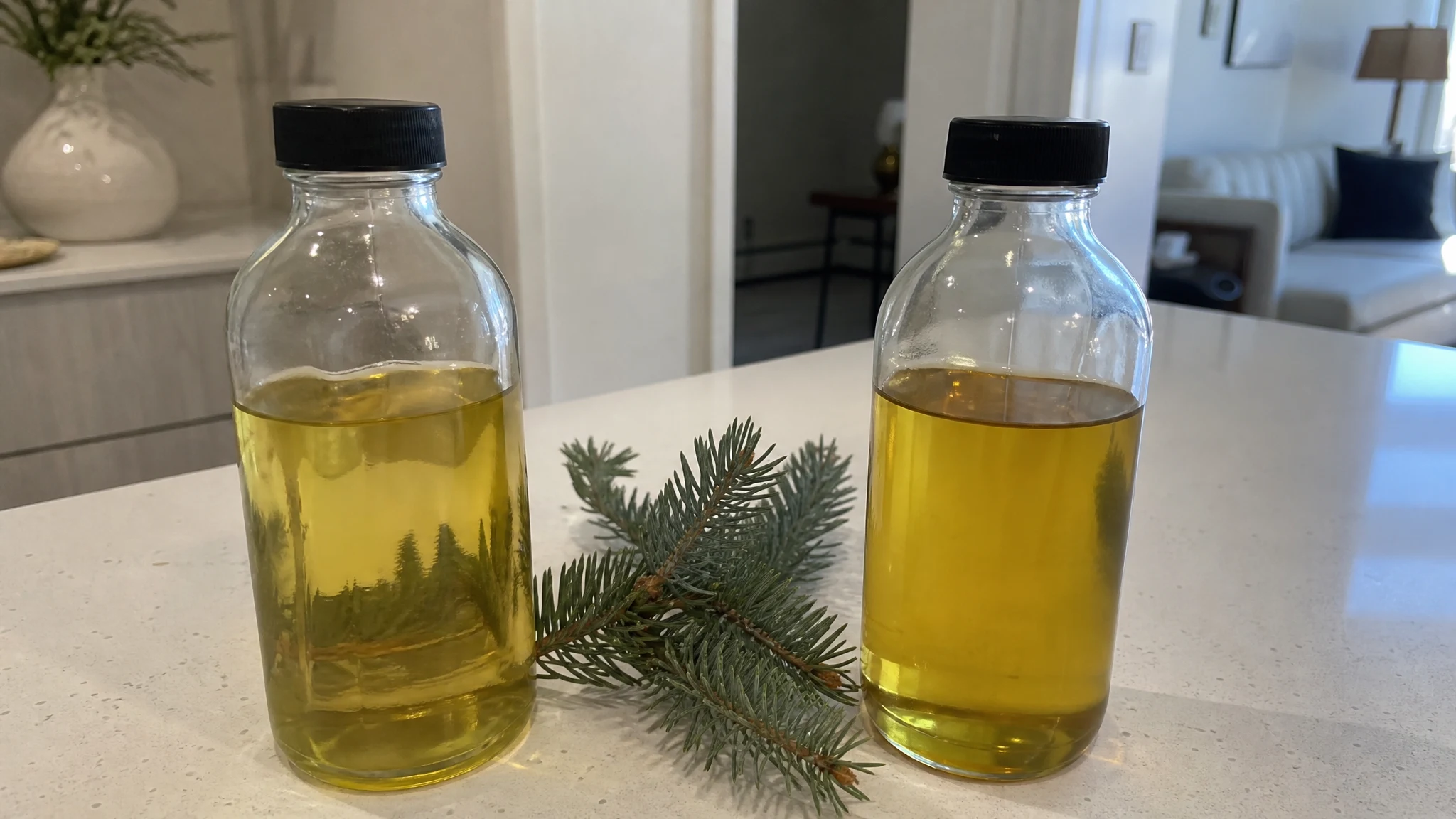
You reorder fir oil from the same listing, the new bottle smells a shade different, and the room spray you had dialed in behaves differently. Nothing went wrong. A distillate from needles is a natural product, and it moves a little with the tree, the season and the still. What matters is that you notice before it reaches a product.

Fir Needle Essential Oil
Our own Fir Needle Essential Oil, in sizes from 0.5 oz to bulk.
From $10.99
Shop Now →How much natural oil can move
Studies of fir oils show the range. Two subalpine fir trees growing in the same patch of Idaho gave limonene at 20.3 and 34.6 percent (Swor et al., 2023), which is a long way apart for neighbors. And one Siberian fir sample gave a bornyl acetate share of 30.6 percent by steam distillation and 40 percent by supercritical CO2 (Ayupova et al., 2025). Neither study is about our oil, so they are not a forecast for any bottle. They simply show that where the boughs come from and how they are processed both leave a fingerprint, and a buyer sees only the result.
What a certificate tells you
The Certificate of Analysis we publish is for one batch of Abies balsamea. It lists a relative density of 0.924 against a window of 0.888 to 0.958, and a refractive index of 1.468 against 1.445 to 1.488, with appearance and smell recorded as complying. Those physical constants are a useful screen, since they catch an oil that is wildly off. They are a coarse screen, though: they average over everything in the bottle, so a modest shift in the balance of compounds slips through. If your formula depends on a specific profile, ask us in writing through the wholesale page or the contact page before ordering and we will tell you what we can send.
A receiving routine that takes ten minutes
You cannot freeze a natural oil, but you can notice drift. All it takes is a scale and a notebook.
- Log the lot. Our bottles carry a distillation date, a bottling date and a lot number. Write all three down with the date the bottle arrived.
- Weigh 10 ml. Draw 10.0 ml with a syringe into a tared beaker. A batch matching our certificate would read about 9.24 g, inside a window of 8.88 to 9.58 g. Record the number every lot. A reading outside the window is worth an email to your seller before you do anything else.
- Keep a retained sample. Pour 5 to 10 ml of each lot into a small amber bottle, filled nearly to the top, labeled with the lot and kept cool and dark.
- Smell old against new on separate paper strips, a minute apart, and write one line about each. Judge against the retained sample, not against memory.
- Pour one small trial at your usual load by weight before you commit to a production batch.
This routine will not explain why a lot differs, only that it does, and that is enough to decide whether to adjust the load, ask a question or hold the lot back. Weigh, do not count drops, since dropper size varies on its own.
Fewer lots, fewer surprises
The simplest lever is changing lots less often. Our wholesale page offers a sample bottle, and bulk sizes are the same oil as the retail sizes, so a sample is a fair preview of a bigger order. When you order, ask whether it will come from the lot you sampled. Bigger purchases do have to be finished in time, since conifer oils typically keep one to two years in a tightly capped, cool, dark spot, so how to keep a large container fresh and the per-batch sums are worth reading together.
Before you blame the oil
Wax lots, pour temperature, cure time and measuring load by volume instead of weight can all dull a throw. If a candle has little scent at all, the causes, in order are a good place to start.
If a product must smell identical every time, a fragrance oil made to a formula is the usual choice, and our comparison of the two explains the trade. If you want the natural oil, which has a living, slightly different character from year to year, the routine above is how you keep that character on your side.
Fir Needle Essential Oil
Fir Needle Essential Oil from our own shop, in sizes from 0.5 oz to bulk.
From $10.99
Shop Now →Sources & Further Reading
- Gymnosperms of Idaho: Chemical Compositions and Enantiomeric Distributions of Essential Oils of Abies lasiocarpa, Picea engelmannii, Pinus contorta, Pseudotsuga menziesii, and Thuja plicata (Swor et al., Molecules, 2023)
- Comparative Phytochemical Profiling of Essential Oils from Selected Abies Species and Analysis of Their Antifungal and Antiradical Activity (Ayupova et al., Pharmaceutics, 2025)