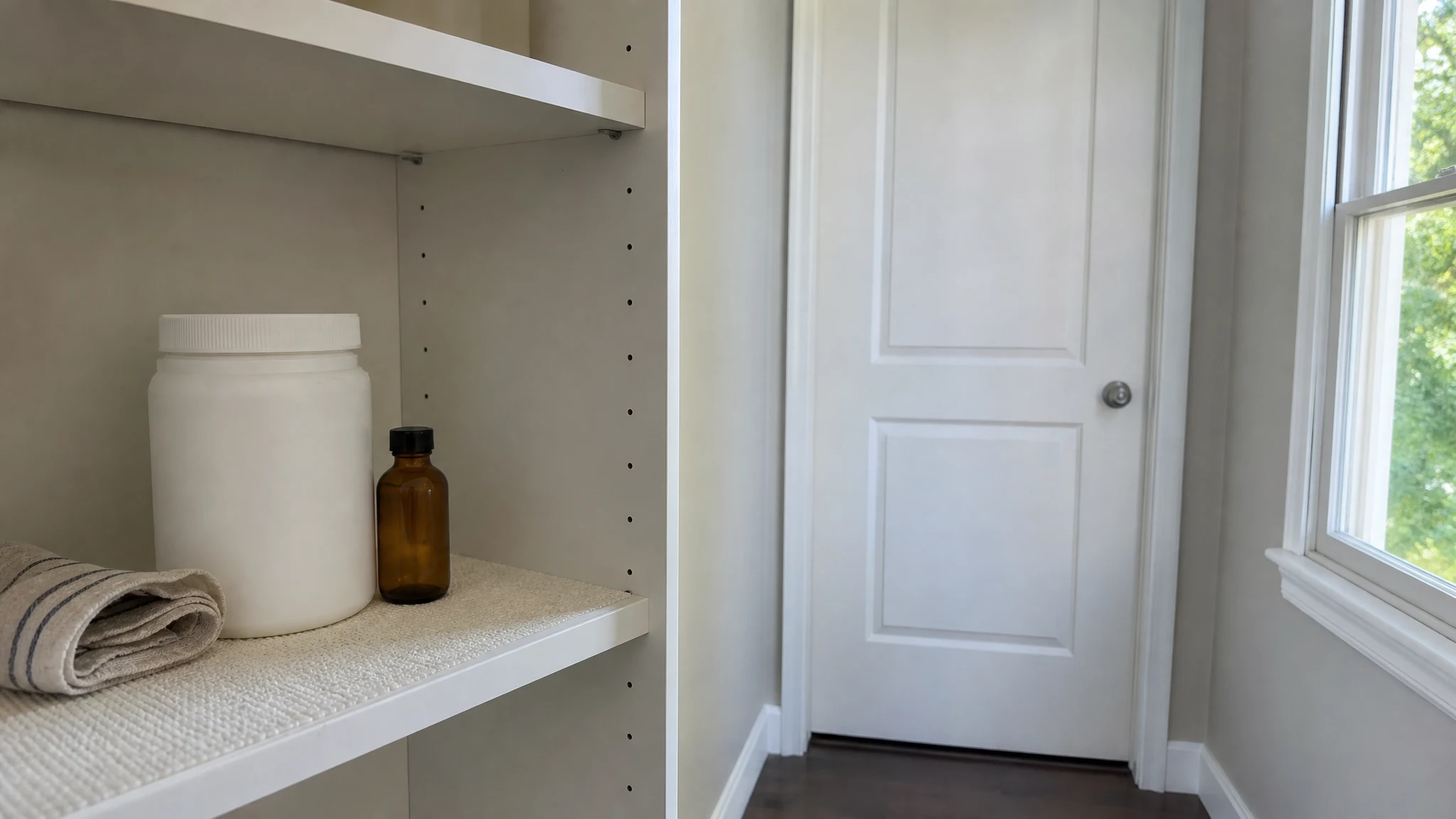
Storing Bulk Essential Oil: Decanting, Headspace, Flash Point
Bulk oil does not age because it is big; it ages because the container gets opened. A 25 lb container that is opened every week to pour out a working amount is exposed to more air, over more months, than the same oil split into sealed bottles at the start. The fix is dull and mechanical: keep the bulk container full and shut, and decant only what you will use soon into smaller amber glass.

Fir Needle Essential Oil
Our own Fir Needle Essential Oil, in sizes from 0.5 oz to bulk.
From $10.99
Shop Now →The arithmetic of headspace
Start with volume, because oil is sold by weight and stored by volume. Using the relative density on the COA we publish (0.924 at 20 C, batch FIRAIUABUNC010A), one pound of our fir needle oil is about 491 ml.
| Size | Weight | Volume at 0.924 | US gallons |
|---|---|---|---|
| 1 lb | 454 g | 491 ml | 0.13 |
| 5 lb | 2.27 kg | 2.45 L | 0.65 |
| 25 lb | 11.3 kg | 12.3 L | 3.24 |
| 400 lb | 181 kg | 196 L | 51.9 |
Now the weekly pour. Each time you draw 1 lb (491 ml) out of a 25 lb container, 491 ml of air takes its place. After ten draws the remaining 15 lb sits under about 4.9 L of air, and when the container is half used, the oil that is left has 6 L of air above it. The last pound of a 25 lb container has spent months under the most air. Reasoning from that: the oil you use last is the oil that has aged most, which is the reverse of what you want.
Decanting early reverses it. One pound fits a 500 ml amber bottle with about 9 ml of air above the oil, and that bottle stays sealed until you start it. Twenty-five such bottles contain the same oil with one air exchange each, instead of twenty-five exchanges in one container. This is arithmetic, not a measured result.
What air does to terpenes
Conifer oils are mostly terpenes, and terpenes oxidize on air exposure. The study to know is Matura and colleagues, published in Contact Dermatitis in 2005. They patch tested 1,511 consecutive dermatitis patients at six European centres with oxidized fragrance terpenes. Oxidized linalool produced a positive reaction in 1.3% and its hydroperoxide fraction in 1.1%; oxidized caryophyllene in about 0.5%; oxidized myrcene in one patient. The authors report that the parent terpenes were not allergenic until air exposure produced oxidation products, and that testing should use the compounds people are actually exposed to.
What the study did not show: it did not test fir oil, and linalool and caryophyllene are not the main fir constituents. Another supplier's safety data sheet for a balsam fir oil lists beta-pinene, limonene, alpha-pinene, delta-3-carene, bornyl acetate, camphene and myrcene, so the overlap with this study is myrcene (one reacting patient), and the paper itself excludes limonene, which earlier work covered. Applying the finding to fir oil is inference. Our own distillation page says oxidized conifer oils are more likely to irritate skin, which is the practical reason to treat a stale container as a risk to the people who use your product, not just to your scent.
What the storage instructions agree on
- A Canadian fir needle oil specification from one supplier: store in full, tight containers in a cool, dry place protected from light; shelf life 1 year from the date shipped.
- A safety data sheet for a balsam fir oil from a second supplier: tightly sealed glass, away from heat, light and ignition sources, well ventilated, cool, away from strong oxidizers.
- Our product pages: store tightly capped in a cool, dark place; shelf life typically 1 to 2 years for conifer oils.
The shared word is "full". A half-empty container is the problem the instruction is describing. For the retail-bottle version, see how to store fir needle oil; this page covers the bulk side. If you buy for a studio, batch consistency and the wholesale guide cover what to ask for first.
How to decant
- Plan decants in blocks: one working bottle per month of use, not a bottle per week. For the sizing sums, see what fir oil costs per batch.
- Fill each bottle to the shoulder, cap tightly, and write the date and lot number on the label.
- Reseal the bulk container immediately. Do not top it up from working bottles; that mixes aged oil back into the lot.
- Keep bulk in the cool and dark. Our distillation page says our oil goes into amber glass in every size; for any plastic or metal bulk container, ask your supplier what it is made of before you store oil in it for months.
Is it a flammable liquid?
This is where two supplier documents for fir oil disagree, and it matters. A Canadian fir needle oil specification lists a flash point of 44 C. The balsam fir safety data sheet lists a flash point of 93 C in its physical properties, yet classifies the oil as Flammable Liquid Category 3 with hazard statement H226, and gives UN 1169, Class 3, packing group III for transport. Those do not fit together: under OSHA's rule (29 CFR 1910.106(a)(19)), Category 3 means a flash point from 23 C up to and including 60 C, and 93 C would be Category 4.
Either way, OSHA's definition of a flammable liquid is any liquid with a flash point at or below 93 C (199.4 F), so a fir oil at either figure falls inside it. The US transport rule is narrower: 49 CFR 173.120 calls a liquid flammable (Class 3) at a flash point of not more than 60 C, and a combustible liquid above 60 C and below 93 C. At 44 C, the oil is Class 3; at 93 C it sits outside both bands.
We have not published an SDS or a flash point for our oil, so do not borrow either figure for your own paperwork. Ask via the wholesale page before ordering what documents exist for the lot you will receive, and use that lot's SDS.
What the storage limits look like
If your lot falls in Category 3, OSHA's container table (Table H-12) caps glass or approved plastic at 1 gallon, metal containers other than DOT drums at 5 gallons, and DOT-specification drums at 60 gallons. Storage cabinets are limited to 60 gallons of Category 1, 2 or 3 liquids, and 120 gallons of Category 4. In oil terms from the table above, 1 gallon of our oil weighs about 7.7 lb, so a 25 lb glass container holds more than three times the 1-gallon glass limit, and one 400 lb drum (about 52 gallons) fits under the 60-gallon drum and cabinet figures with no margin for a second one.
The same table exempts "medicines, beverages, foodstuffs, cosmetics, and other common consumer items" packaged to common practice from the container rules, which is aimed at retail packaging, not a drum in a back room. Do not read this as permission. OSHA covers workplaces; your local fire code and insurer set the quantity limits that apply to your building. Those are decisions for an environmental health and safety professional or your local fire marshal, and for shipping, your carrier will want the SDS.
We would start with the stricter reading: treat bulk fir oil as a flammable liquid, store it away from heat and ignition, keep it in its original sealed container, and move small amounts into glass only as needed.
Fir Needle Essential Oil
Fir Needle Essential Oil from our own shop, in sizes from 0.5 oz to bulk.
From $10.99
Shop Now →Sources & Further Reading
- Matura M et al., 2005. Selected oxidized fragrance terpenes are common contact allergens. Contact Dermatitis 52(6):320-328. portal.research.lu.se/matura-2005
- OSHA, current. 29 CFR 1910.106, Flammable liquids. ecfr.gov/29-CFR-1910.106
- US DOT, current. 49 CFR 173.120, Class 3 definitions. ecfr.gov/49-CFR-173.120
- Amrita Aromatherapy, 2023. Safety Data Sheet, Balsam Fir Organic Essential Oil (another supplier's SDS, not ours). amrita.net/EO3511
- The Lebermuth Company, 2022. Technical Data Specification, Fir Needle Canadian Oil, 50-6125-02. docs.lebermuth.com/50-6125-02