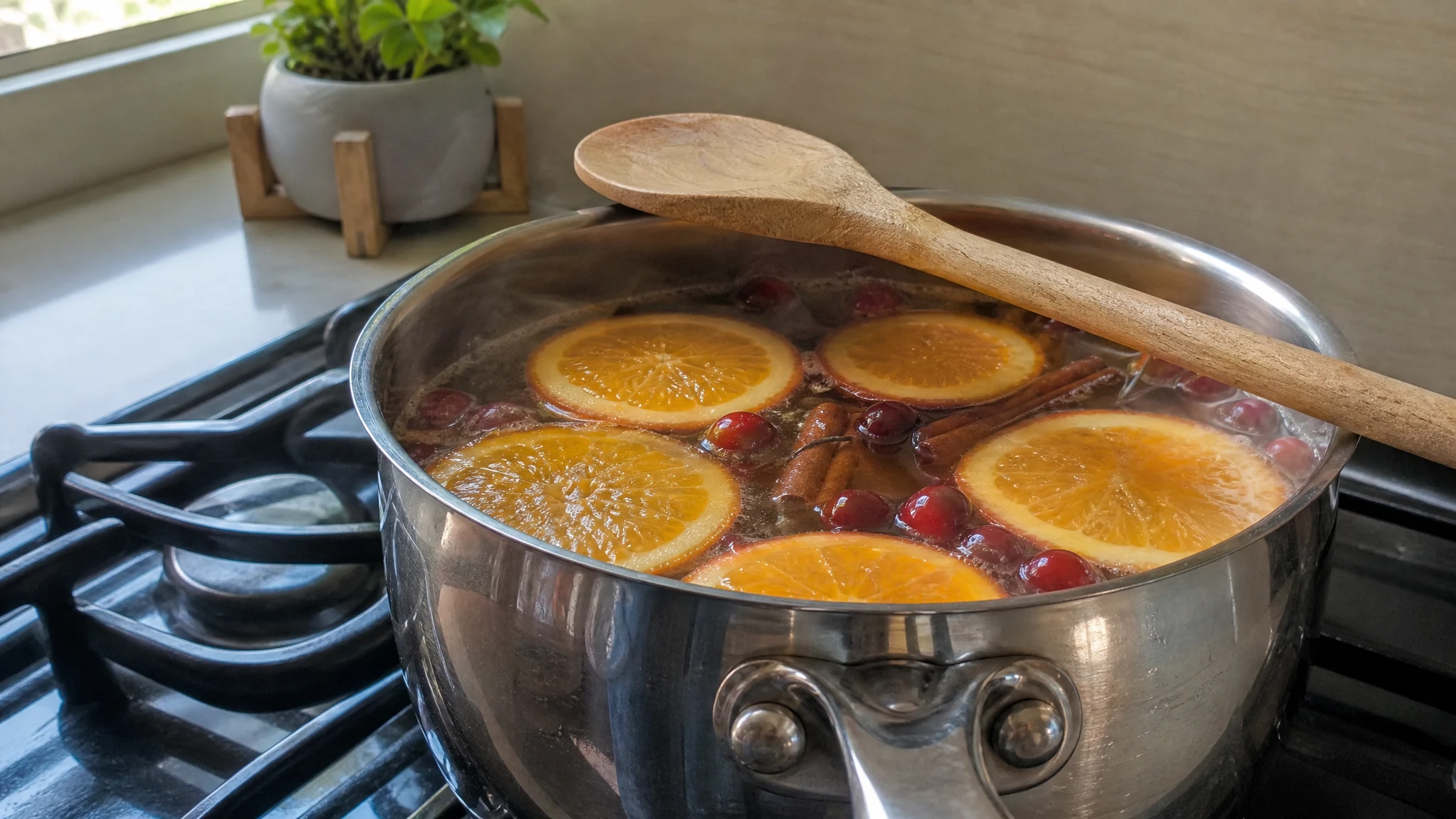
Christmas Simmer Pot With Fir Oil: Floats, Fire, Pets
A simmer pot is a pan of water, fruit and spice that smells good because of the fruit and spice. Fir needle oil is an optional extra, and we think its place is the last minute, in two or three drops, with the pot supervised. The oil does not dissolve in the water, it sits on the surface, and the thing most likely to go wrong in a simmer pot is not the scent but a stove left alone. This article gives the standard recipe, the arithmetic on why the oil behaves as it does, and the households that should skip the oil altogether. We have not made this pot; the recipe is the ordinary fruit-and-spice one with the oil as an add-on.

Fir Needle Essential Oil
Our own Fir Needle Essential Oil, in sizes from 0.5 oz to bulk.
From $10.99
Shop Now →Decide: pot first, oil second
If you want your kitchen to smell like a holiday, the orange, cranberry and cinnamon will do it on their own. Add fir oil only if you want a resinous, evergreen edge, and only if you can stay in the house while the pot is on. We sell one oil, a fir needle essential oil sold undiluted, so everything else here (fruit, spices, a slow cooker, a saucepan) comes from a grocery or kitchen shop.
Who should leave the oil out: anyone who keeps a bird, a cat, or another small animal in the open part of the home; anyone with a pet that drinks from pots or counters; and anyone who cannot watch the pot. The reasons follow.
The recipe (untested by us)
- 1.5 litres of water (about 6 cups)
- 1 orange, sliced
- 100 g fresh cranberries
- 2 cinnamon sticks
- 1 teaspoon whole cloves
- Optional: 2 drops of fir needle oil, added in the last few minutes
Put everything but the oil in a saucepan or slow cooker, bring it to a bare simmer, and keep it there. Check the water level regularly and add hot water when it drops; a pot that boils dry scorches the fruit and then the pan. Add the oil last, stir once, and leave it. When you are done, turn the heat off, let the pot cool, and pour it away. The pot water is not a drink and not food, so do not taste it, and do not leave it where a child or an animal can reach it.
Why the oil floats: the arithmetic
Our published certificate of analysis gives a relative density of 0.924 at 20 C for our oil. Water is 1.0 on the same scale, so the oil is lighter and floats. It also does not mix. For alpha-pinene, a monoterpene common in conifer oils, the Joint FAO/WHO Expert Committee on Food Additives describes it as insoluble in water, and a 1995 paper by Li and Perdue, as compiled in PubChem (compound 6654), gives a solubility of 2.49 mg per litre at 25 C. That is a figure for one compound, not for our oil, so it is an illustration, not a measurement of the pot.
Apply it. Our skin-dilution copy (3 drops per ounce of carrier at 0.5%) implies a drop of about 0.05 ml, and at a density of 0.924 that is about 46 mg. Two drops is about 92 mg. The 1.5 litres of water in the recipe can hold, at that solubility, about 3.7 mg of a compound like alpha-pinene, which is roughly 4% of the two drops. As an inference from those numbers, nearly all the oil stays as a film on the surface and leaves as vapour from the top, not from the water. Reasoning from the boiling point of 156 C for alpha-pinene (Merck Index, 2006, via the same PubChem record), the lightest parts of a conifer oil should leave first, so expect the fir edge to fade before the orange and clove do. We have no timing data.
The same surface film is the reason for the fire caution. A film of oil on top of a hot pan is a flammable liquid at the point of contact with air. Alpha-pinene has a closed-cup flash point of 91 F (33 C) according to the Hazardous Substances Data Bank, citing the NFPA Fire Protection Guide, as compiled by PubChem. Our certificate has no flash point, so we cannot give one for our oil. We found no incident report of a simmer pot with essential oil catching fire, and we are not claiming it happens often. The caution is reasoning: a simmering surface is far above 33 C, and a gas flame or electric element sits right beside it. Two drops is a small quantity; twenty is not, and neither is a pour from the bottle.
The stove is the larger risk
The US Fire Administration reports that cooking is the leading cause of home fires and home fire injuries. For 2021 it cites an estimated 170,000 home cooking fires, with 135 deaths, 3,000 injuries and property loss of more than 494 million dollars. Unattended equipment was the leading factor contributing to ignition in nonconfined home cooking fires, at 37%. Its advice is plain: stand by your pan, and if you leave the kitchen, turn the burner off (US Fire Administration, cooking fire safety). A simmer pot is a pan on a burner for hours, which is exactly the case the figure describes.
| Method | What it does well | What to watch |
|---|---|---|
| Saucepan on a stove | Fast to start; easy to see the level | An open burner under a pan you may forget; boils dry |
| Slow cooker on low | Closed appliance, no flame or exposed element under the pot | Still a heat source; the level still drops; the lid vents the scent |
We prefer the slow cooker on low for anything longer than an hour. That preference is reasoning, not a source: we found no fire statistic that compares the two, so we are recommending the one that removes the open burner. In both cases the rule is the US Fire Administration's: stay in the house, and turn it off when you leave.
Pets and birds
The ASPCA, in a June 2022 article, says concentrated (100%) essential oils can be a danger to dogs and cats that walk through them or have them on their coat, and lists unsteadiness, depression and low body temperature in severe cases, with vomiting and diarrhoea if swallowed. It says a diffuser used briefly in a secured area the pet cannot enter is not likely to be an issue, and it advises avoiding essential oil diffusers in homes with birds because their respiratory tracts are very sensitive (ASPCA, 2022). That article does not mention simmer pots, so applying it to one is our inference: a pot with oil on its surface is open to a pet that jumps on a counter, and it puts the oil into the air of the room for hours.
Pet Poison Helpline's page on liquid potpourri, which is a commercial product and not a home simmer pot, says that ingestion can cause chemical burns to the lips, tongue, gums and throat of companion animals, and that cats are particularly sensitive to the corrosive chemicals in some of those products (Pet Poison Helpline). Do not treat that as a statement about fruit and spice water. Use it as a reason for the habit: whatever is in the pan, keep it off the floor and out of reach, and call a veterinarian or poison line if an animal drinks from it. Our own product pages say to keep the oil away from children and pets, and that it is not for internal use.
What not to do
- Do not add the oil at the start. It will be gone, or it will sit as a film for hours.
- Do not pour more than a few drops. More oil gives a bigger surface film, not more scent in the water.
- Do not leave the house, go to bed or take a long phone call with the burner on.
- Do not use the pot water as a drink, a stock or a base for anything.
Where this fits with the rest of the season
If a stove is the wrong tool in your house, the article on making the house smell like a Christmas tree covers other routes, and the seasonal blends article covers what to pair with fir through December. For a non-heated scent product, see the wax melts article, which carries its own warmer cautions, and the gifts article for things that can be handed over.
Buy the fruit and spice from a grocery, keep the oil to a couple of drops at the end, and keep the pot where you can see it. Our fir needle oil starts at 0.5 oz, which is far more than a simmer pot will ever use.
Fir Needle Essential Oil
Fir Needle Essential Oil from our own shop, in sizes from 0.5 oz to bulk.
From $10.99
Shop Now →Sources & Further Reading
- US Fire Administration (FEMA). Cooking Fire Safety. usfa.fema.gov/prevention/home-fires/prevent-fires/cooking
- ASPCA, 2022. The Essentials of Essential Oils Around Pets. aspca.org/news/essentials-essential-oils-around-pets
- Pet Poison Helpline. Liquid Potpourri. petpoisonhelpline.com
- PubChem (NIH), alpha-pinene, compound 6654: water solubility (Li and Perdue, 1995; JECFA) and flash point (HSDB, citing NFPA). pubchem.ncbi.nlm.nih.gov/compound/6654