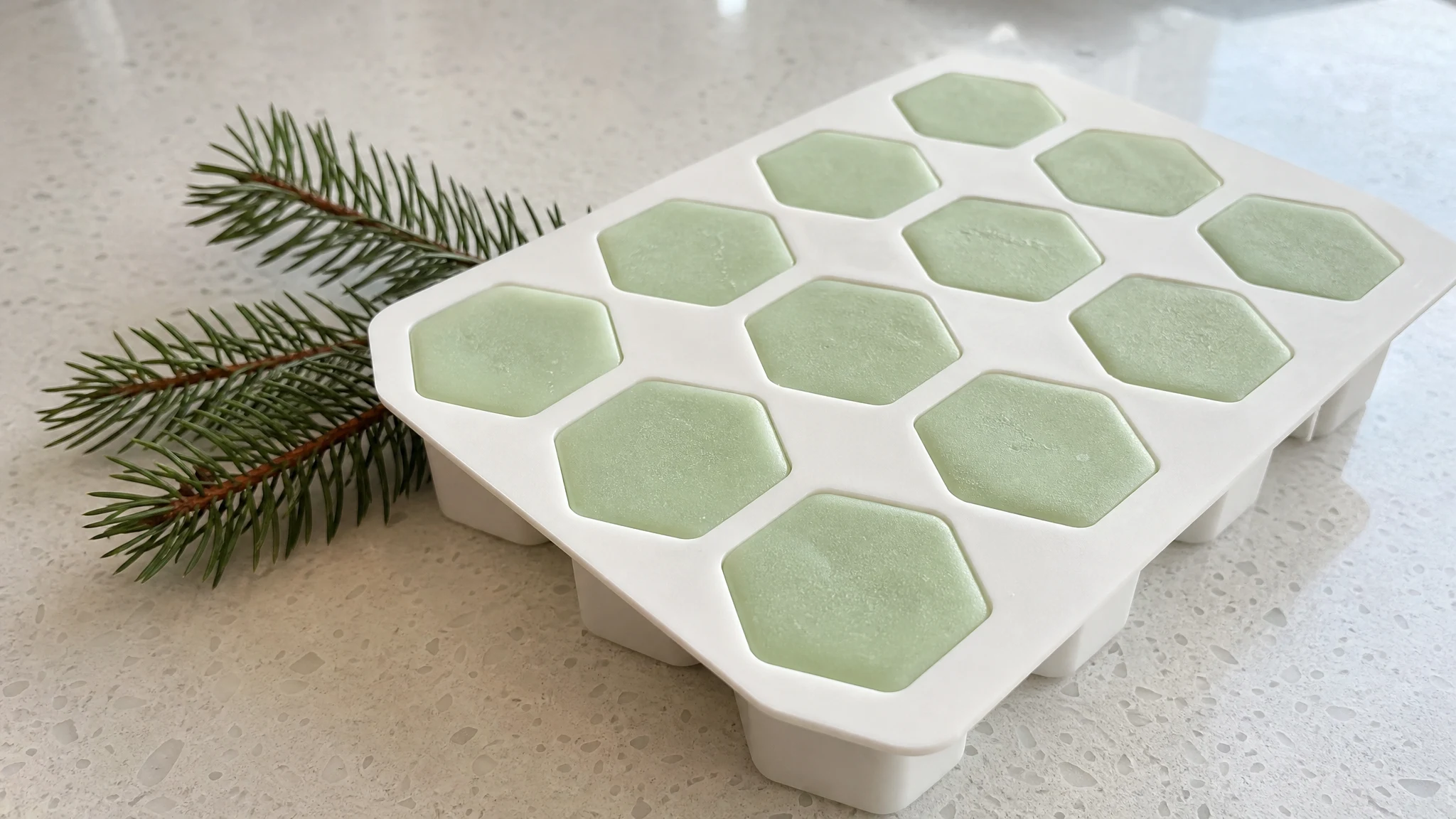
DIY Fir Wax Melts: Load, Temperatures and Warmer Cautions
Wax melts are the lowest-risk way to try a fir wax product, because there is no wick and no flame in the wax itself. They are not risk-free: the warmer is still a heat source, and a fir oil that goes into a closed room all evening is a pet question as well as a fragrance question. This article works out a fir wax melt from a wax maker's published figures and from arithmetic. We have not made this recipe, so treat the numbers as a starting point for a small test batch.

Fir Needle Essential Oil
Our own Fir Needle Essential Oil, in sizes from 0.5 oz to bulk.
From $10.99
Shop Now →Decide first: should you make melts at all?
Make them if you want to see how fir behaves in wax before committing to candles, if you have an electric warmer you trust, and if nobody in the home is a bird, a cat that sleeps beside the warmer, or a person who reacts to fragrance. Skip them, or buy something else, if you plan to leave the warmer running while you are out. We sell one oil, a fir needle essential oil in sizes from 0.5 oz to 400 lb. We do not sell wax, molds, warmers, dye or scent-free melt wax; those come from a candle-making supplier.
The wax is the part that decides the result, so start there. Use an unscented melt wax. A wax sold already fragranced is not a base for your own oil.
What the wax maker's figures say
The numbers below come from the CandleScience product page for CocoSol soy pillar wax and its soy wax melts tutorial, both read for this article. They are one supplier's figures for one family of waxes, so they describe that wax, not every melt wax.
| Wax (CandleScience listing) | Fragrance load for melts |
|---|---|
| CocoSol (coconut, soy, sunflower) | up to 25% |
| EcoSoya PB | 12% |
| IGI 6028 | 9% |
| IGI 4625 | 6% |
The page defines load as weight of fragrance over weight of wax: its "4.0 oz per lb" is 4 oz of fragrance on 16 oz of wax, or 25%. Its own worked example uses 13 oz of wax and 1.3 oz of fragrance, which is 10%, and says you can adjust down. The temperatures it gives: melt the wax, add fragrance at 185 F (85 C), stir for two minutes off the heat, pour at about 170 F (76.7 C), and let the melts cure for one to two weeks. For CocoSol the page lists a melt point of 128 to 136 F (53.3 to 57.8 C).
Two limits matter. First, those percentages are for fragrance oils. The tutorial says to pair soy wax with candle-approved essential oils and to check the recommended usage on the oil's product page, and it gives no essential oil percentage. Second, the maker's ceiling is a ceiling for the wax holding the oil, not a statement about what is comfortable to breathe or about any regulatory limit.
Our position on load: start at 6%, not at the ceiling
Reasoning from the range above: the lowest listed melt load is 6%, the supplier's own worked example uses 10%, and its ceiling for one wax is 25%. Fir needle oil is a top-to-middle note by our product description, which means the light part of it leaves the wax first. The temptation is to push toward 25% to compensate. We would not. Reasoning, not a test result: past what the wax can hold, oil is likely to sweat out of the finished melt, and a volatile oil is no more persistent for being added in a larger dose. Start at 6%, make a second small batch at 8% and a third at 10%, label them, and compare after the cure.
Because our oil is sold undiluted, the arithmetic is yours to do, and our published certificate of analysis gives a relative density of 0.924 at 20 C, which lets you turn grams into millilitres. Per 100 g of wax:
| Load | Oil by weight | Oil by volume (at 0.924) | Rough drops (about 20 per ml) | Total batch |
|---|---|---|---|---|
| 6% | 6 g | 6.5 ml | about 130 | 106 g |
| 8% | 8 g | 8.7 ml | about 173 | 108 g |
| 10% | 10 g | 10.8 ml | about 216 | 110 g |
The drop count is arithmetic from our own skin-dilution copy (3 drops per ounce of carrier at 0.5%), not a measurement; drop size varies with the bottle, so weigh the oil on a kitchen scale. For scale, a 0.5 oz bottle holds about 13.7 g, enough for two batches at 6%, and a 1 oz bottle covers about four.
The formulation (untested by us)
- Weigh 100 g of unscented melt wax into a heat-proof pouring pitcher. Keep a thermometer in it.
- Melt in a double boiler or on an electric hot plate. Do not use an open flame near the oil, for the reason in the next section.
- At about 85 C, take it off the heat, add 6 g of fir needle oil, and stir for two minutes.
- Let the wax fall to about 76.7 C, then pour slowly into a silicone mold.
- Let the melts set for several hours, release them, and put them in a closed container to cure for one to two weeks before you judge them.
This is the supplier's method with an essential oil substituted for a fragrance oil. We have not poured it, so do a small batch first and keep notes on what you added. Do not use the pitcher or spoon for food afterwards; the tutorial says the same.
Why the temperature step deserves respect
Alpha-pinene, a monoterpene found in conifer oils, has a boiling point of 156 C according to the Merck Index (2006), and a closed-cup flash point of 91 F (33 C), from the Hazardous Substances Data Bank citing the NFPA Fire Protection Guide, both as compiled by PubChem (compound 6654). That is a single compound, not our oil: our certificate of analysis has no flash point and no constituent table, so we cannot give a flash point for our oil. As inference, a conifer oil poured into wax at 85 C is being heated roughly 50 C above the flash point of one of its likely main components. Vapour is leaving the pitcher, and it can ignite from a flame or a hot surface. Ventilate the room, use an electric heat source, and keep the oil bottle capped and away from the burner until the moment you pour. Flash point arithmetic for wicked candles is a separate topic, covered in the flash point article.
The warmer is the heat source
The wax maker advises a warmer with a high-heat bulb for maximum throw and says to follow the warmer manufacturer's instructions. We would add a few of our own recommendations. Use an electric warmer with an intact cord, put it on a flat, hard surface where no one can knock it, and switch it off when you leave. A flame-heated tealight warmer is a different product with a worse record: in November 2015 the US Consumer Product Safety Commission announced a recall of about 32,000 Family Dollar ceramic wax warmers that could produce high flames, after 11 reports of high flames, two burn injuries and three reports of property damage (CPSC, recall notice). That recall concerned one product and does not describe electric warmers, but it shows why we say the warmer is not trivial.
On listing marks: we recommend buying a warmer that carries the mark of a recognised testing laboratory and the maker's instructions. We have not checked any particular warmer, and we are not naming one.
Pets and birds
An essential oil warmed for hours is closer to a diffuser than to a candle. The ASPCA, in a June 2022 article, says concentrated (100%) essential oils can be a danger to pets that walk through them or have them applied, lists unsteadiness, depression and low body temperature among signs, and says a diffuser used briefly in a secured area the pet cannot enter is not likely to be an issue. It adds that pets with breathing problems may be better off without diffusers, and advises avoiding essential oil diffusers in homes with birds because their respiratory tracts are very sensitive (ASPCA, 2022). That article is about diffusers and neat oil, not melts, so applying it to a warmer is our inference. Our own product pages say to keep the oil away from children and pets. If you keep a bird, or a cat with airway trouble, ask a veterinarian before running any scented warmer, and keep the loose melts out of reach: a cat that chews a melt is eating wax holding a large share of essential oil.
Fixing a weak or oily melt
- Weak scent after the cure: reasoning from the volatility above, the oil may have been added too hot or the melts left uncovered. Make the next batch at 8%, stir the full two minutes, and cure in a sealed tin.
- Oily film or beads on the surface: the load is above what the wax holds. Drop back toward 6%.
- Scent gone after a day on the warmer: expected for a light oil on a heated dish. Warm a small piece, not a full dish.
Shredded wax is a different format from a poured mold; for a first batch we would use a mold, because you then control the weight of each piece. If you want a gift, see the holiday gifts article, and for the same oil in a wick-fired product see candle making with fir oil and how much oil goes in candles. For a non-wax way to scent a kitchen in the same week, the simmer pot article has its own cautions.
A fir melt is a small experiment: three 100 g batches, one scale, a thermometer and a cure shelf. Run it before you buy wax by the case, and if it works, our oil is sold in sizes from 0.5 oz up to 400 lb for when you scale up.
Fir Needle Essential Oil
Fir Needle Essential Oil from our own shop, in sizes from 0.5 oz to bulk.
From $10.99
Shop Now →Sources & Further Reading
- CandleScience, 2026. CocoSol Soy Pillar Wax product page (melt point, pour temperature, melt load). candlescience.com/wax/candlescience-cocosol-soy-pillar-wax
- CandleScience. How to Make Soy Wax Melts (tutorial). candlescience.com/learning/how-to-make-soy-wax-melts
- PubChem (NIH), alpha-pinene, compound 6654: boiling point (Merck Index, 2006) and flash point (HSDB, citing NFPA). pubchem.ncbi.nlm.nih.gov/compound/6654
- US Consumer Product Safety Commission, 2015. Family Dollar Recalls Wax Warmers. cpsc.gov/Recalls/2016/Family-Dollar-Recalls-Wax-Warmers
- ASPCA, 2022. The Essentials of Essential Oils Around Pets. aspca.org/news/essentials-essential-oils-around-pets