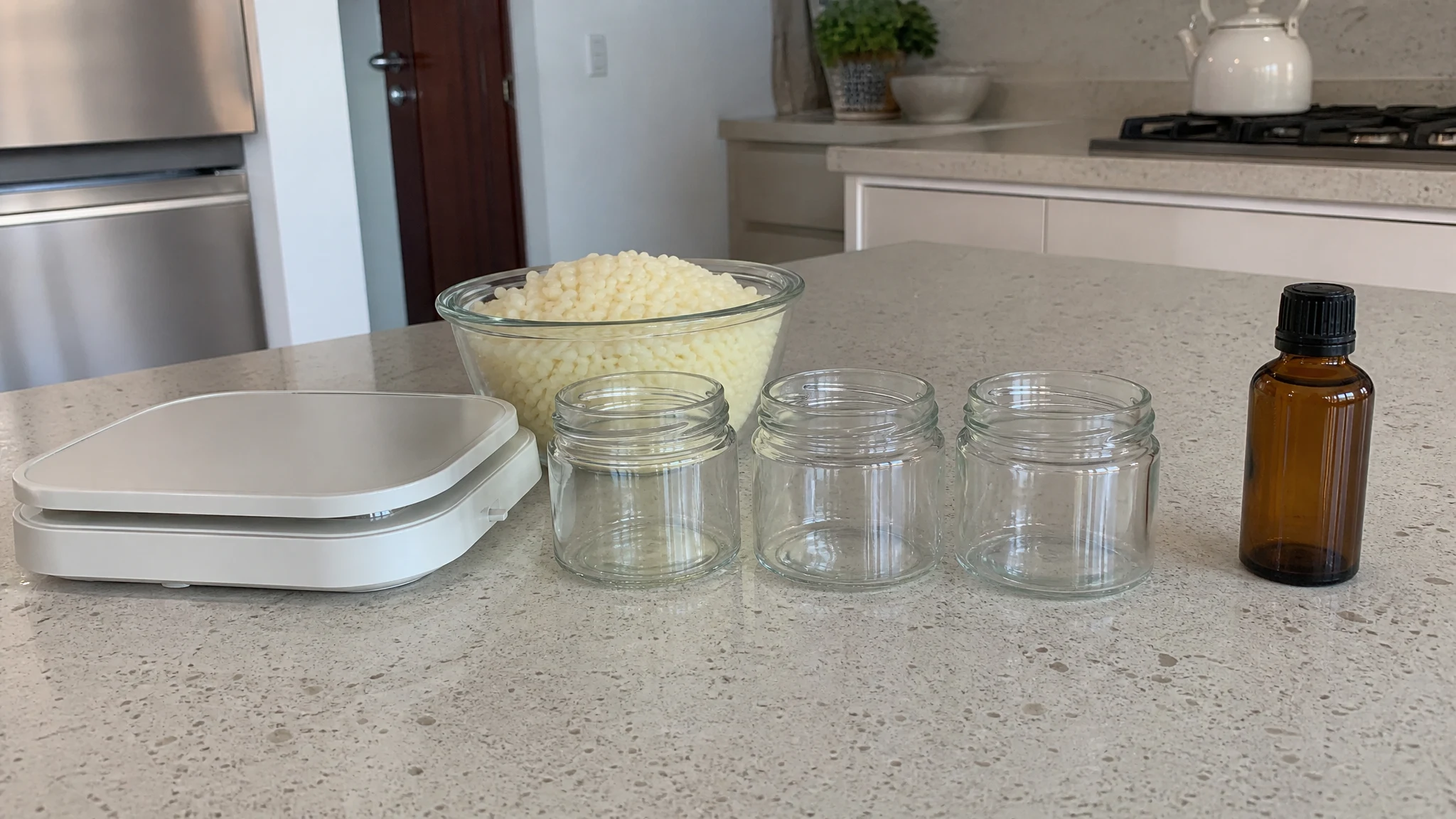
How Much Essential Oil in Candles: Load by Weight, Not Drops
Fragrance load is the weight of oil divided by the weight of wax, so a 6% load means 6 g of oil for every 100 g of wax. It is not a count of drops. Take 200 g of wax: 6% is 12 g of fir needle oil, which at the 0.924 relative density on our published certificate of analysis is about 13 ml, or roughly 260 drops at 20 drops per ml. Drop size depends on the dropper and the oil, so a drop count cannot be turned back into grams reliably; a scale can.

Fir Needle Essential Oil
Our own Fir Needle Essential Oil, in sizes from 0.5 oz to bulk.
From $10.99
Shop Now →The formula, and the one mistake in it
Oil weight = wax weight x load. The mistake is using the weight of the finished candle or the volume of the jar as the base. The sheets we read state loads against wax: the CandleScience listing for Golden Brands GW 464 gives "10% or 1.6 oz/lb. (45 g/454 g)", which is 10% of one pound of wax (CandleScience, GW 464 page). Weigh the wax, multiply, then weigh the oil into the melted wax on a scale that reads to 0.1 g.
Table: oil per pound of wax
These are arithmetic, not test results. One pound is 453.6 g; ml uses the 0.924 density from our certificate (batch FIRAIUABUNC010A, 20 C); drops assume 20 per ml, a figure implied by our own dilution copy (3 drops for the 0.5% end of an ounce of carrier) and varying by dropper.
| Load | Oil per 1 lb wax (g) | Oil per 1 lb wax (oz by weight) | ml of fir oil | Approx. drops |
|---|---|---|---|---|
| 3% | 13.6 | 0.48 | 14.7 | 295 |
| 6% | 27.2 | 0.96 | 29.5 | 590 |
| 8% | 36.3 | 1.28 | 39.3 | 785 |
| 10% | 45.4 | 1.60 | 49.1 | 980 |
One trap: ounces by weight and fluid ounces are different units. Because this oil is lighter than water, one fluid ounce (29.6 ml) of it weighs about 27.3 g, or 0.96 oz. At 6% the table lands almost on one fluid ounce per pound of wax, which is a coincidence of the numbers, not a rule.
For a single jar, scale by grams: a candle holding 200 g of wax needs 8 g at 4% (8.7 ml), 12 g at 6% (13.0 ml) and 16 g at 8% (17.3 ml).
What the wax makers cap, exactly
| Source | Stated figure |
|---|---|
| Soy container wax technical data sheet v5.0, 26 Aug 2020 (TDS) | "levels up to 10-12%", with natural-wax fragrances "highly recommended" |
| Golden Brands GW 464, Voyageur listing (Voyageur) | 7% to 9% recommended; "about 9% max" |
| Golden Brands 464, CandleScience (CandleScience) | 10% containers; 6% tealights |
| EcoSoya CB-Advanced, CandleScience lab notes (notes) | Recommended 6% to 9%; no sweating up to 12% in finished candles |
| Coconut apricot blend, CandleScience lab notes (notes) | "Up to 15%"; some 15% candles melted out of their containers in an oven test; hot and cold throw judged at 6% |
Read these as what each source says about its own wax and its own tested fragrance oils. None is a figure for essential oil, and none is a figure for fir. Applying them to fir needle oil is inference. We also did not find a verifiable paraffin maker's sheet, so we give no paraffin number. The EcoSoya TDS itself carries no load figure; its useful instruction is that every combination of wax, fragrance and wick "must be tested for burn quality" (EcoSoya TDS v3.0).
Notice that the same CandleScience page gives 10% for containers and 6% for tealights in one wax. A ceiling belongs to a wax in a particular format, so a figure copied from a container recipe is wrong for a tealight or a pillar before the oil is even chosen. Use the line on the sheet that matches what you are making.
Why the ceiling is a ceiling, not a target
Northwood, a candle supplier, says "for most wax types, the maximum amount you can add is 10-12%" and that "you will often get better results by using 6-8%" (Northwood). Three mechanisms make more oil a bad bet past that point.
- The wax stops holding it. The BCF and Trading Standards advice sheet lists candle sweating as related to fragrance content, with "a thin film of fragrance on the surface of the wax" (BCF and Trading Standards, 2024).
- The flame changes. The soy TDS says fragrance "greatly" affects wick choice and that too large a wick gives sooting and guttering, too small tunnelling. The same sheet says "burn pool size and depth greatly affect fragrance throw." Reasoning from those two statements: a load change is a wick change, and a candle that tunnelled at 4% will not be rescued by 10% oil.
- The fire risk rises. The same advice sheet states "candle fires are more likely with high fragrance content" and that a small amount of a low flash point fragrance can pull the mixture's flash point toward its own. Our flash point explainer covers that in full.
Scaling up, and working backward from a bottle
Batch arithmetic is the same formula with bigger numbers. A 2 kg pour of wax at 6% needs 120 g of oil (130 ml). Work the other way when you already own the oil: oil weight divided by load gives the wax it can scent, so 100 g of oil at 6% covers 100 / 0.06 = 1,667 g of wax, and at 8% covers 1,250 g. Write the load down next to the wick and wax, because the burn result only means something against those three.
Weighing error is small next to counting error. A scale reading to 0.1 g is off by at most about 1% on a 12 g dose of oil. Zero the scale with the container on it, add the oil last, and stir for the time the sheet gives; Voyageur's GW 464 instructions say about two minutes of stirring after the oil goes in.
Our recommendation for fir, stated as reasoning
We have not poured candles at several loads of this oil, and no number here comes from our own burns. Reasoning from the sheets above, the lowest soy ceiling is about 9%, and the two lab-note sources that ran throw tests judged them at 6%. So test 4%, 6% and 8% by weight, same jar, same wick, then read the result using the method guide. If 8% still reads weak, the next move is the wick, the rest time or the room, not 10%; the ranked list is in why an essential oil candle smells weak.
Oil is the expensive input, and the load percentage is the lever on cost. If you are budgeting a batch, the cost per batch walk-through turns these grams into a per-candle figure. Our oil is sold undiluted from 0.5 oz to 400 lb, so every number in this post is yours to compute against the bottle you hold.
Fir Needle Essential Oil
Fir Needle Essential Oil from our own shop, in sizes from 0.5 oz to bulk.
From $10.99
Shop Now →Sources & Further Reading
- Soy Wax Container, Technical Data Sheet v5.0 (revised 26 Aug 2020). cdn.shopify.com/Soy_Wax_Container_Technical_Data_Sheetv5.0
- EcoSoya, 2020. TDS CB-Advanced v3.0. candle.gr/EcoSoya_CB-Advanced_-TDS_v3.0
- CandleScience. Golden Brands 464 Soy Wax. candlescience.com/golden-brands-464
- CandleScience. Lab Notes: EcoSoya CB-Advanced Soy Wax. candlescience.com/lab-notes-ecosoya-cb-advanced
- CandleScience. Lab Notes: Coconut Apricot Wax. candlescience.com/lab-notes-coconut-apricot
- Voyageur Soap and Candle. Golden Brands GW 464. voyageursoapandcandle.com/gw464
- British Candlemakers Federation and Trading Standards, 2024. Candlemakers Advice Sheet. britishcandles.org/Advice_Sheet_2024
- Northwood Candle and Craft. How to improve candle scent throw. northwoodcandleandcraft.com