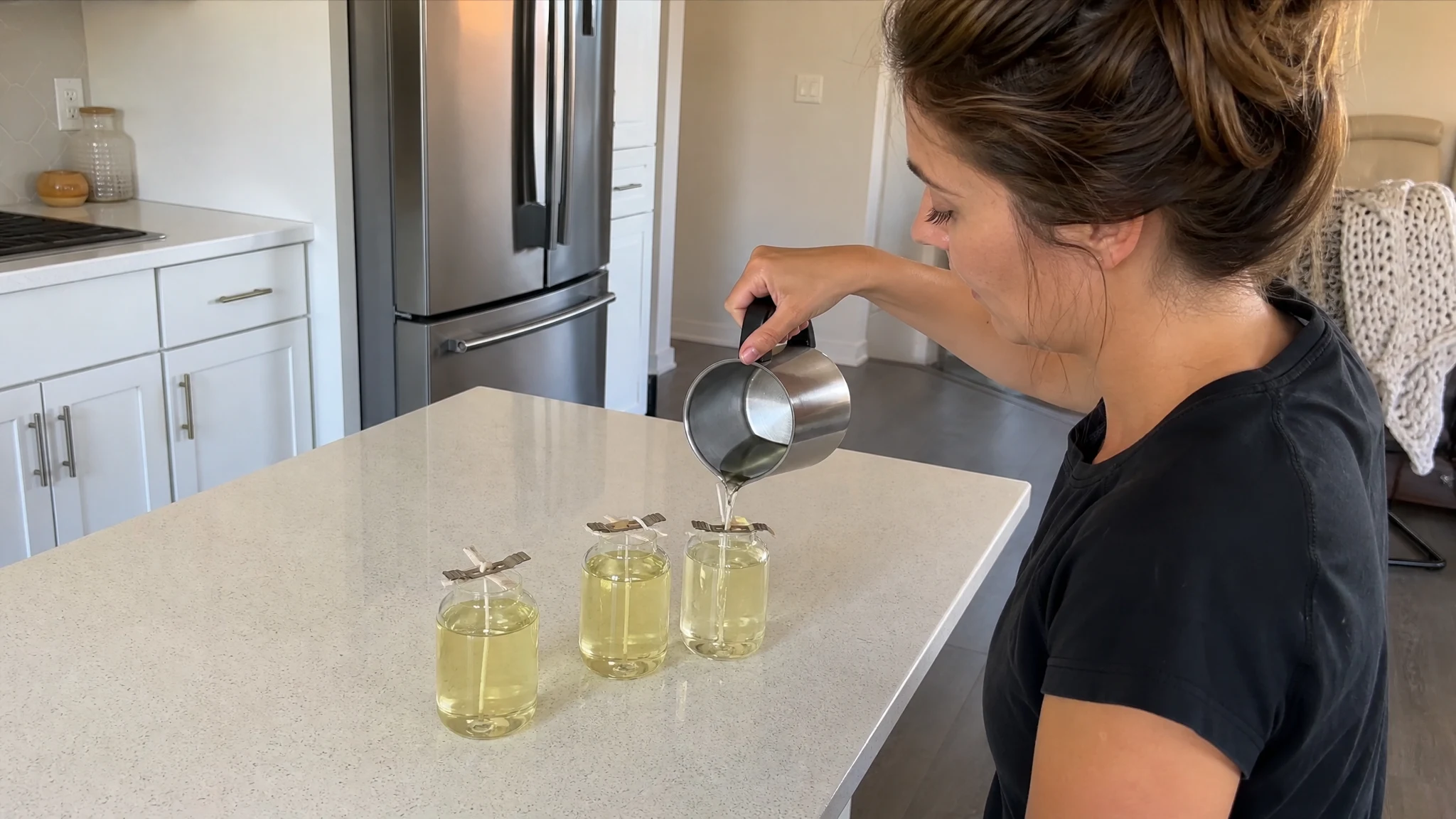
Candle Making With Fir Essential Oil: Order of Work
Yes, you can scent a candle with fir needle essential oil, and the wax makers' own sheets say how: add the oil to melted wax at a stated temperature, stay under the wax's stated load, and test-burn after a rest. What you should not expect is the room-filling hot throw of a fragrance oil built for candles. This guide is the order of work, from decision to first burn. It is a method hub: for a finished recipe see our Fraser fir style candle post.

Fir Needle Essential Oil
Our own Fir Needle Essential Oil, in sizes from 0.5 oz to bulk.
From $10.99
Shop Now →First decide whether an essential oil candle is the product you want
A supplier that publishes its own candle guidance, Northwood, puts the trade-off in one line: the aroma of an essential oil candle "will almost never be quite as strong compared to candles made with fragrance oils" (Northwood, undated web guide). That is a supplier's statement, not a measured study, and we found no wax maker data sheet that gives an essential-oil-specific load. So everything below about fir is reasoning from sheets written for fragrance oils.
If you want a loud, simulated Christmas tree, a fragrance oil is the tool, and we say so in the fragrance oil versus needle oil comparison. Choose fir needle oil for a candle when you want the actual conifer material, accept a quieter result, and are willing to measure rather than guess. We sell only the oil. Wax, wicks, jars and a thermometer come from a candle supplier.
Pick one wax and read its sheet before anything else
The wax decides the ceiling for oil, the temperature at which you add it, and how long it needs to rest. The figures below are what the documents we read actually say, and they do not agree with each other. That spread is the point: treat the sheet for the exact wax in your cupboard as the authority.
| Wax and source | Fragrance load stated | Add / pour temperature stated | Rest before burning |
|---|---|---|---|
| Soy container wax, technical data sheet v5.0, revised 26 Aug 2020 (maker's TDS) | "up to 10-12%" | Cool to pour temperature, then add fragrance; pour near 45 to 55 C for glass adhesion | 48 hours before test burn |
| Golden Brands GW 464 soy, via Voyageur's listing (Voyageur) | 7% to 9% recommended, "about 9% max" | Melt to 185 F, remove from heat, add; pour 125 to 145 F | 48 hours before test burn |
| Same wax, CandleScience page (CandleScience) | 10% for containers, 6% for tealights | Add at 185 F (85 C), pour at 135 F (57.2 C) | Two weeks for best throw |
| Coconut apricot blend, CandleScience lab notes (CandleScience) | "Up to 15%"; held all test fragrances at 15% with no sweating; some 15% candles melted out of their containers in an oven test | Add at 190 F (+/- 5), best pour 175 F (+/- 5) | Burn testers cured 3 days; cold throw "improved slightly after 1 week" |
Two different retailers quote two different loads for the same GW 464 wax (about 9% versus 10%). We have not seen the wax maker's own current sheet for it, so we do not pick a winner. We also did not find a paraffin maker's data sheet with a stated load that we could verify, so this guide does not give a paraffin number.
Choose three loads, all below the lowest ceiling
A maximum is where the wax stops holding oil, not where the candle smells best. The CandleScience coconut apricot notes tested hot and cold throw at 6% while testing stability up to 15%, and its soy lab notes for EcoSoya CB-Advanced recommend "no more than 9%" for best performance even though no sweating appeared up to 12% (CandleScience lab notes). Those lab notes were run with fragrance oils.
Our recommendation, which is a plan and not a result we have produced: make three small candles at 4%, 6% and 8% by wax weight, same wax, same jar, same wick. 8% sits just under the lowest soy ceiling in the table. The arithmetic and the unit table are in how much essential oil in candles. Weigh the oil; do not count drops.
The order of a test pour
- Weigh the wax for one jar, then multiply by the load. For 200 g of wax, 6% is 12 g of oil, which at the 0.924 relative density on our published certificate of analysis is about 13 ml.
- Melt the wax to the sheet's temperature, with a probe thermometer. The v5.0 soy sheet advises against heating that wax above 85 C or for extended periods, and allows temporary excursions to 90 C if it is cooled back down quickly.
- Add the oil and stir. The same sheet says to mix well and to add fragrance immediately before pouring where practical. Whether a given oil can be added above its flash point is its own question, answered in the flash point explainer.
- Pour into a clean jar at or near the container wax's own pour range. The v5.0 sheet says containers should be at least room temperature and that pre-heating to about 45 to 50 C can be beneficial.
- Leave it alone. Two sheets above say 48 hours before a test burn; supplier guidance (Northwood, CandleScience) says one to two weeks for scent to develop. Those are different questions (burn safety versus throw), and you will want both numbers.
Wicking is tested, not calculated
Every sheet we read says the same thing. The soy TDS: "Every combination of container, wax, dye, fragrance and wick must be tested for burn quality." It also says burn pool size and depth "greatly affect fragrance throw so correct wicking is paramount", that too small a wick causes tunnelling and a smaller flame, and that too large a wick may cause sooting and guttering. Adding more oil changes the answer, so a wick that worked at 4% is not automatically right at 8%. We do not sell wicks; your wax supplier's wick chart is the place to start.
The EcoSoya TDS (v3.0, revised 10 Sep 2020) gives the same test routine: burn after 48 hours of cooling, look at pool diameter and "mushrooming" (carbon building on the wick end), and swap wicks until the flame is clean (EcoSoya TDS v3.0).
What the standards and trade bodies cover
In the United States the National Candle Association describes ASTM F2058 as the standard for the warning label and ASTM F2417 as the fire safety standard, which it summarises as covering maximum flame height, tip-over limits, secondary ignition and end-of-useful-life specifications; it also notes that it has worked with ASTM since 1997 (National Candle Association). It gives no numeric limits on that page. If you plan to sell candles, the label and the fire-safety conformity are your responsibility, and a regulatory consultant or testing lab is the right person for that decision, not a bottle supplier.
The joint advice sheet from Trading Standards and the British Candlemakers Federation (January 2024) is the strongest caution we found about fragrance in candles: "Candle fires are more likely with high fragrance content", and it notes that it is "not unknown for customers to add essential oils to the wax pool to 'boost' a candle" (British Candlemakers Federation and Trading Standards, 2024). Do not add oil to a lit candle. It is also written for UK sellers, so it is a guide to the risk, not US law.
Reading the result
Judge cold throw (sniff the unlit jar) separately from hot throw (a lit candle in a room), after the rest period. If the hot throw is weak, work through wick, pool and cure before blaming the oil; the troubleshooting order is written for that. Oil that is old is a later suspect: our product pages give a shelf life of 1 to 2 years for conifer oils, kept capped, cool and dark.
A fir needle oil candle is a small, measured project: one wax, three loads, one wick family, a rest, a burn. Do the small batch before the big one, and keep the numbers you used.
Fir Needle Essential Oil
Fir Needle Essential Oil from our own shop, in sizes from 0.5 oz to bulk.
From $10.99
Shop Now →Sources & Further Reading
- Soy Wax Container, Technical Data Sheet v5.0 (revised 26 Aug 2020). cdn.shopify.com/Soy_Wax_Container_Technical_Data_Sheetv5.0
- EcoSoya, 2020. TDS CB-Advanced v3.0. candle.gr/EcoSoya_CB-Advanced_-TDS_v3.0
- CandleScience. Lab Notes: EcoSoya CB-Advanced Soy Wax. candlescience.com/lab-notes-ecosoya-cb-advanced
- CandleScience. Lab Notes: Coconut Apricot Wax. candlescience.com/lab-notes-coconut-apricot
- CandleScience. Golden Brands 464 Soy Wax product page. candlescience.com/golden-brands-464
- Voyageur Soap and Candle. Golden Brands GW 464 listing. voyageursoapandcandle.com/gw464
- British Candlemakers Federation and Trading Standards, 2024. Candlemakers Advice Sheet. britishcandles.org/Advice_Sheet_2024
- National Candle Association. Understanding Candle Safety Standards. candles.org/?p=593
- Northwood Candle and Craft. How to improve candle scent throw. northwoodcandleandcraft.com