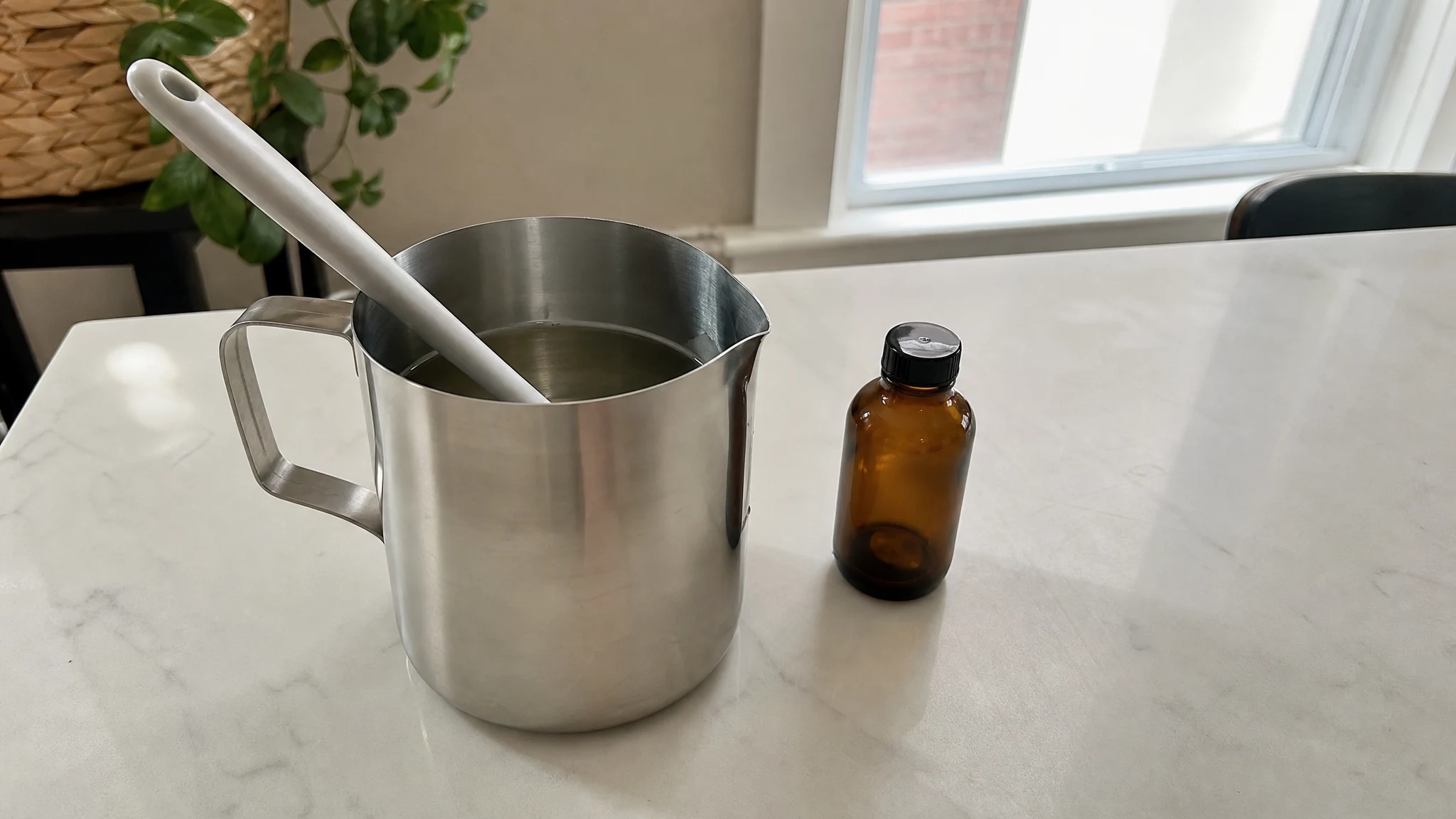
Fir Oil Flash Point in Candles: Myth Versus Mechanism
Flash point is a property of the oil in the bottle, and it governs how you store, ship and pour it. It does not tell you whether the finished candle will "catch fire from the oil", and it is not the temperature at which to add the oil to wax. Those are two separate questions that the internet repeatedly merges, and the fir needle oil sheets we could find show why a number alone settles neither.

Fir Needle Essential Oil
Our own Fir Needle Essential Oil, in sizes from 0.5 oz to bulk.
From $10.99
Shop Now →What the number measures
ASTM D93, the Pensky-Martens closed-cup method, describes flash point as a measure of "the tendency of the test specimen to form a flammable mixture" with air under controlled laboratory conditions, and says it is "only one of a number of properties which must be considered in assessing the overall flammability hazard" (ASTM D93-20, store page). The scope of D93 is petroleum products from 40 to 370 C. Essential oil sheets rarely say which test they used, so read a quoted flash point as a lab-conditions indicator for that sample, not a property of the plant species.
A UK supplier puts the practical meaning plainly: it is the temperature at which a liquid "produces enough vapour that it could briefly ignite", which needs an ignition source (Supplies for Candles).
What fir needle oil sheets say, and why they differ
| Supplier sheet | Flash point stated | Other details printed |
|---|---|---|
| Lebermuth, Fir Needle Canadian Oil, issue date 25 Oct 2022 (spec sheet) | 44 C (about 111 F), test method not stated | Abies balsamea needle oil, steam distilled; specific gravity 0.866 to 0.882 at 25 C |
| Plant's Power, Fir Balsam MSDS, reviewed 31 Jul 2017 (MSDS) | 155 to 163 F (about 68 to 73 C), test method not stated | Abies balsamea needle oil; classed Flammable Liquids Category 3, H226; specific gravity 0.880 to 0.889 at 20 C |
Both describe Abies balsamea needle oil, and their flash points are about 25 to 30 C apart. Neither names a method, the sheets are five years apart, and their density ranges differ. The certificate of analysis we publish gives a relative density of 0.924 at 20 C against a standard of 0.888 to 0.958, which is higher than both sheets' ranges, and our certificate has no flash point at all. We publish no safety data sheet or flash point of our own. So do not transfer either figure to our oil. If you need a flash point for your records, read the sheet for the lot you hold, or ask for one through our wholesale page before ordering; we have not published one.
Myth: you must add oil below its flash point
Two supplier sources address it directly. CandleScience's support page says adding fragrance or essential oil to wax above the oil's flash point "will not cause it to combust" (CandleScience support). The Supplies for Candles page says that although hot wax may be hotter than the flash point, "because there is no open flame present, the fragrance will not ignite", and that the SDS flash point is "not a guide for wax mixing temperatures". These are suppliers' statements, not test reports.
Where do the add temperatures come from, then? From the wax. The soy container sheet says to let the wax cool to your pour temperature, add the fragrance and mix well; CandleScience gives 185 F (85 C) for GW 464 and 190 F for its coconut apricot blend, so that the fragrance bonds with the wax. Set that figure by the wax's sheet.
The arithmetic is worth seeing once. At 85 C, the oil from the first sheet above is 41 C over its 44 C flash point; the second sheet's oil is about 12 to 17 C over. By the "stay below it" myth, both would be wrong to pour. By the wax makers' sheets, both are routine. The difference is the ignition source: stirring a pot at 85 C with the stove off and no flame near the vapour is different from decanting the same oil beside a gas flame. Reasoning from the sources, treat the add step as a ventilated, flame-free step with the heat source off, and treat the bottle as a Category 3 flammable liquid.
What flash point does matter for in the finished candle
Here the sources disagree, and we are not going to average them. The joint advice sheet from Trading Standards and the British Candlemakers Federation (January 2024) says the wax catches fire when the pool reaches the flash point of the wax-fragrance mix, that wax alone is around 200 C, and that "the flash point of the fragrance-wax mix cannot be calculated or estimated. It can only be determined by instrumental analysis in a lab." It gives an example: 2.5% of a fragrance with a flash point of 70 C added to a 200 C wax can bring the mixture's flash point "closer to 90 C". It also says fragrances with a flash point under 60 C "should be avoided" and that the figure sits in Section 9 of the fragrance's safety data sheet (BCF and Trading Standards, 2024).
Put that next to the table. One fir sheet says 44 C, under the 60 C line; the other says about 68 to 73 C, over it. The advice sheet is aimed at UK makers and sellers and was written about fragrances generally, and the suppliers' pages above are about the act of adding oil. They answer different questions, and both are consistent with this reading: adding the oil is a handling step; the burning candle is a mixture whose flash point nobody can compute for you. If you sell candles, a flammability test by a laboratory, or a call to your Trading Standards or regulatory contact, is the right route. This post cannot replace it.
The same sheet names the practical risks that sit around the number: higher fragrance content raises fire likelihood, and fires sometimes start when the flame reaches the bottom of the container and heats the last wax, so many makers advise not burning the last 1 cm. For the load side, see how much essential oil in candles.
Gel wax is the real exception
CandleScience's page notes the gel wax maker Penreco "recommends using fragrances with flashpoints over 170°F", and Supplies for Candles puts the minimum for gel wax at 77 C. Supplies for Candles gives about 130 C for the burn pool of unscented gel wax, so for gel the oil's flash point becomes a selection criterion. Neither fir sheet above reaches 170 F: 44 C is 111 F, and 68 to 73 C is 155 to 163 F. This post is about paraffin, soy and coconut blends, and we do not recommend fir oil for gel candles; see the gel wax maker's guidance.
Handling the concentrate
The Plant's Power sheet gives the baseline for a bottle of conifer oil: keep it away from heat, hot surfaces, sparks and open flames; keep the container tightly closed; store in a cool, well-ventilated place away from sunlight. That matches our own product copy (tightly capped, cool, dark, away from children and pets). Bulk storage is its own topic in storing bulk essential oil.
For making candles, the sequence is in the method guide, and what to do when the result is faint is in the troubleshooting order. For the oil, read the sheet for your lot, keep flames out of the add step, and follow the wax maker's temperature, not the flash point.
Fir Needle Essential Oil
Fir Needle Essential Oil from our own shop, in sizes from 0.5 oz to bulk.
From $10.99
Shop Now →Sources & Further Reading
- ASTM International. D93-20, Standard Test Methods for Flash Point by Pensky-Martens Closed Cup Tester. store.astm.org/d0093-20
- The Lebermuth Company, 2022. Technical Data Specification, Fir Needle Canadian Oil (50-6125-02). docs.lebermuth.com/50-6125-02
- Plant's Power Inc, 2017. Material Safety Data Sheet, Fir Balsam. cdn.shopify.com/MSDS_Fir_Balsam
- British Candlemakers Federation and Trading Standards, 2024. Candlemakers Advice Sheet. britishcandles.org/Advice_Sheet_2024
- CandleScience Support. What does the fragrance flashpoint mean? support.candlescience.com
- Supplies for Candles. Flash Points Explained. suppliesforcandles.co.uk/flash-points-explained
- Soy Wax Container, Technical Data Sheet v5.0 (revised 26 Aug 2020). cdn.shopify.com/Soy_Wax_Container_Technical_Data_Sheetv5.0
- CandleScience. Lab Notes: Coconut Apricot Wax. candlescience.com/lab-notes-coconut-apricot
- CandleScience. Golden Brands 464 Soy Wax. candlescience.com/golden-brands-464