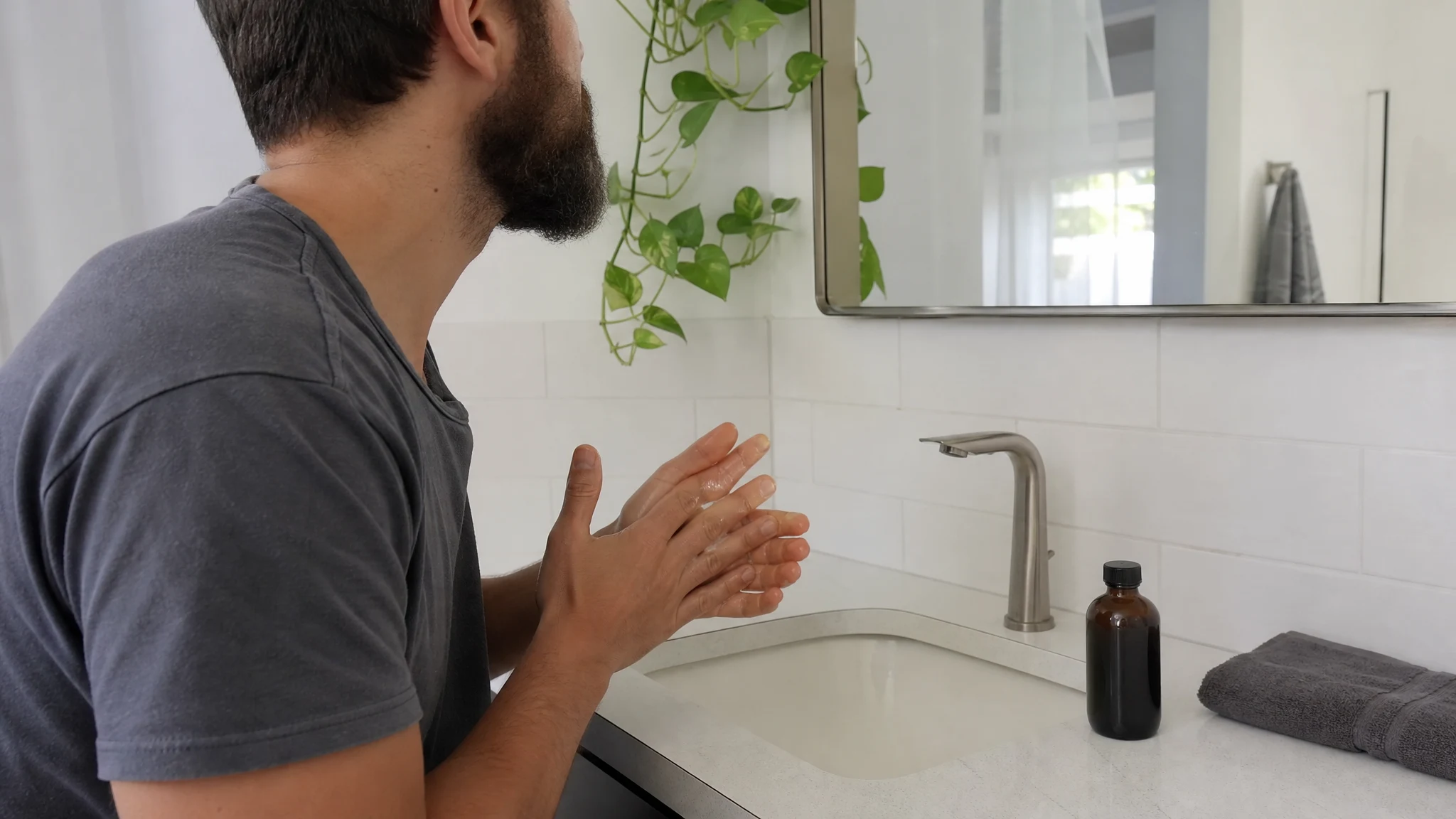
DIY Fir Beard Oil: Drops, Carrier and Dilution for 30 ml
Our advice for a fir beard oil is to make it weaker than you think you should: 3 drops of fir needle oil in a 30 ml bottle, which is 0.5%, not the 12 drops that sits at the top of the 0.5% to 2% range on our own product pages. A beard oil lives on facial skin, within reach of your eyes, and gets rubbed in with the hands you then touch your face with. This post works out the drops, picks the carrier we can support with a study, and says what we have not tested.

Fir Needle Essential Oil
Our own Fir Needle Essential Oil, in sizes from 0.5 oz to bulk.
From $10.99
Shop Now →Why 0.5% and not 2%
Our product pages say to dilute our fir needle oil to 0.5% to 2% in a carrier oil, roughly 3 to 12 drops per ounce of carrier, and to patch test first. That range is written for skin in general. The Tisserand Institute dilution guidelines split it by body area: 0.5% to 1.2% for facial cosmetics and deodorants, 1% to 3% for body oils and lotions, and 0.2% to 1% for sensitive or impaired skin. The page calls these guidelines, not rules, and tells readers to start low and go up only if needed.
A beard oil is a facial product, so the facial range governs, and the whole of that range sits inside the bottom half of ours. Where our range and Tisserand's overlap, the overlap is 0.5% to 1.2%. We would start at 0.5% and stay under 1.2% whatever the scent strength, for two reasons that are reasoning, not measurement: you cannot easily wash a leave-in product off if it stings, and a beard holds scent close to your nose all day, so a strong blend is hard to escape.
If you have eczema, a skin condition, or a history of reacting to fragranced products, the same page lists 0.2% to 1% for sensitivity and impaired skin. We are an oil seller, not a dermatologist: ask a physician before putting any essential oil on skin that is already reactive.
The arithmetic for a 30 ml bottle
Our skin-dilution copy (3 drops per 30 ml gives 0.5%) implies about 20 drops per ml, or 0.05 ml a drop. Our published COA gives a relative density of 0.924 at 20 C, so one drop weighs roughly 0.046 g. Both numbers are arithmetic from our own figures, not something we have measured with your dropper.
| Strength | Fir oil in 30 ml | Drops (20 per ml) | Weight | Where it sits |
|---|---|---|---|---|
| 0.5% | 0.15 ml | 3 | about 0.14 g | our starting point |
| 1.0% | 0.30 ml | 6 | about 0.28 g | inside Tisserand facial range |
| 1.2% | 0.36 ml | 7 | about 0.32 g | top of Tisserand facial range |
| 2.0% | 0.60 ml | 12 | about 0.55 g | top of our page, above facial range |
The weak point is the drop. Droppers differ. If your bottle delivers 15 drops per ml instead of 20, three drops is 0.2 ml, which is 0.67% in 30 ml: more than a third stronger than you meant. Two ways round it. Draw 0.15 ml with a 1 ml oral syringe from a pharmacy, or weigh 0.14 g on a 0.01 g scale. Both beat counting drops, and the syringe costs very little.
Choosing the carrier: the evidence we can point to
We sell no carrier oils, so this is where you go to a craft or soap-making supplier, or a grocery or pharmacy for a cosmetic-grade oil. Among the oils people use for beard oil, jojoba is the one for which we fetched a study. It is not a triglyceride oil like olive or grapeseed. A 2022 paper in BPB Reports (Tsuchimoto, Sakai and Fukui, Osaka University) describes jojoba oil as mainly liquid wax monoesters. They heated jojoba oil, olive oil and squalene at 60 C for 60 days: jojoba's acid value did not change while the others' rose, its peroxide and carbonyl values were lowest, and the authors called it the most stable of the three against autooxidation.
What that did not show: it was an accelerated heat test, not a shelf-life study of a beard oil; the olive oil was a triglyceride comparator, not a rival beard carrier; and the paper found that oxidative stability varied between crude jojoba oils from different suppliers, so a bottle of jojoba is not automatically a stable one. For argan, grapeseed, fractionated coconut and the rest, we did not fetch composition or oxidation data, so we make no claim about them. The practical rule that follows from the jojoba result is to buy a small bottle with a date, keep it capped and dark, and discard anything that smells like old paint or crayons.
Our own storage guidance for the fir oil is the same: it keeps typically 1 to 2 years for conifer oils, our /our-distillation/ page notes that oxidised conifer oils are more likely to irritate, and the advice is to buy it fresh and use it up. A bottle of beard oil is two oils ageing at once, so make 30 ml, not 250 ml.
Make it, with the limits stated
We have not made or tested this recipe. It is a formulation worked out from the Tisserand range and the arithmetic above. Make a small batch first and patch test it.
- Pour 29.85 ml of jojoba (or your chosen carrier) into a 30 ml amber glass dropper bottle. A supply shop sells the bottle; we do not.
- Add 0.15 ml of fir needle oil: 3 drops, or the syringe measure.
- Cap and roll between your palms for 30 seconds. Label it with the date.
- Patch test: a dab on the inner forearm, wait a full day, and watch for redness, itching or swelling. The method is in our dilution and patch test post, which also has the table we are not repeating here.
- Use 3 to 5 drops of the finished oil for a full beard, warmed between the hands, kept away from the eyes.
Mind the scale. 3 drops of fir in 30 ml means our undiluted oil is being measured in fractions of a millilitre, so a spill of 1 ml of neat oil is more than six bottles' worth. Pour over a tray.
What not to claim, and what goes wrong
Do not say it grows hair, thickens a beard or cures beard itch. The FDA's cosmetic-or-drug page says intended use decides the category, shown by labelling, advertising and websites, and that claims to restore hair growth make a product a drug. It also says a massage oil that only lubricates and adds fragrance is a cosmetic. A beard oil sold or labelled for scent and conditioning stays on the cosmetic side; the same bottle with a growth claim does not. If you sell it, read our labelling post and ask a regulatory consultant, because FDA's homemade cosmetics fact sheet says makers must hold evidence their product is safe and a label needs a street address, not just a post office box or website.
- Stinging or redness: stop, rinse, and drop to 0.2% to 0.5% or leave the fir out. The cause is usually the oil strength or an oxidised bottle, not the beard.
- Pillowcase marks: reasoning, not observation: the stain is the carrier oil, which is 99%+ of the bottle, so fir does little to it. Use fewer drops of the finished oil.
- Children and pets: keep the bottle out of reach. A 2019 Medical Journal of Australia study of NSW Poisons Information Centre calls (4,412 essential oil exposures from 2014 to 2018, 63% in people under 15) reports that about 5 ml of some oils can cause life-threatening toxicity in children. A pet that licks your beard is licking the oil. Pet Poison Helpline's essential oils page says cats and birds are at greatest risk and ranks skin contact second only to swallowing; ask a veterinarian before using it around either.
For other ways to blend with fir once the base is sorted, see formulating with fir needle oil, and the same dilution maths applies to the lotion bar.
A fir beard oil is a small, forgiving project if you keep the strength at the bottom of the facial range. Our oil comes undiluted from 0.5 oz upwards, so the dilution is always your job and the maths above is the whole of it.
Fir Needle Essential Oil
Fir Needle Essential Oil from our own shop, in sizes from 0.5 oz to bulk.
From $10.99
Shop Now →Sources & Further Reading
- Tisserand Institute, undated. Essential oil dilution guidelines. tisserandinstitute.org/safety/dilution
- Tsuchimoto S, Sakai H, Fukui K, 2022. Oxidative stability and antioxidant activity of jojoba oil, BPB Reports 5(6). jstage.jst.go.jp/bpbreports/5/6/5_121
- US FDA. Is It a Cosmetic, a Drug, or Both? (Or Is It Soap?). fda.gov/cosmetics
- US FDA. Small Businesses and Homemade Cosmetics: Fact Sheet. fda.gov/cosmetics
- Cairns R, Harnett J, 2019. Essential oil exposures reported to the NSW Poisons Information Centre, Medical Journal of Australia, via University of Sydney news release. sydney.edu.au/news
- Pet Poison Helpline, undated. Essential oils (author a veterinary student extern). petpoisonhelpline.com/blog/essential-oils