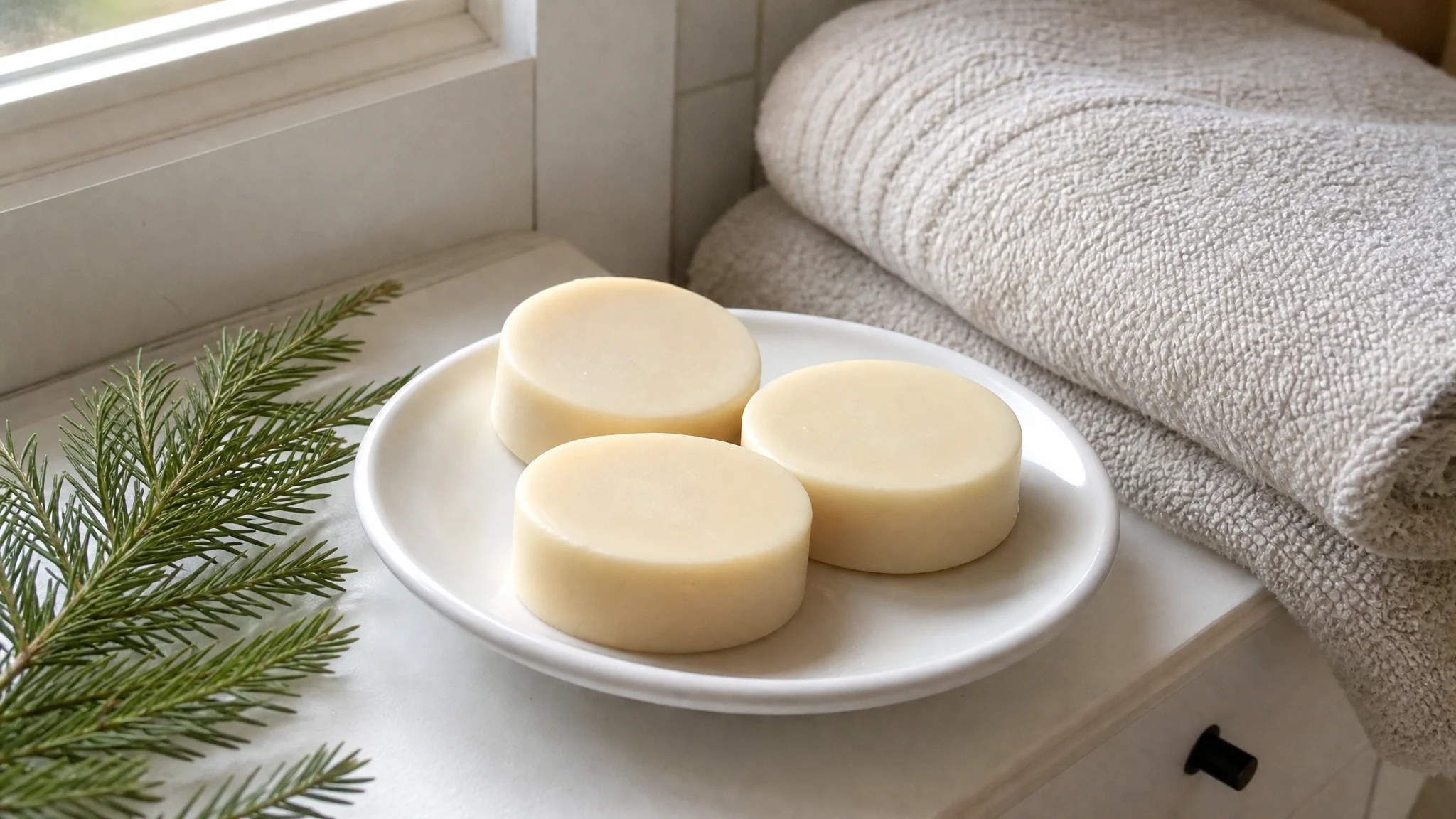
Fir Lotion Bar: Why No-Water Is Easier, and Where to Add Oil
A lotion bar is the easier first fir body product than a whipped body butter or a lotion, and the reason is chemical, not aesthetic: a bar has no water in it, so there is nothing to preserve. The difficulty it does have is temperature. Fir needle oil is volatile and flammable, and beeswax needs 62 to 65 C to melt, so the order and timing of the steps matter more than the ratios.

Fir Needle Essential Oil
Our own Fir Needle Essential Oil, in sizes from 0.5 oz to bulk.
From $10.99
Shop Now →Bar or butter: decide on water
A lotion bar is wax, butter and liquid oil, poured into a mold. A water-based lotion or a whipped butter with water in it is a different product: once water is in the formula, microbial growth becomes a design problem, and FDA's homemade cosmetics fact sheet says every maker must hold adequate evidence that the product is safe. We have no preservative guidance to give, we sell no preservatives, and choosing and dosing one is a question for a cosmetic chemist. A bar sidesteps the question while it stays dry. That "while" is reasoning from the formula, not a measurement: a bar left in a wet shower dish takes on water, so keep it in a tin.
If you plan to sell bars, the preservative question is replaced by labelling, safety substantiation and registration questions. Our labelling post starts that, and a regulatory consultant should finish it.
Three ingredients, three melting points
The bar's behaviour comes from the gap between its two solids.
- Beeswax. One supplier's white beeswax specification (Supplies for Candles, revised December 2022) gives a drop melting point of 62 to 65 C (BP/Ph Eur 2.2.17) and a congealing point of 61 to 65 C (ASTM D938). It is the stiffener.
- Shea butter. A 2023 paper in Foods (Abdel-Razek and co-authors) measured crude shea butter at 45.77% oleic and 43.53% stearic acid, with a slip melting point of 32 C. It cites a literature range of 25 to 45 C. The stearic-rich fraction is what makes it a solid that softens on skin. The same paper measured 5.06% unsaponifiable matter in the crude butter.
- A liquid oil. It sets how soft the bar is. For one we can support with a study, see jojoba in our beard oil post.
Because the wax melts roughly 30 C above the butter, a bar is a hard-wax skeleton with softer fats in it. More wax gives a harder bar that glides and leaves little residue; more oil gives a softer, greasier bar. That is reasoning from those figures, and we have not made the bar to see where the balance falls.
The fir oil step: where the real decision is
The melt has to reach the wax's melting point, at least 62 C by the spec above. The one published figure we found for a steam-distilled Abies balsamea needle oil is a flash point of 44 C on a Lebermuth technical data specification (Fir Needle Canadian Oil, issued October 2022; the sheet does not state the test method). Our own published COA gives density and refractive index and no flash point, so we cannot give you one for our batch, and we will not borrow another supplier's number as if it were ours. Treat 44 C as an order of magnitude for a neat conifer oil.
Reasoning from that figure, three consequences follow. Never add the oil to a melt that is still on the heat, because that is the one moment the pot is well above 44 C and has a flame or hot plate under it. Stir it in at the lowest temperature at which the mix still pours, and pour at once, because every minute in a warm open pot is fragrance leaving. And do not trust a number from us for that pour temperature: the blend of wax, butter and oil starts to cloud somewhere below the wax's own congealing range of 61 to 65 C, and we have not measured where. A thermometer and watching the surface for the first haze is the method. A 1% solution in fat gives off far less vapour than the neat oil, but that is also reasoning, so keep flames off the bench.
The fir oil dose in grams
Two of our sources apply here. Our product pages give 0.5% to 2% for skin. The Tisserand Institute dilution guidelines give 1% to 3% for body oils and lotions, noting they match fragrance levels in commercial personal care products, and 0.5% to 1.2% for facial cosmetics. The two ranges overlap at 1% to 2%. We would use 1% for a first batch, since a bar is rubbed on as a concentrated film.
| Strength (90 g batch) | Fir oil | Drops (about 0.046 g each) | Per 30 g bar |
|---|---|---|---|
| 0.5% | 0.45 g | 10 | 0.15 g, 3 to 4 drops |
| 1% | 0.9 g | 20 | 0.3 g, 6 to 7 drops |
| 2% | 1.8 g | 39 | 0.6 g, 13 drops |
| 3% | 2.7 g | 59 | 0.9 g, 20 drops |
The drop size comes from our own copy (3 drops in 30 ml is 0.5%) and our COA density of 0.924 at 20 C: arithmetic, not a measurement of your dropper. Weigh the oil if you have a 0.01 g scale. Above 2% you are outside our page range, and above 1.2% outside Tisserand's facial range, so keep bars off the face.
The formulation, untested
We have not made this bar. It is a one-to-one-to-one weight split chosen because it scales simply, and the dose is worked out above. Make one small batch first and patch test.
- Weigh 30 g beeswax, 30 g shea butter and 30 g of a liquid carrier oil into a heatproof jug. Supply shops sell all three and the silicone mold; we sell only the fir oil.
- Melt the wax and shea in a water bath, then stir in the liquid oil. Take the jug off the heat and away from the flame.
- Let it cool, stirring, to the lowest temperature at which it still pours.
- Stir in 0.9 g (about 20 drops) of fir oil for 1%, pour into three cavities, and leave to set undisturbed.
- Patch test a bar on the inner forearm and wait a day. Our skin and pet basics post has the method.
If the bar is too hard, shift 5 g from wax to liquid oil next time. If it smears and sweats, shift the other way. The ingredients are the lever; the fir dose does not change.
Freshness, shelf life, and who should skip it
Butters age. In the 2023 Foods paper the crude shea butter had a peroxide value of 5.91 meq O2/kg against 0.24 to 0.63 for the refined fractions, all under the 10 meq O2/kg food threshold the paper cites; that was a laboratory comparison, not a shelf-life study. The practical point is to buy shea with a batch date. A bar is only as long-lived as its shortest-lived ingredient: our product copy gives typically 1 to 2 years for conifer oils, and the carrier oil may be shorter, so date the label and use the bar up within months, not years. That is a planning figure from reasoning, not a tested shelf life.
- Tree nut allergy: shea comes from the shea nut, and we did not fetch evidence either way on whether it matters topically. Ask an allergist before using or gifting a bar, and avoid nut-derived carrier oils for gifts.
- Reactive or broken skin: Tisserand lists 0.2% to 1% for sensitive or impaired skin, below the 1% to 3% body range. See a physician first.
- Children, pets and babies: we make no safety claim for them. Ask a pediatrician or veterinarian before using a bar around them, and remember an oily hand that strokes a cat leaves oil on fur.
The same bar makes a hand gift in the holiday gift roundup, and the usage-rate ceilings behind these numbers are covered in fir needle oil IFRA usage rates.
A fir lotion bar is a reasonable first body product: three solids, one dose of oil, and a pour you control with a thermometer. Start at 1%, keep it dry, and weigh the fir oil, which comes undiluted in our sizes from 0.5 oz up.
Fir Needle Essential Oil
Fir Needle Essential Oil from our own shop, in sizes from 0.5 oz to bulk.
From $10.99
Shop Now →Sources & Further Reading
- Tisserand Institute, undated. Essential oil dilution guidelines. tisserandinstitute.org/safety/dilution
- Supplies for Candles, 2022. White Beeswax BP product specification WAX008 (revised 16 December 2022). suppliesforcandles.co.uk/WAX008
- Abdel-Razek AG et al., 2023. Effect of refining and fractionation on minor components, fatty acids, antioxidant and antimicrobial activities of shea butter, Foods 12(8):1626. PMC10137687
- The Lebermuth Company, 2022. Technical Data Specification, Fir Needle Canadian Oil, product 50-6125-02. docs.lebermuth.com/50-6125-02
- US FDA. Small Businesses and Homemade Cosmetics: Fact Sheet. fda.gov/cosmetics