DIY Fir Shower Steamers: Ratio, Dose and Who Should Skip
A fir shower steamer is two cheap powders and a few drops of oil, and the part you control is the dose: we would put 1% fir needle oil in the mix, which is about 5 drops per 25 g tablet, and not the higher figures that circulate for bath products. A shower stall is a small closed room, the steam holds the vapour close to your face, and the people most likely to react to a fragranced room are the ones who should skip this project.

Fir Needle Essential Oil
Our own Fir Needle Essential Oil, in sizes from 0.5 oz to bulk.
From $10.99
Shop Now →Decide first: who should not make these
Skip a fir steamer if anyone who uses the shower has asthma or reactive airways, is a young child, or if a cat or bird shares the home. The evidence for caution on fragrance is broader than essential oils and none of it is about fir, so we report it as it is. In a nationally representative online survey of 1,137 US adults (Steinemann, Air Quality, Atmosphere and Health, 2018), 26.8% reported diagnosed asthma or an asthma-like condition, and 64.3% of those people reported at least one adverse health effect from fragranced products, including respiratory problems (43.3%) and asthma attacks (27.9%). It is a self-reported survey about fragranced products in general, so it measures what people say happened, not what fir oil does in a steam-filled room.
That is our reason for the low dose, and it is reasoning, not a measured limit: no source we fetched gives a safe vapour level for shower steam. If you have asthma, ask your physician before you put any scented tablet in a shower. If you share your home with a cat or bird, Pet Poison Helpline's essential oils page (undated) says cats and birds are at greatest risk from essential oils, and ranks skin exposure above breathing as a route. Ask a veterinarian.
What is actually happening in the tablet
The fizz is an acid-base reaction. Jungbunzlauer's technical paper on effervescent systems gives it as one citric acid plus three sodium bicarbonate yielding trisodium citrate, three water and three carbon dioxide: C6H8O7 + 3 NaHCO3 gives Na3C6H5O7 + 3 H2O + 3 CO2. Water starts it. The same paper says effervescent components are hygroscopic and moisture sensitive, and that damp storage can set off a premature reaction that recrystallises trisodium citrate, causing caking and further gas release, enough to burst packaging.
Three practical points follow. Each fizz makes more water, so a tablet that begins to react while wet keeps going; mix with as little liquid as possible. A tablet must be dry before it goes in a sealed bag. And the reaction needs a ratio, which we can work out.
Working from molar masses (our arithmetic, assuming anhydrous citric acid at 192.1 g/mol and sodium bicarbonate at 84.0 g/mol): 1 g of citric acid needs 3 x 84.0 / 192.1 = 1.31 g of bicarbonate to react completely. If your citric acid is the monohydrate form, which is heavier per mole, use less bicarbonate. Read the pack.
The dose, in grams
For a 150 g batch of six 25 g tablets, we would use 55 g citric acid, 72 g sodium bicarbonate (55 x 1.31 = 72.1) and 23 g cornstarch. Cornstarch is a diluent that keeps acid and base grains apart and makes the mix hold together; that role is our reasoning, not a figure from a source.
Our product pages say 0.5% to 2% in a carrier for skin. The Tisserand Institute dilution guidelines give 2% to 4% for bath products, noting that bathwater dilutes the oil further, so that range runs slightly higher for a perceptible aroma. A shower steamer is not a bath: there is no tub of water, and the fir vapour is released into the air you breathe. So we would stay below the Tisserand bath range.
| Oil as % of mix | Per 150 g batch | Drops (about 0.046 g each) | Per 25 g tablet |
|---|---|---|---|
| 0.5% | 0.75 g | 16 | about 3 drops |
| 1% | 1.5 g | 33 | about 5 drops |
| 2% (bottom of Tisserand bath range) | 3.0 g | 65 | about 11 drops |
| 4% (top of Tisserand bath range) | 6.0 g | 130 | about 22 drops |
Our drop size is derived from our own skin copy (3 drops per 30 ml is 0.5%, about 20 drops per ml) and the 0.924 relative density on our published COA, so it is arithmetic, not a measurement of your dropper. Weigh the oil if you can. At 1%, one tablet carries about 0.25 g of fir oil.
The formulation, untested
We have not made this recipe or timed it. It follows from the reaction ratio and the dose above. Make one tablet first.
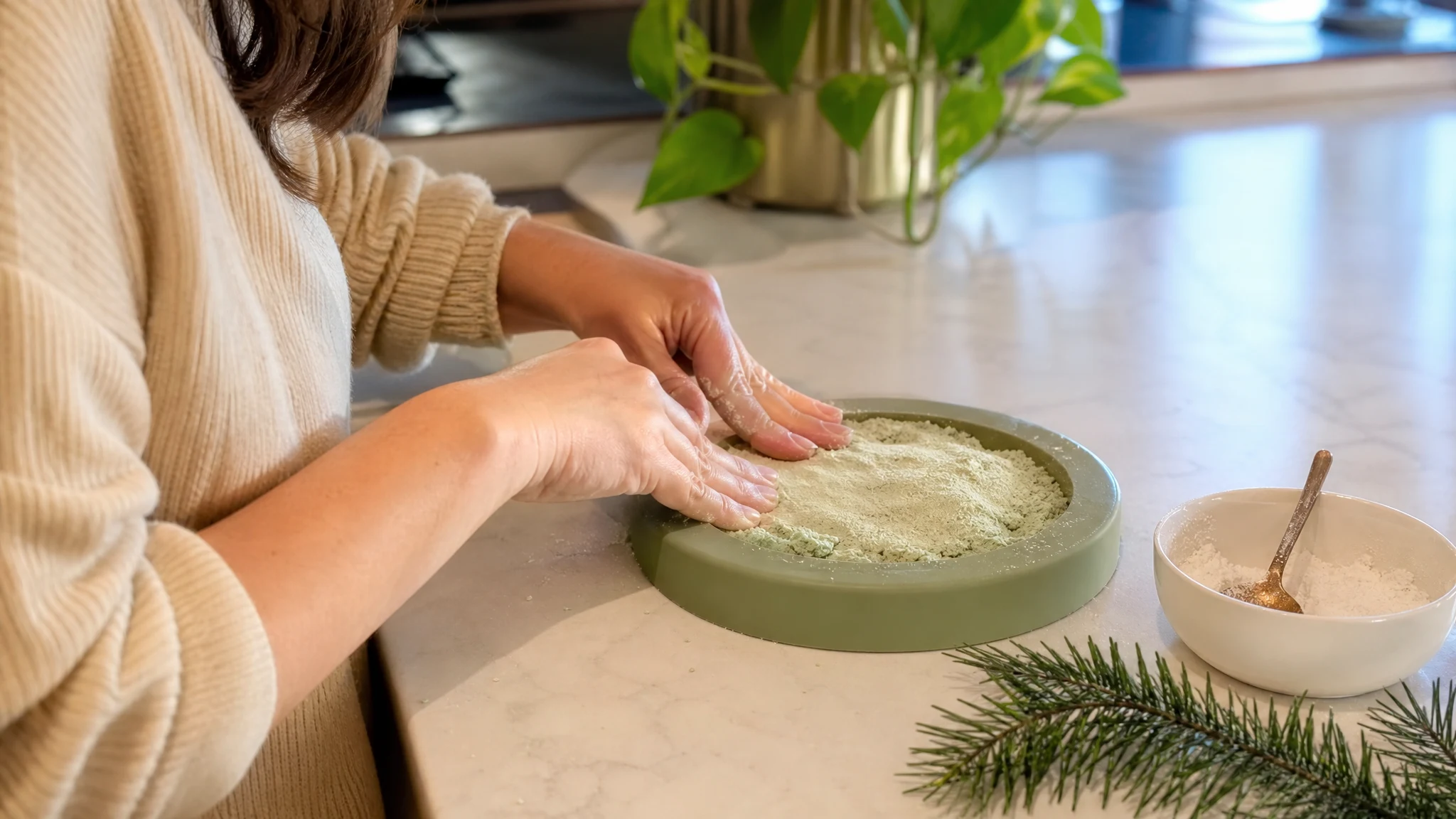
- Stir the 23 g of cornstarch with the fir oil (1.5 g, or 33 drops for the batch) in a dry bowl until no wet spots remain. Putting the oil on the starch first spreads it before acid and base meet.
- Add the citric acid and bicarbonate and mix dry until even. Supply shops and grocery stores carry the powders and silicone molds. We sell only the fir oil.
- Spray witch hazel or water in tiny bursts, mixing between each, until the mix holds when squeezed but is not wet. If it fizzes in the bowl, you have used too much.
- Press firmly into the molds and unmold when firm. Leave the tablets somewhere dry until hard. We have no drying time to give, because it depends on your room's humidity; press one before bagging it, and the surface should not give.
- Store in an airtight jar only once dry, with the date.
Place a tablet on the shower floor or a ledge where steam and splash reach it but the water jet does not. This is reasoning: a direct stream would dissolve it in moments, shortening the release. Do not set it where you stand barefoot, since oily citrate residue on a wet floor is slippery (also our reasoning, not something we measured). Rinse the floor afterwards. If your skin stings where residue touches it, rinse and stop.
What goes wrong
- Fizzes in the bowl: too much liquid. Start again with less spray.
- Crumbles: too little liquid or too little pressing. Add a spray and press harder.
- Smell is faint: do not raise the dose to fix it, because the cause may be an old oil. Our product copy says conifer oils keep typically 1 to 2 years, and our /our-distillation/ page says oxidised conifer oils are more likely to irritate. Check the date.
- Headache, cough, tight chest or sore eyes: leave the shower, ventilate, and see a physician if it persists. This is the outcome the low dose is meant to avoid.
Keep the neat oil and the tablets out of children's reach. A 2019 Medical Journal of Australia analysis of NSW Poisons Information Centre calls (4,412 essential oil exposures from 2014 to 2018, 63% in people under 15) reports that about 5 ml of some oils can cause life-threatening toxicity in children. A small pressed tablet is easy for a child to mistake for a sweet.
If you want to give the tablets away, label them and read the gift roundup first. For the same oil in a hot room, our sauna post covers a different set of limits, and formulating with fir needle oil covers blends. Dilution basics are in our skin and pet post.
A shower steamer is a good first project for the chemistry alone: one equation, one ratio, one dose to hold down. Weigh the fir oil, keep it near 1%, and our undiluted oil in sizes from 0.5 oz will cover many batches.
Fir Needle Essential Oil
Fir Needle Essential Oil from our own shop, in sizes from 0.5 oz to bulk.
From $10.99
Shop Now →Sources & Further Reading
- Jungbunzlauer. Functional acids with added value in effervescent systems (technical paper, 2025 upload). jungbunzlauer.com/effervescent-systems
- Steinemann A, 2018. Fragranced consumer products: effects on asthmatics, Air Quality, Atmosphere and Health 11(1):3-9. researchonline.jcu.edu.au/52402
- Tisserand Institute, undated. Essential oil dilution guidelines. tisserandinstitute.org/safety/dilution
- Pet Poison Helpline, undated. Essential oils (author a veterinary student extern). petpoisonhelpline.com/blog/essential-oils
- Cairns R, Harnett J, 2019. Essential oil exposures reported to the NSW Poisons Information Centre, Medical Journal of Australia, via University of Sydney news release. sydney.edu.au/news