Fir Oil Flash Point: What It Means in a Candle
Few numbers on an essential oil sheet cause as much confusion as the flash point. It gets quoted as the temperature at which you must add oil to wax, and as proof that a candle will or will not catch fire. It is neither. It tells you how to store, ship and handle the bottle, and once you see what it is measuring, the rest falls into place.

Fir Needle Essential Oil
Our own Fir Needle Essential Oil, in sizes from 0.5 oz to bulk.
From $10.99
Shop Now →What the number measures
A flash point is the lowest temperature at which a liquid gives off enough vapour to ignite briefly when a flame is held near it. ASTM D93, the closed-cup method most often cited, describes it as one property among several to consider when judging flammability, not a verdict on its own. Supplies for Candles puts it simply: heat alone does not cause ignition.
One fir needle oil sheet shows how specific it is. A Lebermuth technical sheet for a steam-distilled Abies balsamea needle oil, issued in October 2022, gives a flash point of 44 C (about 111 F). That belongs to that supplier's oil. The Certificate of Analysis we publish for one batch of ours lists density and refractive index and no flash point, so we do not pass that number on as ours; ask us through the wholesale page if your paperwork needs one for the oil you buy.
Why you can pour above it
Both CandleScience and Supplies for Candles address the common worry directly. CandleScience says adding fragrance or essential oil to wax above the oil's flash point will not cause it to combust, and Supplies for Candles says that because there is no open flame, the fragrance will not ignite, and that the flash point is not a guide for wax mixing temperatures.
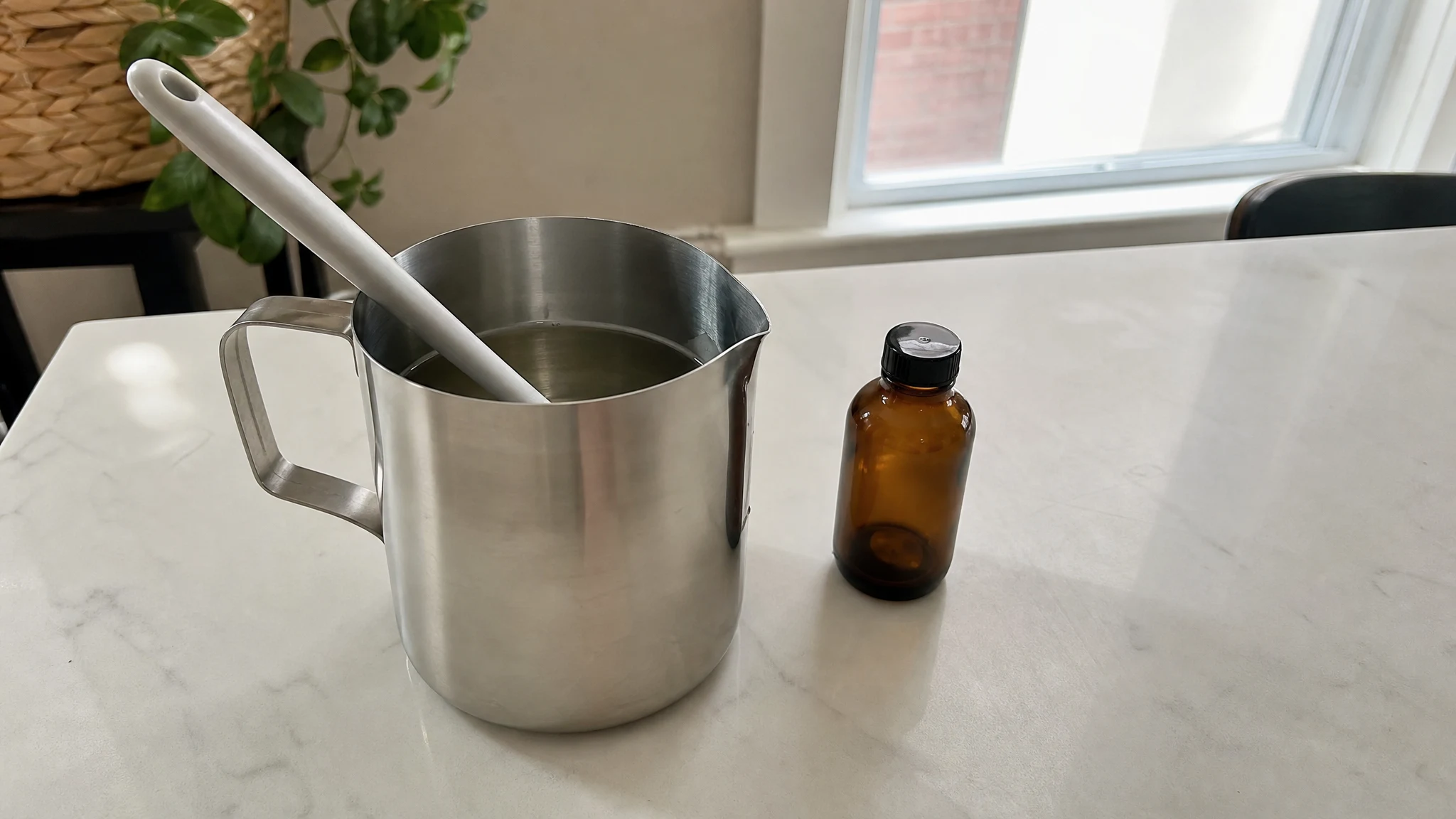
The add temperature comes from the wax. CandleScience's melt tutorial has you add oil at 185 F (85 C) and pour at 170 F (76.7 C), to get the oil mixed in and the cure working. Set it by your wax's own sheet.
The arithmetic is worth seeing once. At 85 C, an oil with a 44 C flash point is 41 degrees above it. By the stay-below rule that would be wrong, yet it is routine pouring. What changes the picture is the ignition source: stirring a pot with the heat off and no flame nearby is a different scene from decanting the same oil beside a gas flame. Keep the add step ventilated and flame-free, and cap the bottle when you are done.
Where flash point matters in the finished candle
A burning candle is a different question. The British Candlemakers Federation and Trading Standards advice pack (January 2024) explains that wax alone has a high flash point, around 200 C, but adding fragrance can lower it significantly, and that the flash point of a fragrance and wax mix cannot be calculated or estimated, only measured in a laboratory. Its example: 2.5% of a fragrance with a 70 C flash point can bring a 200 C wax closer to 90 C. It says fragrances with flash points under 60 C should be avoided, and points to Section 9 of the fragrance's safety data sheet for the figure.
These two sets of advice sit comfortably together. Adding oil is a handling step; a burning candle is a mixture, and its flash point is something a lab has to determine. If you plan to sell candles, a laboratory test, or a conversation with your local Trading Standards or regulatory contact, is the right route, and this post is no substitute.
The same pack lists sensible habits around the number: higher fragrance content makes fires more likely, and many makers advise leaving the last centimetre of wax unburned, since fires sometimes start when the flame reaches the bottom of the container. For the load itself, see how much oil in a candle.
Gel wax plays by different rules
Gel candles are where an oil's flash point becomes a real selection criterion. CandleScience notes that Penreco recommends fragrances with flash points over 170 F for its gel waxes, and Supplies for Candles says only fragrances with a flash point above 77 C should go in its gel wax, at up to 6%. The Lebermuth sheet's 44 C is 111 F, below both lines, so we would not suggest fir oil for gel candles. Paraffin, soy and coconut blends are the home for fir, and our candle making guide walks through the order of work.
Keeping the bottle
For the concentrate, we recommend keeping it tightly capped, cool and out of the light, away from heat and flames. That also keeps it fresh; our bulk storage post looks at decanting, and if a finished candle comes out faint, troubleshooting a candle with no scent goes through the causes in order.
Read the sheet for the oil you hold, keep flames out of the pour, and follow your wax maker's temperatures rather than the flash point.
Fir Needle Essential Oil
Fir Needle Essential Oil from our own shop, in sizes from 0.5 oz to bulk.
From $10.99
Shop Now →Sources & Further Reading
- ASTM International, D93 Standard Test Methods for Flash Point by Pensky-Martens Closed Cup Tester. https://store.astm.org/d0093-20.html
- The Lebermuth Company, Technical Data Specification, Fir Needle Canadian Oil (50-6125-02), issued October 25, 2022. https://docs.lebermuth.com/download/public/50-6125-02/Technical%20Data%20Specification.pdf
- British Candlemakers Federation and Trading Standards, Candlemakers Advice Sheet, January 2024. https://www.britishcandles.org/documents/www.britishcandles.org/Advice_Sheet_2024/candlesadvicepack(2024).pdf
- CandleScience Support, What does the fragrance flashpoint mean? https://support.candlescience.com/en_us/what-does-the-fragrance-flashpoint-mean-H1whhmgsZl.md
- Supplies for Candles, Flash Points Explained. https://www.suppliesforcandles.co.uk/flash-points-explained/
- CandleScience, How to Make Soy Wax Melts. https://www.candlescience.com/learning/how-to-make-soy-wax-melts