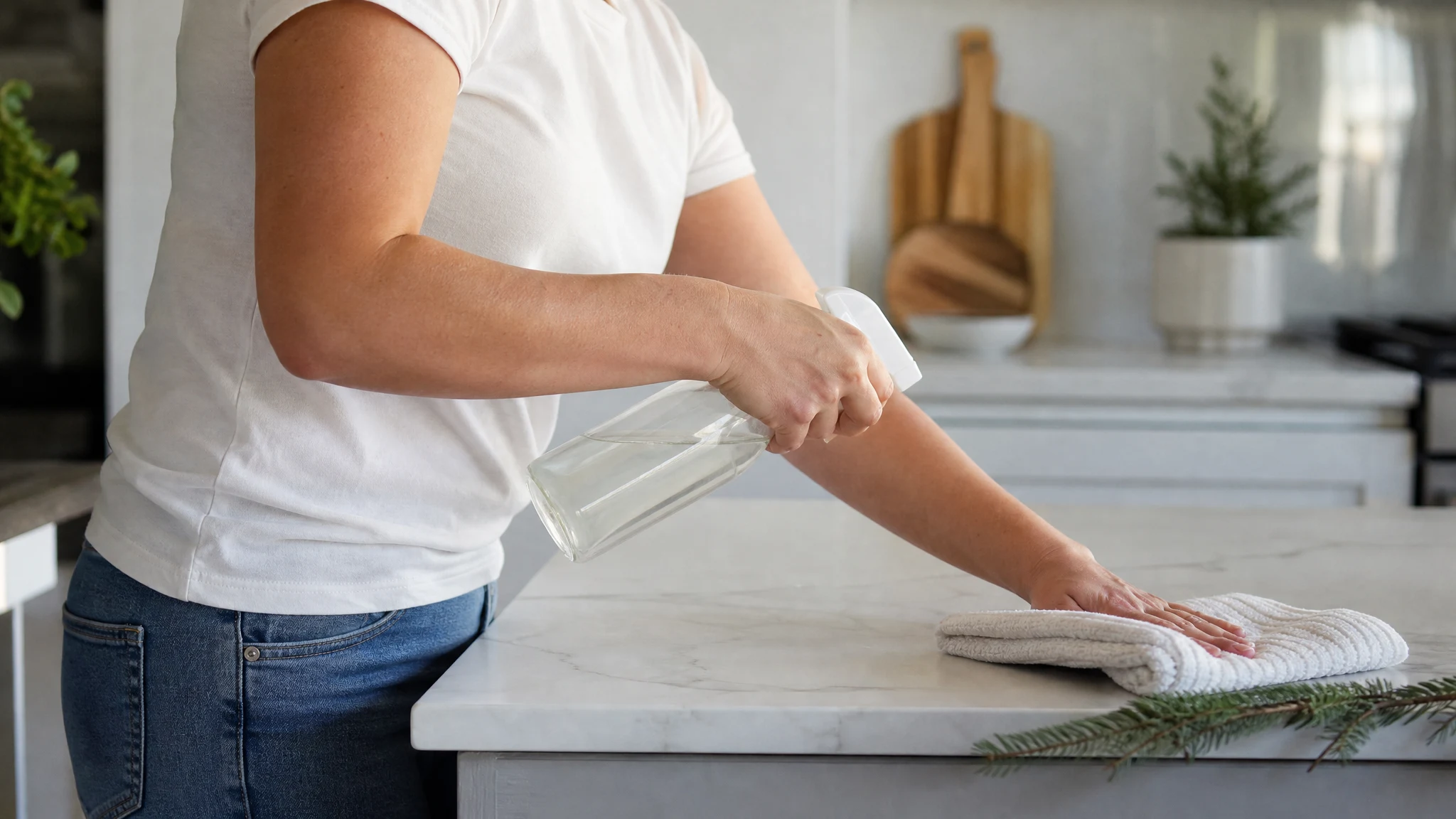
A Fir-Scented All-Purpose Cleaner That Works
A fir cleaner is one of the nicest small pleasures in a kitchen: you wipe the counter and the room smells like a walk in the woods. The oil is there for the scent, and the soap does the cleaning. Get a few choices right, and you end up with a spray you will actually reach for.

Fir Needle Essential Oil
Our own Fir Needle Essential Oil, in sizes from 0.5 oz to bulk.
From $10.99
Shop Now →Start with the surface
Natural stone is where an all-purpose recipe can go wrong. The Natural Stone Institute says products containing lemon, vinegar or other acids may dull or etch calcareous stones such as marble and limestone, and recommends a neutral cleaner, a stone soap, or a mild liquid dishwashing detergent with warm water (Natural Stone Institute: Learn About Cleaning Products for Natural Stone). So on marble, limestone or travertine, we would reach for a product sold as stone soap and leave this recipe for other surfaces. If you are unsure what your counter is, ask your installer.
For sealed laminate, glazed tile and stainless steel, this spray is a good fit. Waxed or oiled wood, painted walls and unsealed grout are better handled by checking with the finish maker and trying a hidden corner first, since oil can leave a mark.
Why soap and vinegar stay in separate bottles
Many recipes combine vinegar, castile soap and essential oil. Lisa Bronner of Dr. Bronner's explains why that one fights itself: castile soap is a base and vinegar is an acid, so they neutralise each other, leaving a curdled, oily residue that does not clean, regardless of the order you mix them. Her own all-purpose spray is simply 2 tablespoons of soap in 2 cups of water (Why Vinegar & Castile Soap Don't Mix Well). We follow that logic: choose soap and water for general cleaning, and keep vinegar for something else.
Getting the oil to mix
Essential oil does not dissolve in water. In a spray bottle it floats and clings, so the first few sprays are mostly water and the last are mostly oil. Soap helps disperse it, and a solubilizer such as polysorbate, sold by soap and cosmetic suppliers, is the standard fix in cosmetic sprays. For this spray, the simple habit is to shake the bottle before each use.
The recipe
- 2 cups (about 475 ml) of water in a spray bottle
- 2 tablespoons (about 30 ml) of liquid castile soap from a grocery or soap supplier
- 10 drops of fir needle oil
Add the soap to the water first, then the oil, then shake. Label the bottle with the date and use it within a few weeks, since a homemade spray has no preservative.
The arithmetic: at roughly 20 drops per ml (a rough convention), 10 drops is about 0.5 ml, which works out to about 0.1 percent of the spray. The Certificate of Analysis we publish for one batch gives a relative density of 0.924, so that is about 0.46 g of oil. You could go to 20 drops, about 0.2 percent, and we would stop there. Our skin guidance of 0.5 to 2 percent in a carrier is for skin, and a wipe-down cleaner has no reason to approach it. Start with ten drops, wipe a small patch, and see whether you want more scent.
A word about germ claims
This is a cleaner that smells of fir, and we describe it as that. Under the EPA's rule for minimum risk products, the label may not claim to control or mitigate microorganisms that threaten human health, and the active ingredients must come from a published list (40 CFR 152.25 - Exemptions for pesticides of a character not requiring FIFRA regulation). The EPA describes the exemption as covering products it has determined pose little to no risk (Minimum Risk Pesticides Exempted from FIFRA Registration). In the version we read, fir oil is not on that list, so keep the wording to what the product does for your counter and the scent. If you ever plan to sell a cleaner, take the labelling questions to a regulatory consultant and your state pesticide agency.
Pets and floors
Oil left on a floor can end up on a paw. The ASPCA says concentrated oils can be harmful to dogs and cats that walk through them or get them on a coat, and Pet Poison Helpline lists pine oils among those that can poison both cats and dogs (Is the Latest Home Trend Harmful to Your Pets? What You Need to Know!; Updates on Essential Oils). Neither names fir. In a home with a cat, we would leave the oil out of anything used on floors or on a surface a cat sleeps on, make the soap-and-water version without it, and check with your veterinarian.
If you want to scent the air rather than the counter, the room spray post is the right tool, and our skin and pet basics covers the safety side. For a whole house that smells like the season, see our tree scent guide. Keep any leftover oil capped and out of the light, as our storage article explains.
A clean counter that smells like fir is a simple luxury. A hidden-corner test and a labelled bottle are all it takes.
Fir Needle Essential Oil
Fir Needle Essential Oil from our own shop, in sizes from 0.5 oz to bulk.
From $10.99
Shop Now →Sources & Further Reading
- Natural Stone Institute: Learn About Cleaning Products for Natural Stone
- Why Vinegar & Castile Soap Don't Mix Well (Lisa Bronner)
- 40 CFR 152.25 - Exemptions for pesticides of a character not requiring FIFRA regulation (Cornell LII)
- Minimum Risk Pesticides Exempted from FIFRA Registration (US EPA)
- Is the Latest Home Trend Harmful to Your Pets? What You Need to Know! (ASPCA)
- Updates on Essential Oils (Pet Poison Helpline)