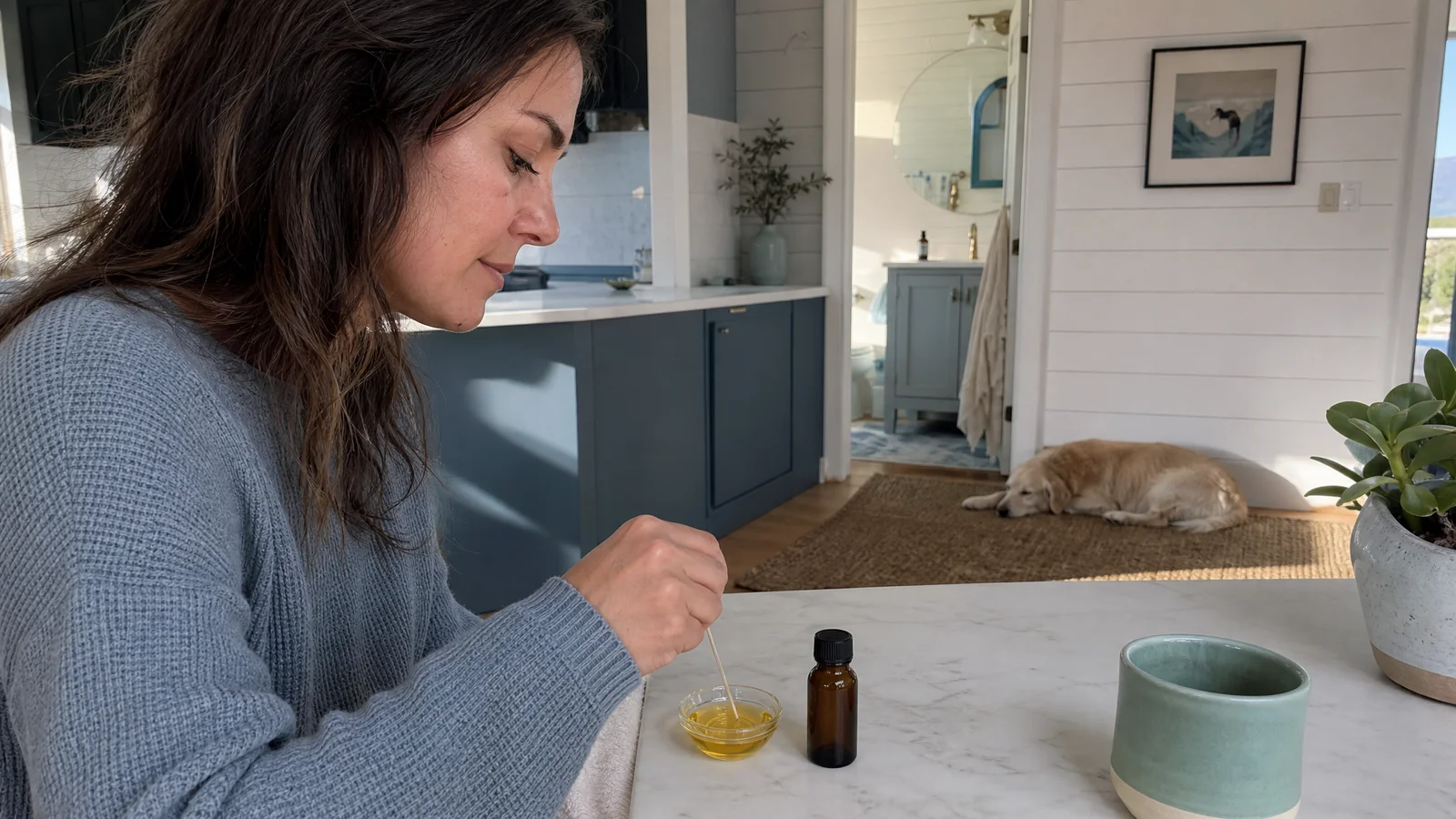
Diluting Fir Oil for Skin: Drops, Patch Tests and Pets
Fir needle oil arrives undiluted, and that is the first thing to know about putting it near skin: it is a concentrate, and a carrier oil turns it into something you can use. A carrier is the easy part. The real question is how much oil per ounce, and the answer shifts with where the product goes.

Fir Needle Essential Oil
Our own Fir Needle Essential Oil, in sizes from 0.5 oz to bulk.
From $10.99
Shop Now →Start from where it will sit on the body
We recommend diluting to between 0.5% and 2% in a carrier oil and patch testing first. That is our general line for skin, not a fir-specific limit, so it helps to set it beside the Tisserand Institute's dilution guidelines, which give a range for each use: 0.2 to 1% for sensitive or impaired skin, 0.5 to 1.2% for facial products and deodorants, 1 to 3% for body oils and lotions, and 2 to 4% for bath products. Tisserand calls these guidelines rather than rules, suggests starting low, and says undiluted oils should not be applied to skin.
In a fluid ounce (29.57 ml) of finished product, and counting roughly 20 drops to the millilitre (droppers vary, so this is an estimate), that becomes:
| Use | Range | Approx. drops per fl oz |
|---|---|---|
| Sensitive or impaired skin | 0.2 to 1% | 1 to 6 |
| Face and deodorants | 0.5 to 1.2% | 3 to 7 |
| Body oils and lotions | 1 to 3% | 6 to 18 |
Our own guideline of roughly 3 to 12 drops per ounce is the same arithmetic at 0.5% and 2%. For anything going on the face, we would work to the lower Tisserand range rather than the top of ours, and a body oil is where the higher end belongs. Our beard oil guide shows the weight version for 30 ml.
Why a young bottle is the better bottle for skin
Oils change as they take up oxygen, and Tisserand notes that those oxidation products tend to raise the risk of adverse skin reactions. Fir is built largely from monoterpenes, and a review by Karlberg and Lepoittevin in Contact Dermatitis found that oxidised delta-3-carene was the main culprit behind the sensitising effect of Scandinavian turpentine. That review is about turpentine rather than fir oil, so we treat it as a reason for caution, not a finding. In practice it points to a simple habit: put your freshest bottle into leave-on skin products, and keep older ones for room scent. Our storage guide explains the details.
A patch test done properly
The American Academy of Dermatology describes a more patient protocol than most essential oil guides do. Choose a quarter-sized spot where the product will not rub or wash off, such as the underside of the forearm or the bend of the elbow. Apply the product you plan to use, in your normal amount, twice a day for 7 to 10 days. If your skin stays calm, you are in good shape. If it turns red, itchy or swollen, wash gently and stop. If you cannot tell which ingredient is responsible, a board-certified dermatologist can arrange formal patch testing.
- Test the finished blend, in its carrier and at its real percentage, never the neat oil.
- Give it the full week or so; a reaction on day four would slip past a one-day test.
- Retest when you change the bottle or the strength.
The AAD page covers skin care products generally and does not mention essential oils, so applying it to fir blends is our own sensible extension.
Around pets
We know of no study of fir oil in household pets, so the guidance here is general. The ASPCA advises against applying essential oils directly to a pet. It says brief diffuser use in a secured area the pet cannot enter is not likely to be an issue, and that pets with breathing problems, and homes with birds, are better off without diffusers. If a pet is exposed, call your veterinarian or the ASPCA Animal Poison Control Center at (888) 426-4435. Spills matter most: a pet that steps in a drop and then grooms has been exposed. Keep the bottle out of reach of animals and children. Our simmer pot guide covers room placement.
When to ask a professional first
Broken or eczema-prone skin, a history of reacting to fragranced products, pregnancy, and use on infants or young children all deserve a conversation with a dermatologist, OB/GYN or pediatrician before any essential oil goes on. We sell an external cosmetic oil and make no medical claims for it.
Choose the carrier at a craft shop or grocery, start low, test the real blend for a week, and enjoy the scent of the forest on your own terms.
Fir Needle Essential Oil
Fir Needle Essential Oil from our own shop, in sizes from 0.5 oz to bulk.
From $10.99
Shop Now →Sources & Further Reading
- Tisserand Institute. Essential oil dilution guidelines. tisserandinstitute.org/safety/dilution
- Tisserand Institute. Oxidized essential oils. tisserandinstitute.org/learn-more/oxidized
- Karlberg and Lepoittevin, 2021, Contact Dermatitis (abstract). europepmc.org/article/MED/34453446
- American Academy of Dermatology. How to test skin care products. aad.org/public/everyday-care/skin-care-secrets/prevent-skin-problems/test-skin-care-products
- ASPCA, 23 June 2022. The Essentials of Essential Oils Around Pets. aspca.org/news/essentials-essential-oils-around-pets