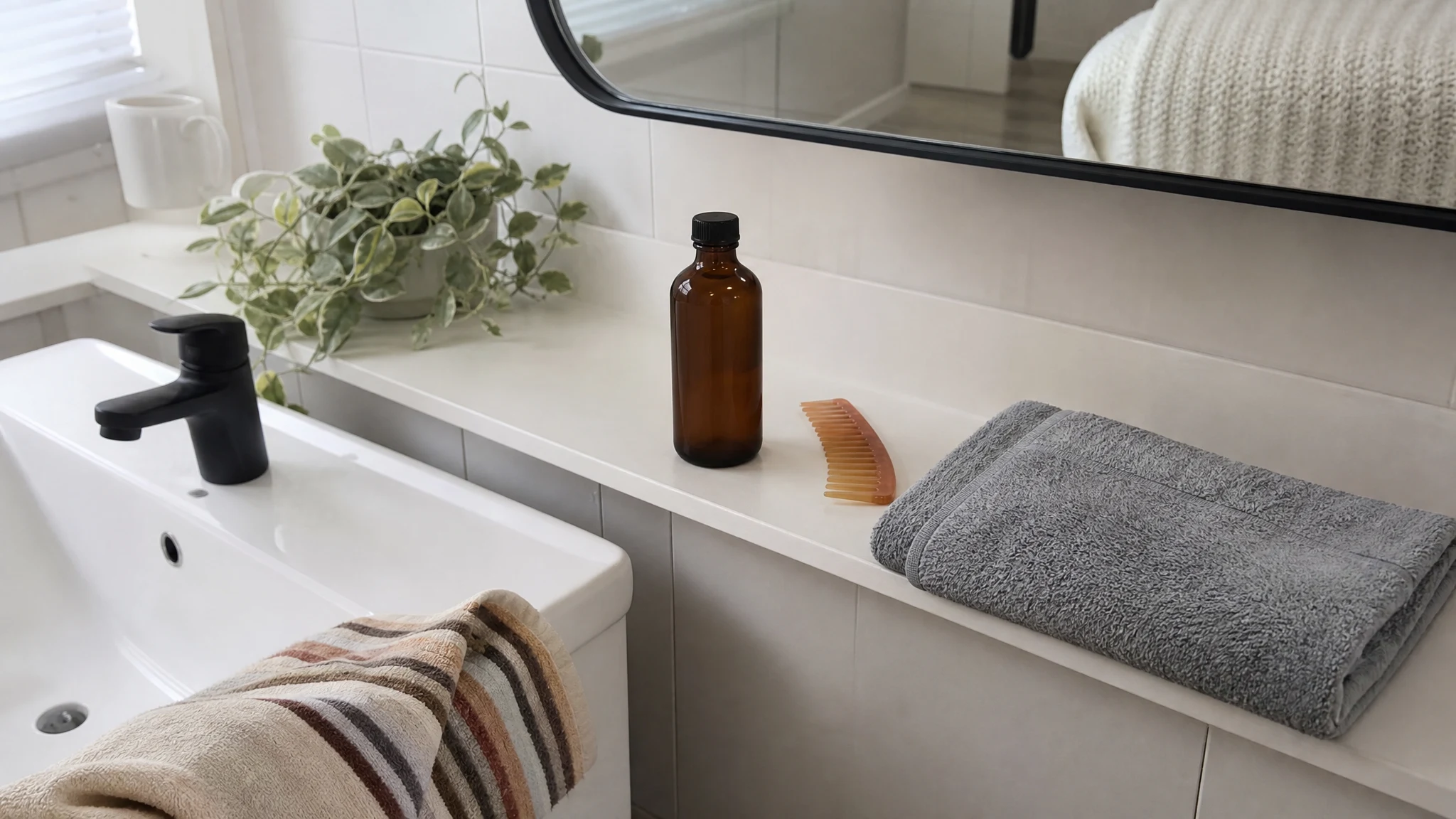
A Fir Beard Oil Recipe, Down to the Drop
Make your fir beard oil weaker than you think you should. Three drops of fir needle oil in a 30 ml bottle comes to 0.5 percent, a modest dose that still smells like a walk under evergreens. It is a small project, and the pleasure is in getting the numbers right.

Fir Needle Essential Oil
Our own Fir Needle Essential Oil, in sizes from 0.5 oz to bulk.
From $10.99
Shop Now →Why we start at 0.5 percent
Our guidance for diluting fir needle oil for skin is 0.5 to 2 percent in a carrier oil, roughly 3 to 12 drops per ounce, with a patch test first. That range is written for skin in general. The Tisserand Institute splits it by area: 0.5 to 1.2 percent for facial cosmetics, 1 to 3 percent for body oils and lotions, and 0.2 to 1 percent for sensitive or impaired skin. It calls these guidelines and suggests starting low (Recommended dilutions).
A beard oil lives on the face, within reach of your eyes, and gets rubbed in with hands you then touch your face with. Where our range and Tisserand's facial range overlap is 0.5 to 1.2 percent, so we start at the bottom of it. A leave-in oil is hard to wash off if it stings, and a beard keeps the scent close to your nose all day, so there is no need for strength. If your skin is already reactive, ask a physician before using any essential oil on it.
The arithmetic for 30 ml
Three drops in 30 ml works out to 0.5 percent if a drop is about 0.05 ml. With the relative density of 0.924 on the Certificate of Analysis we publish for one batch, a drop weighs about 0.046 g. Here is how the strengths line up:
- 0.5 percent: 0.15 ml, about 3 drops. Our starting point.
- 1.0 percent: 0.30 ml, about 6 drops. Inside the facial range.
- 1.2 percent: 0.36 ml, about 7 drops. The top of the facial range.
The weak spot is the drop itself, because droppers differ. If yours delivers 15 drops per ml rather than 20, three drops is 0.2 ml, or about 0.67 percent. A 1 ml oral syringe from a pharmacy lets you draw exactly 0.15 ml, and a scale that reads to 0.01 g lets you weigh 0.14 g. Either beats counting.
Choosing a carrier
We sell only the fir oil, so the carrier comes from a craft or soap-making supplier, or a pharmacy or grocery. Of the oils people use for beard oil, jojoba is the one we can point to evidence on. It is technically a liquid wax rather than a triglyceride oil like olive. In a Japanese study of crude jojoba oil, the team heated jojoba, olive oil and squalene at 60 C for 60 days; jojoba's acid value did not change while the others rose, and the authors judged it the most stable of the three (Oxidative Stability and Antioxidant Activity of Crude Jojoba Oil). That was a heat test, not a shelf-life study of beard oil, and they also found that crude jojoba oils vary between suppliers. The practical lesson is to buy a small, dated bottle, keep it capped and dark, and replace it if it smells like old paint or crayons.
The same habit suits the fir oil. It typically keeps one to two years when tightly capped in a cool, dark place, so make 30 ml rather than 250 ml. Our storage guide explains why.
Make it
- Pour 29.85 ml of jojoba, or your chosen carrier, into a 30 ml amber glass dropper bottle.
- Add 0.15 ml of fir needle oil, which is 3 drops or the syringe measure.
- Cap it and roll it between your palms for 30 seconds. Label it with the date.
- Patch test: a dab on the inner forearm, left for a full day, watching for redness, itching or swelling. Our dilution and patch test guide has the steps.
- Use 3 to 5 drops of the finished oil, warmed between your hands, and keep it away from your eyes.
Do the pouring over a tray. With only 0.15 ml of neat oil in the bottle, a spill of 1 ml of undiluted oil is several bottles' worth. If you notice stinging or redness, stop, rinse, and either drop to 0.2 to 0.5 percent or leave the fir out.
Keep the label about scent
The FDA says intended use decides whether something is a cosmetic or a drug, and that labels, advertising and websites all show it. A massage oil that only lubricates and adds fragrance is a cosmetic (Is It a Cosmetic, a Drug, or Both? (Or Is It Soap?)). So we keep beard oil wording to scent and feel. If you sell it, the FDA's homemade cosmetics fact sheet says makers must hold evidence that the product is safe, and the label needs a street address (Small Businesses & Homemade Cosmetics: Fact Sheet). Our labelling post is a good start, and a regulatory consultant can settle the details.
Kids and pets
Keep the bottle out of reach of children. Pet Poison Helpline says cats and birds are at greatest risk from essential oils, and that swallowing is the main concern, followed by skin contact (Essential Oils (Pet Poison Helpline)). A pet that licks a beard is licking the oil, so ask your veterinarian before using it around a cat or bird.
For more on blending fir with other ingredients once the base is sorted, see formulating with fir needle oil. The same dilution arithmetic carries over to a lotion bar.
Keep it light, weigh it carefully, and you will end up with a small bottle that smells like the forest and stays on the gentle side.
Fir Needle Essential Oil
Fir Needle Essential Oil from our own shop, in sizes from 0.5 oz to bulk.
From $10.99
Shop Now →