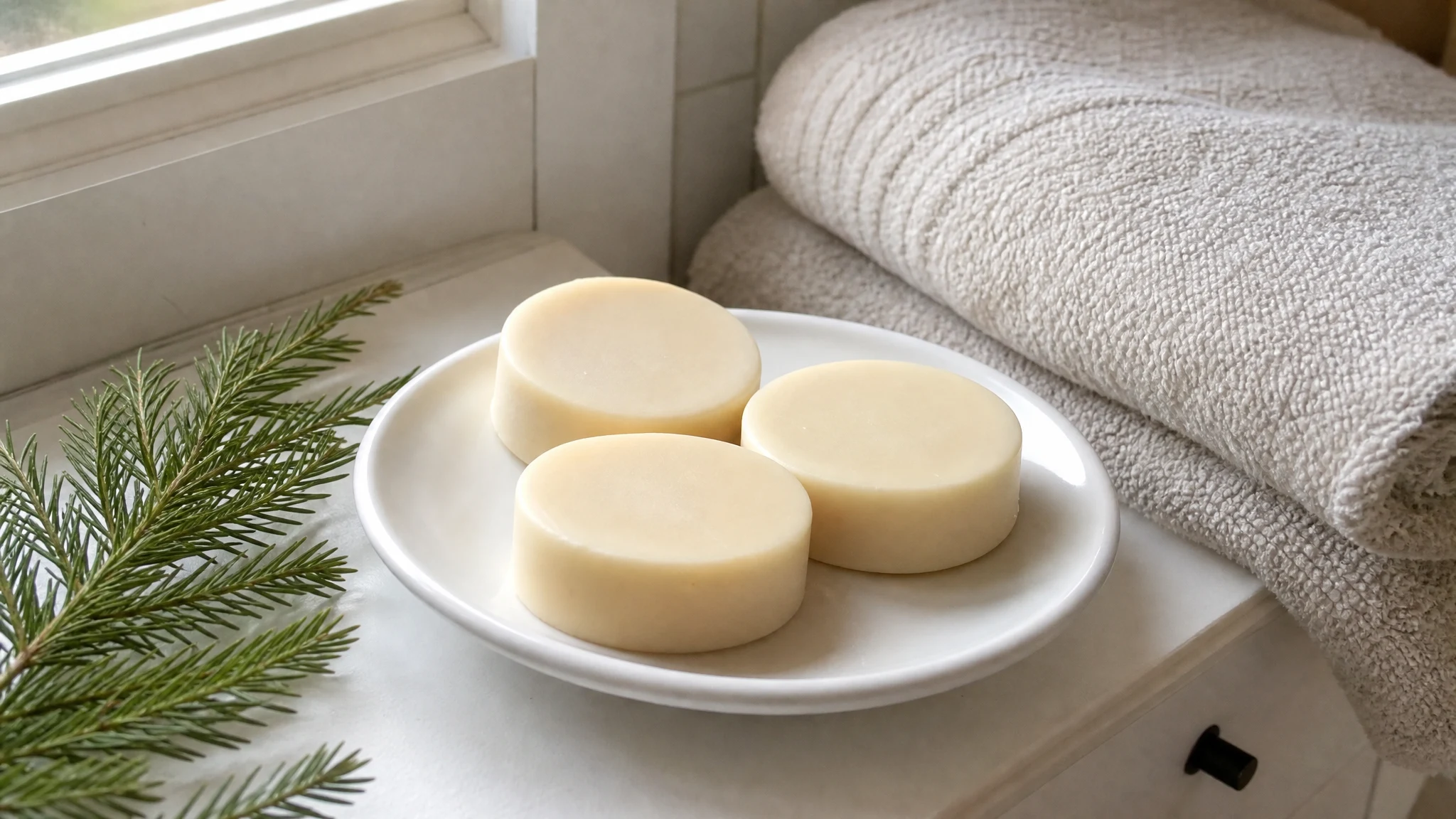
Fir Lotion Bars: Three Solids and One Dose of Oil
If you want to make your first fir body product, start with a lotion bar. It is wax, butter and a liquid oil poured into a mold, with no water anywhere, and that single fact removes most of the fuss. What is left is a lovely, simple exercise in order of work: the fir goes in last, and it goes in measured.

Fir Needle Essential Oil
Our own Fir Needle Essential Oil, in sizes from 0.5 oz to bulk.
From $10.99
Shop Now →Why no water makes it easier
Add water to a body product and you have a different job on your hands, because anything with water in it needs a preservative system, and choosing one is a conversation for a cosmetic chemist. We sell no preservatives, so a bar suits us well. FDA's guidance for small businesses makes homemade cosmetics sound as approachable as they are: making them at home is not against the law, they must not contain harmful microorganisms, and whoever puts their name on the label is responsible for being able to show the product is safe.
The bar stays dry only as long as you keep it dry, so a tin beats a wet shower dish. And if you ever plan to sell bars, the questions become labelling and safety substantiation; our labeling guide is a good place to start, and a regulatory consultant is the right place to finish.
What each ingredient does
Think of a bar as a stiff wax skeleton with softer fats tucked into it.
- Beeswax is the stiffener. More of it gives a harder bar that glides and leaves little residue.
- Shea butter is mostly oleic and stearic acid; one 2023 study in Foods measured crude shea at about 46% oleic and 44% stearic, with a melting point around 32 C, which is why it softens on warm skin.
- A liquid oil sets how soft and slippery the bar feels. More oil makes a softer, richer bar.
An equal-weight split of 30 g each is an easy place to begin because it scales without any fuss. If the bar is too hard, move 5 g from wax to liquid oil next time; if it smears, move it the other way. The fir dose does not change.
When the fir goes in
Wax needs real heat to melt, and fir needle oil is volatile and flammable. A technical sheet from the supplier Lebermuth for a steam-distilled Abies balsamea needle oil lists a flash point of 44 C (about 111 F). The Certificate of Analysis we publish for one batch of our oil gives density and refractive index but no flash point, so that is a figure for another supplier's oil, but it makes the point clearly enough for any conifer oil.
So the order matters. Melt the wax and shea in a water bath, stir in the liquid oil, then take the jug off the heat and away from any flame. Let the mix cool, stirring, to the lowest temperature at which it still pours, and only then stir in the fir. Pour straight away, since every minute in a warm open jug is fragrance leaving. Watch the surface for the first haze to know you are close to setting.
How much fir
Our dilution guidance for skin is 0.5% to 2% in a carrier. The Tisserand Institute lists 1% to 3% for body oils and lotions, 0.5% to 1.2% for facial products and 0.2% to 1% for sensitive skin. We would start at 1%, because a bar is rubbed on as a concentrated film.
| Strength | Oil in a 90 g batch | Drops | Per 30 g bar |
|---|---|---|---|
| 0.5% | 0.45 g | about 10 | 3 to 4 drops |
| 1% | 0.9 g | about 20 | 6 to 7 drops |
| 2% | 1.8 g | about 39 | 13 drops |
The drop counts use 0.924 for density from our published certificate and a rough 20 drops per milliliter. A scale reading to 0.01 g is better than counting drops.
The method
- Weigh 30 g beeswax, 30 g shea butter and 30 g liquid carrier oil into a heatproof jug. A craft or soap-making supplier carries all three, and the mold.
- Melt the wax and shea in a water bath, then stir in the liquid oil and remove from the heat.
- Cool to the lowest pourable temperature, stir in 0.9 g (about 20 drops) of fir oil for 1%, and pour into three cavities.
- Leave to set undisturbed, then patch test on the inner forearm and wait a day. Our skin and pet basics post has the method.
Who it suits, and keeping it fresh
A bar lasts only as long as its shortest-lived ingredient. We say conifer oils typically keep 1 to 2 years, capped, cool and dark, and a carrier oil may be shorter, so write the date on the tin and use the bar up within months. If you are making it as a gift, shea comes from a tree nut, so anyone with a tree nut allergy should ask an allergist first, and bars are a thoughtful fit for the hands and body rather than the face, given Tisserand's lower facial range. Reactive skin is a conversation for a physician, and for children and pets, a pediatrician or veterinarian.
More bar ideas sit in our holiday gifts roundup, and the numbers behind the dose are in fir needle oil and IFRA.
Three solids, one measured dose and a pour you can watch: that is a very good first fir body product.
Fir Needle Essential Oil
Fir Needle Essential Oil from our own shop, in sizes from 0.5 oz to bulk.
From $10.99
Shop Now →Sources & Further Reading
- Tisserand Institute, Essential oil dilution guidelines. https://tisserandinstitute.org/safety/dilution/
- Abdel-Razek AG et al., Effect of refining and fractionation on minor components, fatty acids, antioxidant and antimicrobial activities of shea butter, Foods 12(8):1626, 2023. https://pmc.ncbi.nlm.nih.gov/articles/PMC10137687/
- US FDA, Small Businesses and Homemade Cosmetics: Fact Sheet. https://www.fda.gov/cosmetics/resources-industry-cosmetics/small-businesses-homemade-cosmetics-fact-sheet
- The Lebermuth Company, Technical Data Specification, Fir Needle Canadian Oil (50-6125-02), issued October 25, 2022. https://docs.lebermuth.com/download/public/50-6125-02/Technical%20Data%20Specification.pdf