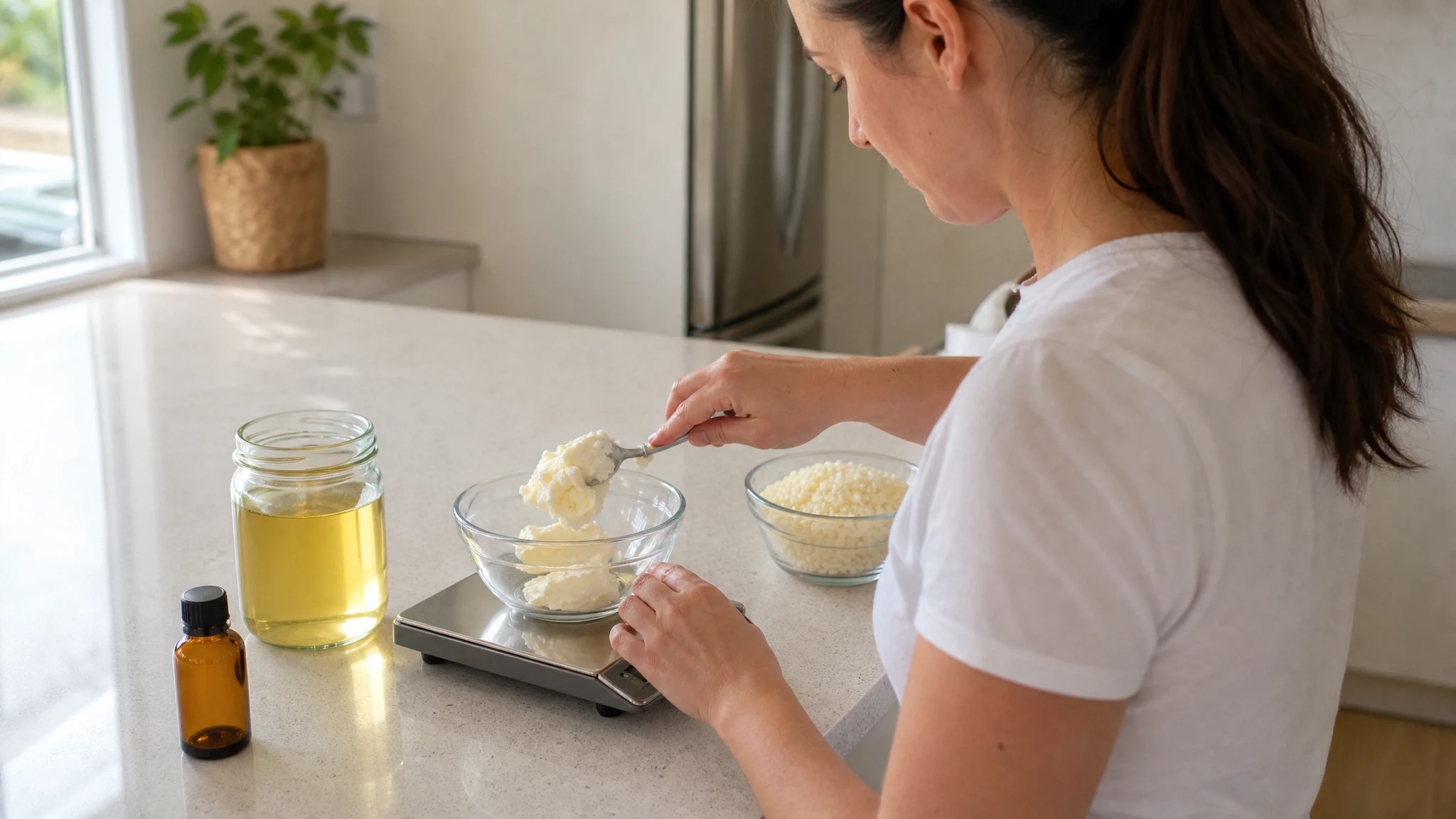
Formulating With Fir Oil: Start With the Product
Choose the product before you choose the dose, because the product sets the ceiling, not the oil. A rinse-off bar, a body lotion and a facial product sit under different limits, and a melt-and-pour base brings its own rules from whoever made it. Our fir needle oil is sold undiluted, so every percentage below is arithmetic you do yourself, and this page gives the order to do it in.

Fir Needle Essential Oil
Our own Fir Needle Essential Oil, in sizes from 0.5 oz to bulk.
From $10.99
Shop Now →Name the product, then find who sets the limit
| Product | Who sets the ceiling |
|---|---|
| Melt-and-pour bar | The base maker's own sheet |
| Cold-process bar or other wash-off product | IFRA category limits for restricted materials; Tisserand Institute lists 2% to 4% for bath and wash-off products |
| Body lotion or body oil | IFRA category limits; Tisserand Institute lists 1% to 3% |
| Facial product | Tisserand Institute lists 0.5% to 1.2% |
| A skin oil made with our oil | Our guidance: 0.5% to 2% in a carrier oil |
The ranges come from the Tisserand Institute's dilution page. IFRA limits depend on the material and the product category, and your oil supplier's IFRA paperwork is where they appear; our usage-rate guide shows how to turn a limit into grams.
Take the lowest number that applies
If the base maker says 2%, the Tisserand range says up to 4% and a supplier certificate says something lower, the lowest figure is your ceiling. That one habit settles most formulating arguments before they start.
Add the oil late and cool
Fir needle oils are rich in light, volatile terpenes, so the rule of thumb is to add the oil as late and as cool as the process allows. Process temperatures come from the people who made your base or wax, so read their sheet.
- Melt-and-pour. Add after the base has melted, as close to pouring as you can manage.
- Cold-process soap. The decisions around lye contact are covered in our cold-process post; here we only fix the amount.
- Lotions and creams. Your preservative and emulsifier data sheets state a maximum add temperature. The oil goes into a phase cooler than that.
- Anhydrous balms and bars. With no water phase, add at the lowest temperature at which the mix still pours. The lotion bar post works through one, and the melt-and-pour post covers a bar.
Freshness is a buying question
There is one fir-relevant rule on file. IFRA's 1994 standard on Pinacea derivatives covers essential oils from the pine family, including the genera Pinus and Abies. It asks that such oils be used only when peroxides are kept as low as practicable, for example by adding antioxidants at production, and sets a peroxide value below 10 millimoles per litre. It exists to manage skin sensitisation.
In everyday terms: fresh oil is better oil. Our certificate for one batch gives a density of 0.924 and a refractive index of 1.468 and does not include a peroxide value, so if that number matters for your product, ask us in writing through the contact page. Meanwhile we recommend keeping the bottle capped, cool and dark, and using it within the 1 to 2 years we typically give for conifer oils.
Know what your product is
The FDA decides whether something is a cosmetic or a drug by its intended use. Its soap FAQ says a product counts as soap only if it is made mainly of alkali salts of fatty acids, cleans through those salts alone and is marketed only as soap, and it gives "making the user smell nice" as an example of a cosmetic use. So describe what the product is and how it smells, and leave disease language out. What your particular bar or lotion must say on its label is a question for a regulatory consultant.
Run a split test before the real batch
Treat everything here as a plan, because the formulas are yours to make. The method that costs least:
- Weigh rather than count drops. A drop of our oil is roughly 0.046 g, based on about 20 drops per millilitre and the 0.924 density of that batch; the real figure varies by dropper.
- Make three 100 g cups of your base at 0.5%, 1% and 2%, wherever your lowest ceiling allows: 0.5 g, 1.0 g and 2.0 g of oil.
- Change nothing else between cups, and label them with the oil's lot number.
- Smell blind at day 1, day 7 and the end of any cure, and note the winner.
- Patch test the finished product on your own skin before it goes to anyone else.
If scent fades during cure, the scent-retention guide has ideas, and partner oils are in the soap blends post. We sell only the fir needle oil, so bases, butters, waxes, preservatives and solubilisers come from a soap or cosmetic supplier.
If you are unsure which row of the table your product belongs in, settle that first and write the ceiling down before you open the bottle.
Fir Needle Essential Oil
Fir Needle Essential Oil from our own shop, in sizes from 0.5 oz to bulk.
From $10.99
Shop Now →Sources & Further Reading
- Tisserand Institute (R. Tisserand), undated. Recommended dilutions. tisserandinstitute.org/safety/dilution
- IFRA, 1994. IFRA Standard, Pinacea derivatives (Amendment 28). ifrafragrance.org/IFRA_STD_184
- FDA, 2024. Frequently Asked Questions on Soap. fda.gov/cosmetics