Keeping Fir's Crisp Scent in Your Soap
Open a bottle of fir and the whole room turns into a December hillside. Stir it into a batch of soap, and a few weeks later the bar can smell like very little at all. Where did the forest go?

Fir Needle Essential Oil
Our own Fir Needle Essential Oil, in sizes from 0.5 oz to bulk.
From $10.99
Shop Now →The lightest notes leave first
Fir needle oil is a crowd of compounds, and they do not all evaporate at the same pace. Look at a study of silver fir oil by Garzoli and colleagues, who sampled the air above the oil as well as the oil itself. The vapour was richer in the quick, piney alpha-pinene (51.3% against 30.8% in the liquid) and had almost none of the heavier bornyl acetate (0.4% against 4.2%). The boiling points tell the same story: alpha-pinene boils at about 155 to 156 C, limonene at 176 C and bornyl acetate at 223 to 224 C.
In plain terms, the first thing you smell from fir is its lightest, brightest side, and that is also the part most ready to drift away from warm soap and an open curing rack. That is reasoning from one analysed oil, not a measurement in soap, but it explains why a fir bar can go from bold to soft while the deeper woody backbone lingers.
Habits that help
None of these is magic, and all of them follow from the chemistry above.
- Start with a fresh bottle. Oxidation changes conifer oils as they age, and light, heat and moisture speed it up. The Tisserand Institute notes that most oils keep at least a year or two, and that cool storage helps. Keep the cap tight and the bottle in a cool, dark spot.
- Add the oil late and cool. Stir it in at emulsion or very light trace rather than while everything is hot. Less time warm means less time evaporating.
- Weigh it. One soap-maker chart suggests about 13 g of fir needle per pound of oils, roughly 3% of the oil weight (a pound is about 454 g), and Tisserand lists 2% to 4% as a general range for wash-off products. A little more is not a retention strategy, so weigh, stay in range and let the bar do the rest.
- Cut generous bars and cure them covered. Less surface per gram means slower loss. That is common sense about evaporation rather than a tested figure, but it costs nothing.
- Give fir a heavier partner. A slower woody oil gives the blend a base that outlasts the sparkle. Cedarwood is a common soap-making choice. We sell only our fir needle oil, so a partner oil comes from a soap-making supplier; our fir soap blends post covers ideas.
The soap itself is part of the picture, too. Lye soap is a very different environment from a candle or a diffuser, and the lye-stage details are in our cold-process soap walkthrough. If you are using a melt-and-pour base, the melt-and-pour recipe keeps things gentler, because there is no lye stage to work around.
A side-by-side you can run
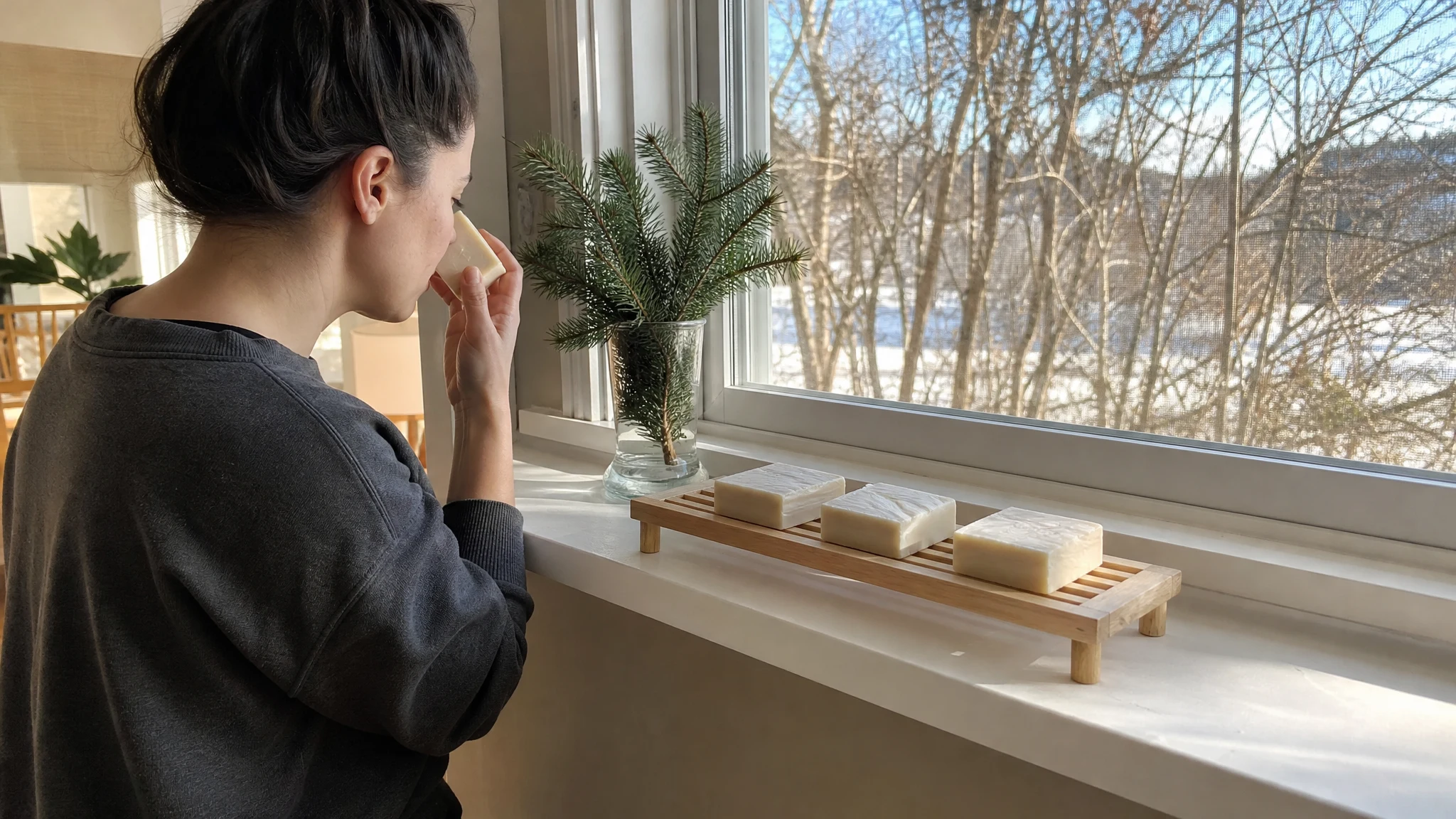
If you want to know what helps in your own kitchen, split one batch into three equal parts before adding oil. Weigh the same amount into each, change one thing in two of them (the add temperature, or a heavier partner oil), label each with its date and oil batch, and ask someone else to sniff them blind at day one, a week in and after the cure. Run it twice before changing your recipe, since one nose and one batch prove very little.
The chemistry behind why fir smells the way it does is in our bornyl acetate post, and our storage guide covers keeping that bottle fresh. Handle lye with eye protection and gloves, and patch test a finished bar on your own skin before gifting it.
A good fir soap is one where the first sniff of the cured bar still takes you back to the trees, and a little patience with timing and weights gets you there.
Fir Needle Essential Oil
Fir Needle Essential Oil from our own shop, in sizes from 0.5 oz to bulk.
From $10.99
Shop Now →