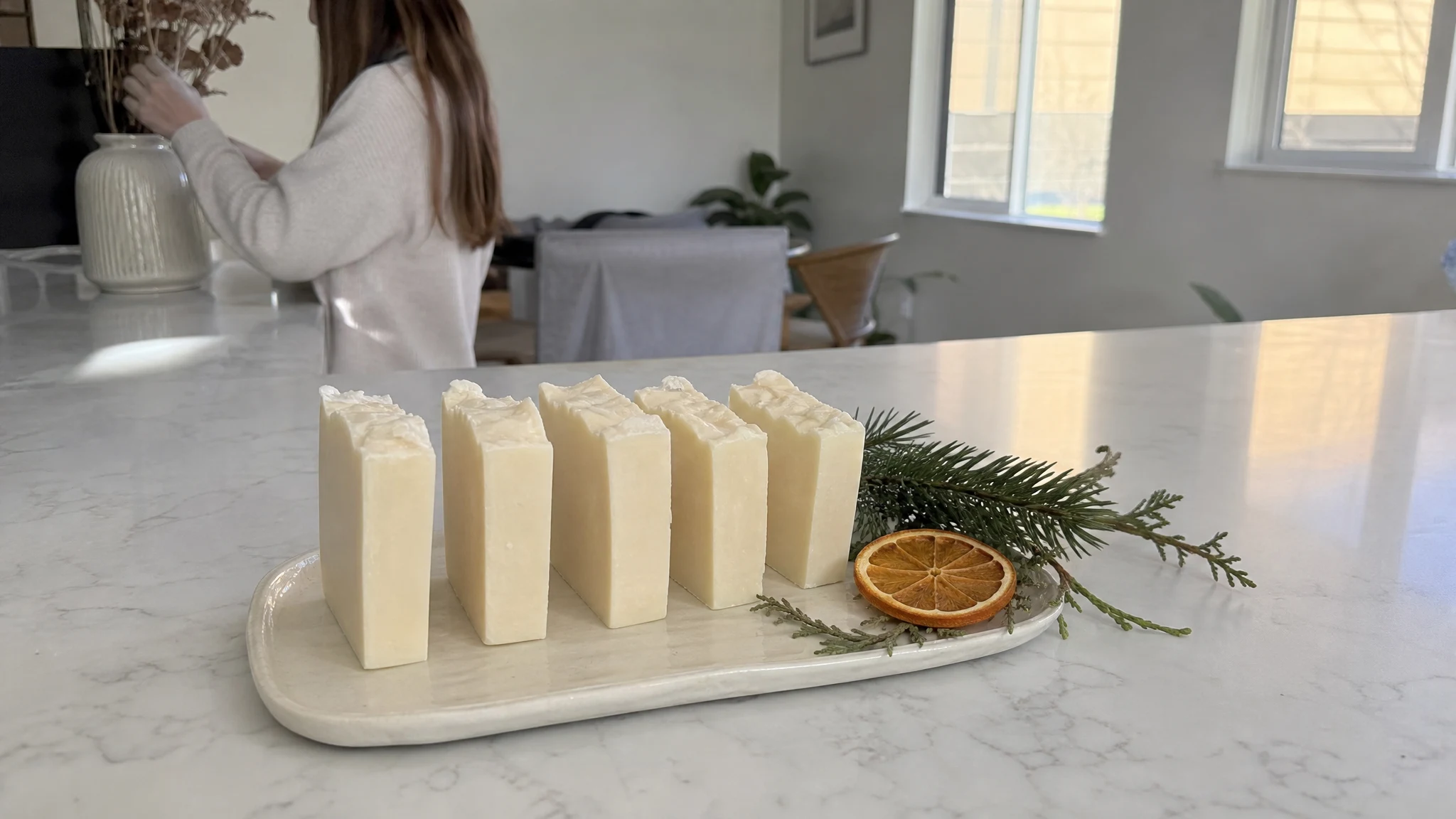
Fir Soap Blends: Six Starting Ratios Built on a Rate Budget
Weigh your blends and never count drops, and set the whole-blend rate before you pick any ratio. If the soap takes 4.54 g of scent per 454 g (1%), that figure is the budget, and every partner oil spends part of it. Below are six starting ratios worked from that budget. We have not made any of them, so each one is a formulation to test in a small batch, not a proven recipe.

Fir Needle Essential Oil
Our own Fir Needle Essential Oil, in sizes from 0.5 oz to bulk.
From $10.99
Shop Now →Fix the budget, then divide it
A blend ratio means nothing until it is tied to the total. The order that avoids mistakes:
- Total rate. For a melt-and-pour base, the base maker's figure (the melt-and-pour recipe compares four sources and starts at 1%). For cold process, the Tisserand Institute range for wash-off products is 2% to 4% for a single oil, and wash-off products do not linger on skin, which is why the range sits above the leave-on body range of 1% to 3%. We start at 1% for either.
- Shares by weight of the oil total. Fir 60%, partner 40%, and so on.
- Each oil's share of the finished soap. Share times total rate. A partner at 40% of a 1% blend is 0.4% of the bar.
- Check that figure against the partner's own safety documents, not ours.
Weighing matters because drops are not a unit of weight. Our own copy implies about 20 drops per millilitre, and our certificate gives a density of 0.924, so one drop of our oil is about 0.046 g; a thinner or thicker oil, or a different dropper, changes that. A blend counted at 12 drops to 8 is not a known 60:40 by weight. A 0.01 g scale removes the question.
Six starting blends
All amounts are grams of oil per 454 g of base at a 1% total (4.54 g). The partners are the oils our product pages name as blends for fir; we sell none of them, and they come from a supplier of your choice. Scale up or down by the same percentages.
| Blend | Fir | Partner(s) | Partner share of finished soap |
|---|---|---|---|
| A. Woods | 60%, 2.72 g | Cedarwood 40%, 1.82 g | 0.4% |
| B. Fir and orange | 70%, 3.18 g | Sweet orange 30%, 1.36 g | 0.3% |
| C. Fir and lavender | 70%, 3.18 g | Lavender 30%, 1.36 g | 0.3% |
| D. Cool wash | 85%, 3.86 g | Peppermint 15%, 0.68 g | 0.15% |
| E. Resin and wood | 60%, 2.72 g | Frankincense 20%, 0.91 g; cedarwood 20%, 0.91 g | 0.2% each |
| F. Cabin | 50%, 2.27 g | Cedarwood 30%, 1.36 g; sweet orange 20%, 0.91 g | 0.3% and 0.2% |
Why these ratios: fir is at least half of every blend so it stays recognisable, and the strongest or most cautioned partner (peppermint) gets the smallest share. That is our scent judgment and a safety-minded recommendation, not a measured result. No vapour pressure data for the partner oils' constituents was gathered for this article, so it cannot rank which partner will outlast fir in the bar; for retention, see the scent-retention guide. The twelve-partner scent map is in the live blending post, which this page does not repeat.
Scaling up: a worked example
For a 1.5 kg batch at a 1% total, the budget is 15.0 g. Blend F then needs 7.5 g of fir (50%), 4.5 g of cedarwood (30%) and 3.0 g of sweet orange (20%). In volume terms the fir is 7.5 g divided by 0.924, about 8.1 mL, but you should not measure it that way: weigh each oil into the same cup on the scale, zeroing between additions, so a small overshoot of one oil is visible at once. If you overshoot a partner by 0.2 g in that batch, the soap carries about 1.01% scent instead of 1%, which is small, but note it on the batch sheet instead of rounding it away.
The two cautions that actually change a recipe
Citrus and sunlight. IFRA's guidance lists, among oils with phototoxicity Standards, bergamot oil expressed, bitter orange peel oil expressed, grapefruit oil expressed, lemon oil cold expressed and lime oil expressed, with a general Standard titled citrus oils and other furocoumarins containing essential oils. Sweet orange does not appear by name in that table, but that is not clearance, because the Standard applies by furocoumarin content and the Standard's own text was not read for this article. The same guidance notes that phototoxicity considerations were traditionally not applied to rinse-off products, with restriction limits for rinse-off added so far only for tagetes oil and methyl N-methyl anthranilate. As reasoning, a citrus partner in a wash-off bar is a smaller issue than the same oil in a leave-on lotion, but ask for the certificate for the exact oil. IFRA's 52nd Amendment consultation outcome (31 August 2026) renames the furocoumarin Standard "Furocoumarins in Natural Complex Substances" and merges eight individual ones into it, so check which Amendment your paperwork cites.
Peppermint and children. The Tisserand Institute's page on peppermint and eucalyptus for children says peppermint "can potentially slow breathing in small children". A reader there quoted Robert Tisserand's book as saying not to apply it to or near the face of infants or children, and he answered that the page's update did not mean the book advice was wrong. So Blend D is not for a children's bar or for a face wash. Ask a physician or pharmacist about specific cases; the page is not a ruling on any one product.
For cedarwood, ask the supplier for the Latin name on the certificate, since the common name alone does not say which species you hold. Frankincense is the same.
What could not be sourced, so it is cut
No primary source was found for claims that particular oils discolour soap or accelerate trace, so there is no discolouration guidance here. Whatever you use, run a one-cup test and look at the cup again after a week.
Check the blend, then the batch
- Per-oil limits. IFRA's guidance puts bar soap in Category 9 and tells you that when a product crosses categories the most stringent restriction applies. Each partner supplier should be able to state its Category 9 limit for the exact oil and Amendment. We have not published an IFRA certificate for ours; ask through our wholesale page before ordering if you need one, and expect to be told what is and is not available. The IFRA usage-rate guide shows how a percentage limit becomes grams.
- Test cup. Make 100 g of base with 1.00 g of blend (for blend B: 0.70 g fir, 0.30 g orange). Sniff at day 1 and day 7.
- Skin. Patch test a finished bar on yourself, as our product-page safety copy says. Keep soaps with any of these oils away from children and pets, and ask a veterinarian about animals: IFRA's guidance says its assessments cover human exposure, and that safety to pets is the manufacturer's responsibility.
The cold-process steps for the batch itself are in our cold-process post, and the order of decisions behind all of this is in the formulating guide.
Pick one blend, make a 100 g cup, and let the two-week smell decide whether it earns a full batch.
Fir Needle Essential Oil
Fir Needle Essential Oil from our own shop, in sizes from 0.5 oz to bulk.
From $10.99
Shop Now →Sources & Further Reading
- IFRA, 2023. Guidance for the use of IFRA Standards, 30 June 2023 (51st Amendment). ifrafragrance.org guidance PDF
- IFRA, 2026. End of consultation letter for the 52nd Amendment, 31 August 2026. ifrafragrance.org/latest-updates
- Tisserand Institute (R. Tisserand), undated. Recommended dilutions. tisserandinstitute.org/safety/dilution
- Tisserand Institute (H. Tisserand), undated. Peppermint and eucalyptus for children. tisserandinstitute.org/kids-inhalation-safety