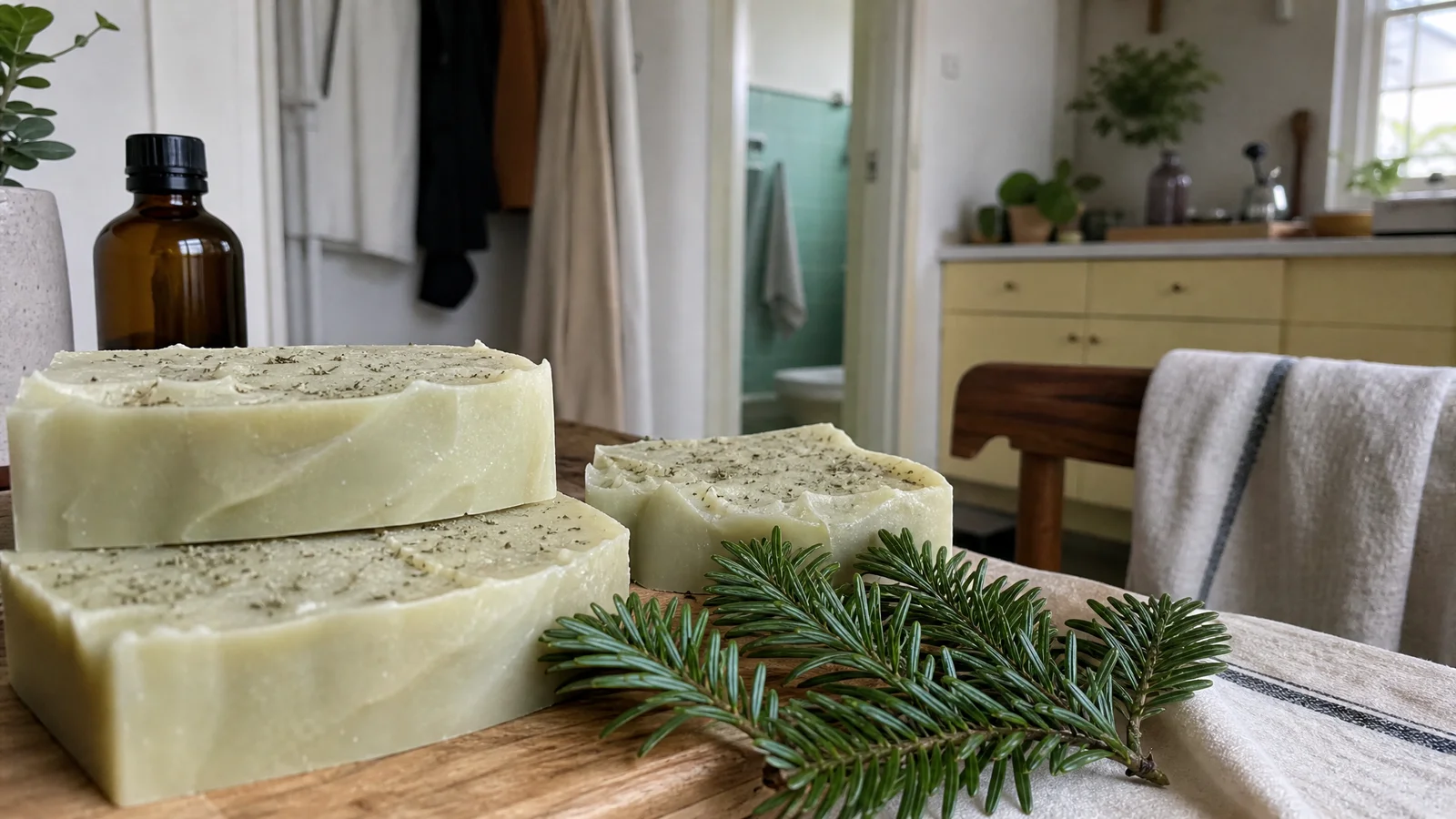
Cold Process Fir Soap: Getting the Oil Rate Right
Anyone who has searched for how much essential oil goes into cold process soap has met two different kinds of number. Soapmakers talk in grams per pound of oils, while skin guidance talks in percentages of a finished product. They look similar, and they are not the same thing. Sorting that out is the heart of making a good fir bar, and it comes right after one safety conversation.

Fir Needle Essential Oil
Our own Fir Needle Essential Oil, in sizes from 0.5 oz to bulk.
From $10.99
Shop Now →Lye first
Cold process soap is made by reacting oils with sodium hydroxide, which is lye. The US National Institute for Occupational Safety and Health lists sodium hydroxide as causing eye and skin burns and irritation, and advises flushing skin and eyes with water immediately, removing contaminated clothing, and seeking medical attention if it is swallowed. So wear splash goggles and long gloves, work where children and pets cannot reach, keep running water close, and if you have never handled lye, make a plain unscented batch with an experienced soapmaker or a class first. A scent decision is small beside that one.
Reading the rate
Soapmakers use PPO, or per pound of oils, where a pound is 454 g and only the oils count, not the water or lye. The Nerdy Farm Wife's essential oil chart lists fir needle at 13 g PPO, which it gives as 3%. It lists 18 g (4%) for cedarwood and black spruce and 2.7 g (0.6%) for clove leaf and cinnamon leaf, so the numbers move around a good deal from oil to oil. It is one soapmaker's working chart rather than a standard.
Skin guidance is calculated on another base. The Tisserand Institute lists 2% to 4% for bath and wash-off products, soap included, and our own skin guidance is 0.5% to 2% in a carrier. Because a batch weighs more than its oils alone, a percentage of the oil weight is a smaller percentage of the finished bar, so the two numbers fit together more comfortably than they first appear.
| Soaping oils | 1% of oils | 2% of oils | 3% of oils |
|---|---|---|---|
| 454 g (1 lb) | 4.54 g | 9.08 g | 13.62 g (about 14.7 ml) |
| 1,000 g | 10 g | 20 g | 30 g (about 32.5 ml) |
| 1,500 g | 15 g | 30 g | 45 g (about 48.7 ml) |
The milliliters use the relative density of 0.924 on the Certificate of Analysis we publish for one batch of our oil. Our suggestion is to start at 1% to 2% of the oil weight. That is a gentle bar with plenty of room to move up on the next batch, whereas a full 3% for a big batch is a lot of oil, so the chart's number is a choice to make deliberately. Whichever you choose, a finished, cured bar still deserves a patch test.
Order of work for the fir
- Weigh the oil in a small cup before the lye is mixed, on a scale reading to 0.1 g or better. Drops are too imprecise at these amounts.
- Jot down the rate, the oil weight and the percentage on your batch sheet, along with the bottle's batch number. When a bar surprises you, you will know exactly which number it was.
- Add the oil at emulsion or a very light trace; the Nerdy Farm Wife says to add essential oils just at emulsion or when the soap reaches a very light trace. It flags clove and cinnamon leaf as oils that speed trace and does not say that about fir, but keeping your mold ready is a sensible habit with any new oil.
- Stir through, pour and leave it alone, and do not add more oil to a batter that is already thickening.
- Cure, then smell. A day-two bar is not the bar you are making.
Soap or cosmetic
If bars stay at home, nothing changes. If you give them away or sell them, FDA's soap FAQ says a product is regulated as soap only if it is made mainly of alkali salts of fatty acids, those are its only cleansing agents, and it is marketed only as soap; a moisturizing or fragrance purpose makes it a cosmetic. A fir bar sold for its scent may be one or the other, and a regulatory consultant can say which. Our labeling guide lists the questions to ask.
What we leave to your calculator
We do not give lye, water or oil-blend figures here, because those belong to your own recipe run through a lye calculator you trust. Our post on scent in soap covers how much fir tends to survive the cure, and if you would prefer a lye-free first project, melt and pour uses the same careful arithmetic. For pairing fir with another oil, see soap blends; other oils come from other sellers, and each has its own rate and safety data.
For the patch test, lather the cured bar on the inner forearm, rinse, and watch for a day, as our skin and pet basics post describes. Keep finished bars away from small children who might mistake them for sweets.
Get the rate right on paper, weigh it on a scale, and a cold process fir bar becomes a very rewarding thing to cure.
Fir Needle Essential Oil
Fir Needle Essential Oil from our own shop, in sizes from 0.5 oz to bulk.
From $10.99
Shop Now →Sources & Further Reading
- CDC NIOSH, Pocket Guide to Chemical Hazards: Sodium hydroxide. https://www.cdc.gov/niosh/npg/npgd0565.html
- US FDA, Frequently asked questions on soap. https://www.fda.gov/cosmetics/cosmetic-products/frequently-asked-questions-soap
- The Nerdy Farm Wife, 30 essential oils for soapmaking, with printable chart. https://thenerdyfarmwife.com/essential-oils-for-soapmaking-chart/
- Tisserand Institute, Essential oil dilution guidelines. https://tisserandinstitute.org/safety/dilution/