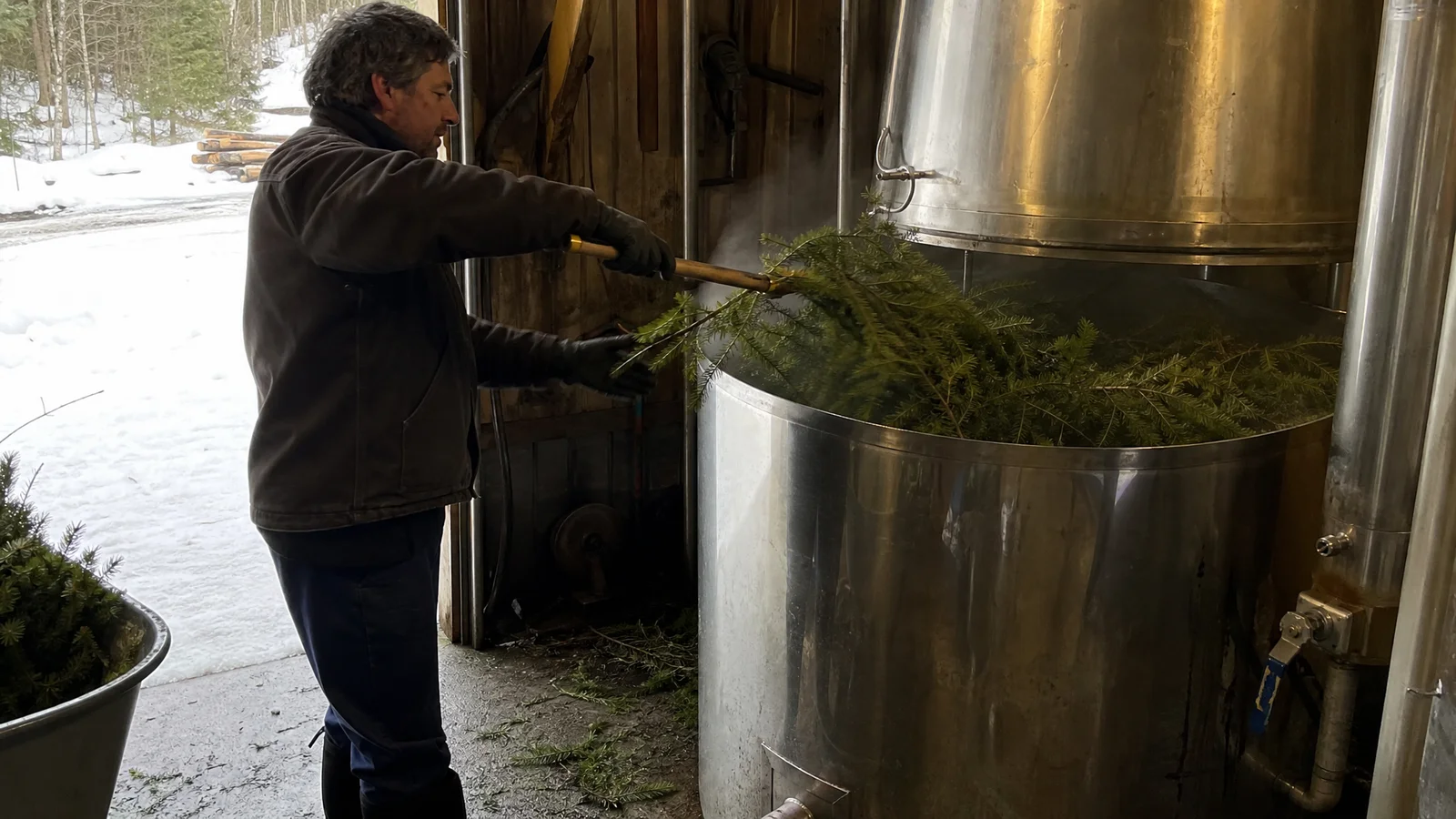
How Fir Oil Is Made, From Winter Boughs to Bottle
"Steam distilled" sits on nearly every fir oil label, which is exactly why it tells you so little. Behind those two words are choices that really shape the bottle: which part of the tree goes in, how long the run lasts, and how fresh the greenery is. Here is how fir oil comes to be and what published studies show about it.

Fir Needle Essential Oil
Our own Fir Needle Essential Oil, in sizes from 0.5 oz to bulk.
From $10.99
Shop Now →What the still is doing
Steam distillation passes steam through plant material so the aromatic compounds travel with it into a condenser. Because those compounds do not mix with water, they form their own layer once cooled and can be separated off. That layer is the essential oil, and for fir it floats: the batch on our published Certificate of Analysis has a relative density of 0.924, lighter than water. The certificate gives the extraction method as "Steam Distilled", and our product pages describe the oil the same way, made from balsam fir (Abies balsamea) needles with fine twigs.
Cut in the cold months
Our Distillation page describes boughs from the North American boreal forest, cut in the cold months as a by-product of the trimming that supplies the seasonal greenery trade. We like that story: the same boughs that become wreaths and garlands can also give an oil. Bottles carry a distillation date, a bottling date and a lot number, in amber glass.
Same words, different runs
Researchers who say "steam distillation" do not all do the same thing. Swor and colleagues hydrodistilled frozen subalpine fir foliage for four hours. Garzoli's group ran a silver fir oil for six. Ayupova and colleagues steamed 250 g of fresh Siberian fir needles for three hours, and a Moroccan fir study used three hours on needles dried for three days. Different species, different material and different timing, so this is not a league table of methods. It simply shows that a label is a category rather than a recipe.
Method can matter, though. In the Siberian fir study, bornyl acetate (the compound most associated with fir's balsamic character) came out at 30.63% by water-steam distillation and 40.00% with supercritical CO2, which shows how much the way an oil is made can shift its balance.
Why a small bottle holds a lot of branches
Oil yields are low. Swor's two subalpine fir trees gave 1.611% and 1.857% oil by weight of foliage in the lab; the Moroccan study reported 0.24%. At the higher lab figure, 1 kg of foliage gives about 16 g of oil. Using our certificate's density, a 16 oz bottle holds about 437 g, which would take roughly 27 kg of foliage at that yield. We do not publish production yields, so this is arithmetic for scale, not a statement about our run. It does explain why fir oil is a treat made from a great deal of tree.
Needles and twigs
Our pages describe needles together with fine twigs. In black spruce, a related conifer, earlier work cited by Francezon and Stevanovic reported a needle oil yield of 1.3% against 0.3% for twigs, and needle oil rich in bornyl acetate while twig oil had very little. That is a different genus, so we offer it only as a hint that the mix in the charge can shape the aroma. If it matters for your formula, ask us through our contact page before you order.
The water layer is its own thing
What condenses beneath the oil is a hydrosol, and it is not a weak version of the oil. In the black spruce study it was made up of oxygenated monoterpenoids, with alpha-terpineol the main one, and it held little of the hydrocarbons that dominate the oil. We do not sell fir hydrosol.
Three questions worth asking any seller
- Which species, and which part: needles, needles and twigs, or branches?
- Is there a distillation date and lot number on the bottle?
- Is there a composition report for the lot, and who ran it?
Our listing guide, quality checks and GC-MS reading guide take those questions further, and our cost-per-batch piece shows how to compare bottles fairly.
Next time a fir bottle says steam distilled, you will know there is a whole forest of detail behind it.
Fir Needle Essential Oil
Fir Needle Essential Oil from our own shop, in sizes from 0.5 oz to bulk.
From $10.99
Shop Now →Sources & Further Reading
- Wikipedia. Steam distillation. en.wikipedia.org/wiki/Steam_distillation
- Swor et al., 2023. Molecules 28(6):2477. pmc.ncbi.nlm.nih.gov/articles/PMC10057033
- Garzoli et al., 2021. Pharmaceuticals 14(2):134. pmc.ncbi.nlm.nih.gov/articles/PMC7914598
- Ayupova et al., 2025. Pharmaceutics 18(1):26. pmc.ncbi.nlm.nih.gov/articles/PMC12845231
- El Bakkali et al., 2026. Scientific Reports 16:6904. pmc.ncbi.nlm.nih.gov/articles/PMC12917149
- Francezon and Stevanovic, 2017. BioResources 12(2):2635-2645. bioresources.cnr.ncsu.edu