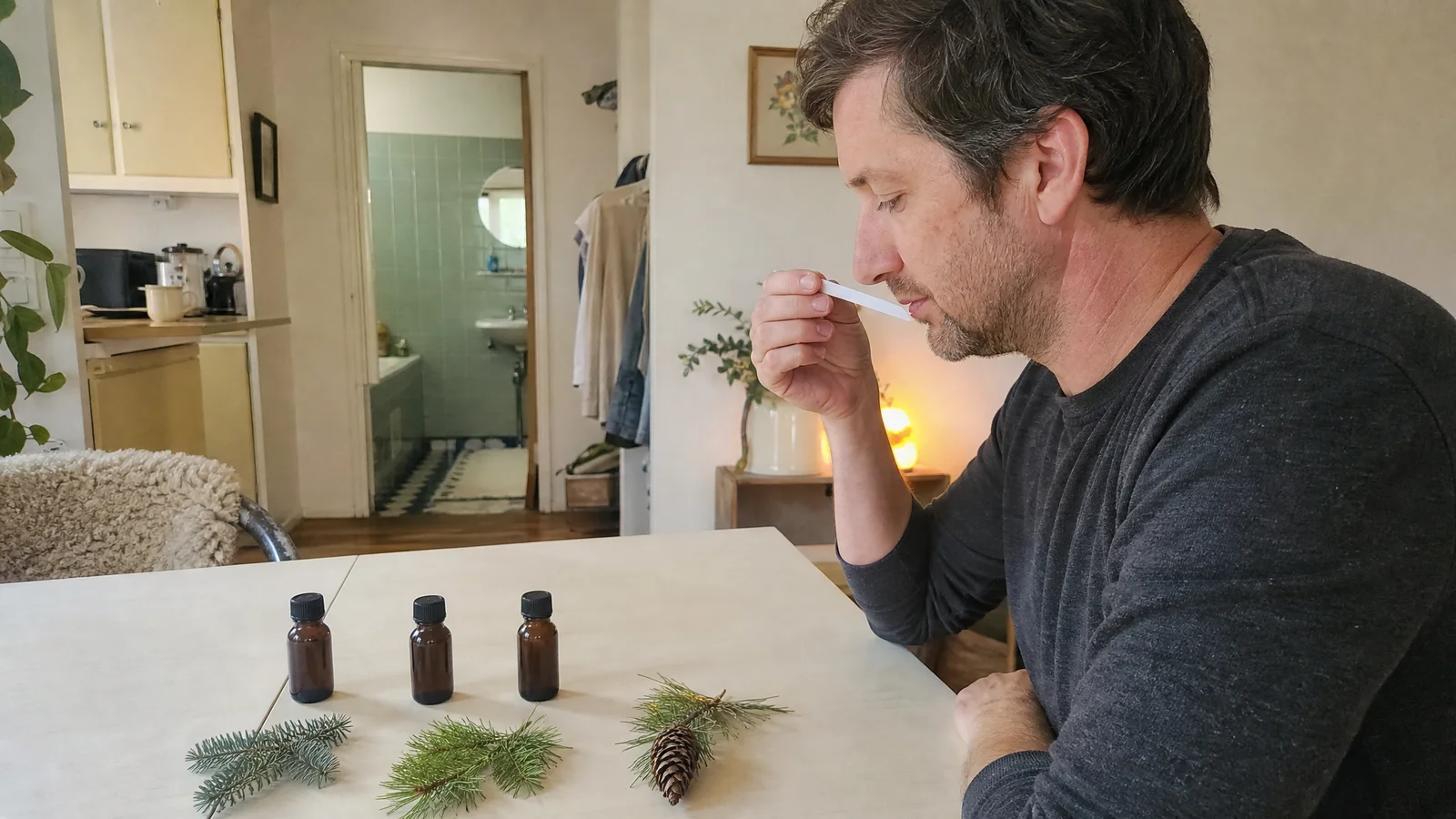
Balsam, Siberian and Douglas Fir: Three Different Trees
Douglas fir is not a fir. That single fact is why the three names in this title do not line up the way a shelf label suggests. Balsam fir is Abies balsamea, Siberian fir is Abies sibirica, and Douglas fir is Pseudotsuga menziesii, a different genus that its species page calls "not a true fir". Picking among them by common name means comparing different trees, so here is how they differ and which one is in our bottle.

Fir Needle Essential Oil
Our own Fir Needle Essential Oil, in sizes from 0.5 oz to bulk.
From $10.99
Shop Now →Where each tree lives
Balsam fir is a tree of the north: its range runs from Newfoundland west to central Alberta and across the northeastern United States. The Siberian fir in the studies below came from East Kazakhstan, and the Douglas fir from Idaho. Place matters because oil composition moves with where and how the needles were gathered.
What each oil leads with
Different laboratories, plant parts and methods are involved, so read these as snapshots, not a controlled race. Balsam fir oil in a 2006 analysis had beta-pinene, delta-3-carene and alpha-pinene as its main components (Pichette et al.). Steam-distilled Siberian fir branch tips led with bornyl acetate at about 31 percent, followed by camphene and alpha-pinene (Ayupova et al., 2025). Needles from three Rocky Mountain Douglas firs in Idaho gave bornyl acetate between about 39 and 41 percent (Swor et al., 2023).
Two things follow, both as reasoning and not as findings. The pairing most buyers expect, Siberian and balsam as close needle cousins, does not show up in these numbers, since the Siberian sample leads with the same compound as the Douglas fir. And those are single studies in single places, so none of this says Douglas fir smells like Siberian fir. What it does say is that a name narrows the field and a lot document narrows it further. Even trees in one area differ: two subalpine firs in the same Idaho study had limonene 14 points apart.
What about the scent itself?
The papers report chemistry, not smell panels, so we will not rank the three by aroma. We describe our fir needle oil as crisp, resinous and evergreen, like freshly cut boughs, with a sweet balsamic depth. If you can, smell samples from sellers who name the species, and trust your own nose.
The one we sell
We sell a single oil, Fir Needle Essential Oil, undiluted, and the Certificate of Analysis we publish for one batch names Abies balsamea, with a relative density of 0.924 and a refractive index of 1.468. We do not sell Siberian fir, Douglas fir, silver fir or fir absolute. If you want one of those, buy from a seller who names the species and the plant part. Our absolute comparison explains why fir absolute and Canada balsam are separate materials from the steam-distilled oil.
Choosing by situation
- Following a recipe that names a species: use that species, or treat a swap as a new formula and start at a lower load.
- Building a fir scent from scratch: pick one oil, write down its species, supplier and lot, and compare on paper strips. Our scent profile is a good companion.
- Selling what you make: the species goes on your label and in your file, and the lot document matters even more. Our labeling guide covers naming.
- Chasing a fir fragrance oil match: that is a different material, covered in our comparison.
On skin use, our guidance is to dilute to between 0.5 and 2 percent in a carrier oil, patch test first, and keep the oil away from eyes, children and pets. It is not for internal use, and anyone with a medical question, a pregnancy or a pet should ask a physician or veterinarian first.
The better question is rarely which forest is best, and more often which one is in your bottle.
Fir Needle Essential Oil
Fir Needle Essential Oil from our own shop, in sizes from 0.5 oz to bulk.
From $10.99
Shop Now →Sources & Further Reading
- Douglas fir - Wikipedia
- Abies balsamea - Wikipedia
- Composition and antibacterial activity of Abies balsamea essential oil (Pichette et al., Phytotherapy Research, 2006)
- Comparative Phytochemical Profiling of Essential Oils from Selected Abies Species and Analysis of Their Antifungal and Antiradical Activity (Ayupova et al., Pharmaceutics, 2025)
- Gymnosperms of Idaho: Chemical Compositions and Enantiomeric Distributions of Essential Oils of Abies lasiocarpa, Picea engelmannii, Pinus contorta, Pseudotsuga menziesii, and Thuja plicata (Swor et al., Molecules, 2023)