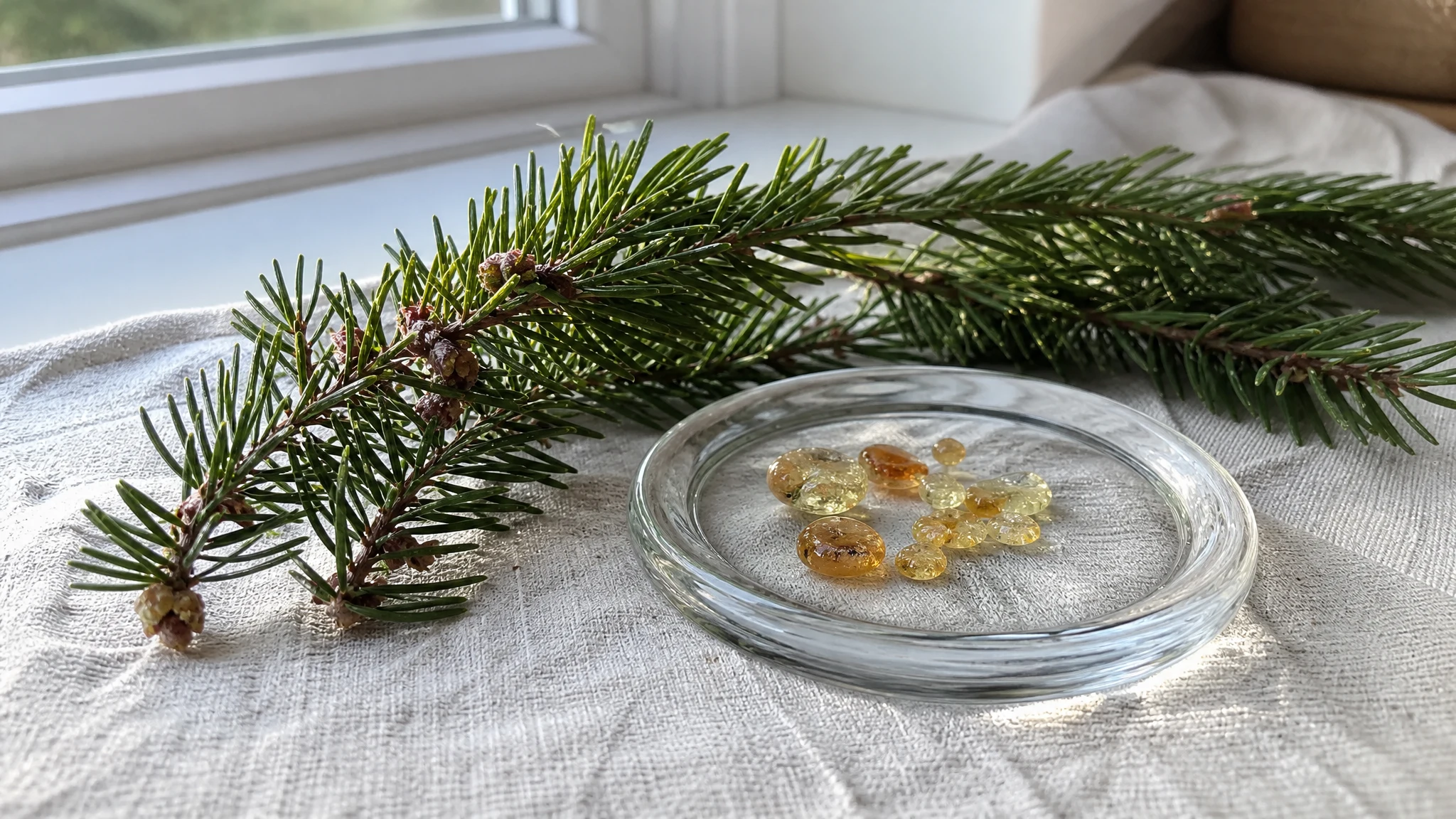
Fir Oil, Fir Absolute or Canada Balsam: Which One Is It?
"Balsam fir" on a listing can mean three quite different things: a free-flowing oil steam distilled from needles, a pasty green-brown absolute made with solvents, or a sticky resin tapped from blisters in the bark. They share a tree and very little else. We sell the first, and the quickest way to tell them apart is to read the listing the way a chemist would, starting with how the material was made.

Fir Needle Essential Oil
Our own Fir Needle Essential Oil, in sizes from 0.5 oz to bulk.
From $10.99
Shop Now →Three materials from one tree
The needle oil. This is ours: steam passes through the needles, carries the aromatic part over, and the oil is separated from the water. The certificate we publish for one batch names Abies balsamea and describes the oil as a brown liquid with a relative density of 0.924 and a refractive index of 1.468. The story of how it gets from bough to bottle is in our post on making fir needle oil.
The absolute. An absolute starts as a solvent extract and is then purified with ethanol. The French producer Biolandes lists a balsam fir absolute made from needles by exactly that route. Its technical data sheet describes a pasty, green-brown material with a woody, fruity, sweet, pine odour, and marks it "only for industrial use". It is a perfumer's raw material and behaves nothing like a pourable oil.
Canada balsam. This is the old-fashioned one. The 1911 British Pharmaceutical Codex describes an oleoresin that collects in blisters in the bark, which were punctured to harvest it. It is a pale yellow, viscous liquid that thickens over time and dries to a hard, clear varnish, and it is mostly resin with a smaller share of volatile oil. The USDA Forest Service notes the same thing from the tree's side: the oleoresin is confined to the bark blisters, and it was used for mounting microscope slides. That is closer to tree sap than to anything made from needles.
The numbers that give each one away
| Needle oil (ours) | Needle absolute | Canada balsam | |
|---|---|---|---|
| Made from | Needles, steam distilled | Needles, solvent extracted and purified | Resin from bark blisters |
| Looks like | Brown liquid | Green-brown paste | Pale yellow, viscous |
| Refractive index | 1.468 (our batch certificate) | Not on the sheet | 1.518 to 1.521 (1911 Codex) |
The refractive index is a handy tell. The Codex gives Canada balsam a figure near 1.52, which is why it was prized for slides: it behaves like glass. Our oil sits at 1.468. If a "fir balsam" listing quotes a number up near 1.52, you are looking at a resin, not the oil we sell. The two sources are a century apart and from different lots, so use the comparison for the big picture rather than the third decimal.
Which one are you buying?
Four quick checks will sort almost any listing.
- Look at the plant part. Needle points to an oil or absolute; bark or exudate points to a resin.
- Look at the process. "Steam distilled" means an oil; "solvent extraction" or "absolute" means a different product.
- Look at the form. A pourable liquid is an oil; a paste or a thick, sticky liquid is not.
- Ask for the batch paper. A certificate that names the species is a good start, and anything further your formula needs, such as GC/MS or safety documents, is worth asking for in writing before you order. You can ask us through the contact page.
If you make products to sell, one more detail matters: the ingredient name on a label follows the material. Biolandes lists its absolute under an INCI name that ends in "extract", so ask your supplier for the exact name of the exact material and do not borrow one from a different product. An absolute is also not a drop-for-drop swap for a free-flowing oil, and its usage rate should come from its own supplier's IFRA paperwork.
Smell and everyday use
For a household scent, the needle oil is the one that fits: it pours, it measures out by weight, and we describe it as crisp, resinous and evergreen, like freshly cut boughs. Our scent guide goes into what that means in practice, and the chemistry post looks at the molecules behind it. If you enjoy the history of the tree, the history of fir tells the resin story properly.
Our oil is sold neat, so on skin we recommend 0.5% to 2% in a carrier oil, a small patch test first, and no contact with eyes, children or pets. It is not for internal use. Absolutes and resins come with their own handling notes, so follow their suppliers. Anyone who is pregnant or has a medical condition should check with a physician before using any of them.
We sell one steam-distilled fir needle oil. If your formula calls for an absolute or Canada balsam, a perfumery or craft supplier that publishes its data sheet is the right place to buy it.
Fir Needle Essential Oil
Fir Needle Essential Oil from our own shop, in sizes from 0.5 oz to bulk.
From $10.99
Shop Now →Sources & Further Reading
- Biolandes, 2024. Fir Balsam Absolute Technical Data Sheet F1418, v2. biolandes.com/F1418
- Pharmaceutical Society of Great Britain, 1911. The British Pharmaceutical Codex, Terebinthina Canadensis, B.P. Canada Turpentine. henriettes-herb.com/bpc1911
- Frank R.M., 1990. Silvics of North America: Balsam Fir. USDA Forest Service. research.fs.usda.gov/silvics/balsam-fir