Fir Oil and the Forest: Questions Worth Asking
It takes about a kilogram of fir foliage to fill a half-ounce bottle. That one number changes how you think about the word "sustainable", because the real question about fir oil is where all that green comes from.

Fir Needle Essential Oil
Our own Fir Needle Essential Oil, in sizes from 0.5 oz to bulk.
From $10.99
Shop Now →Where our boughs come from
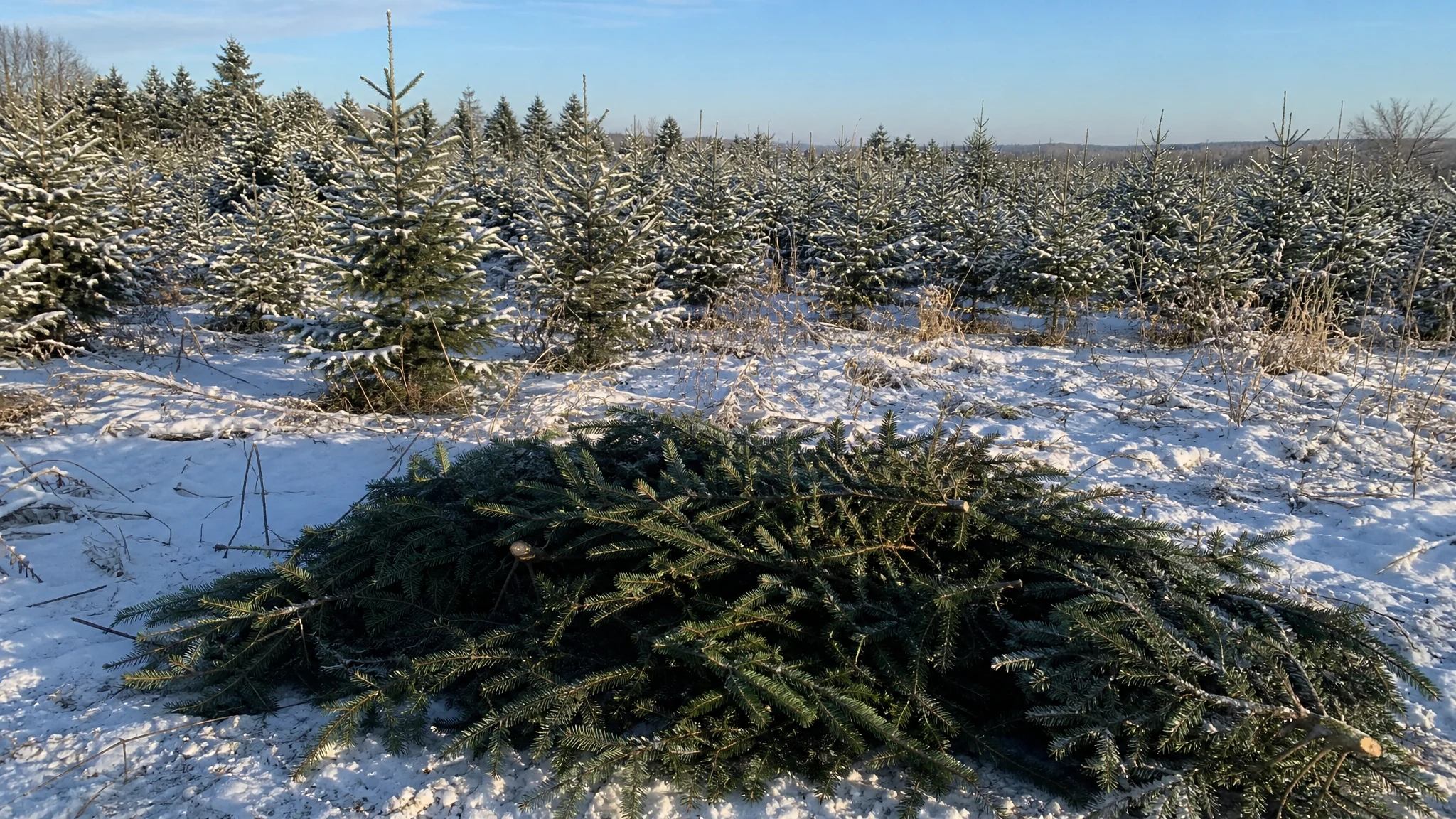
The oil we sell is steam distilled from balsam fir needles and fine twigs, and the Certificate of Analysis we publish for one batch names Abies balsamea. The boughs come from the North American boreal forest, are cut in the cold months, and are a by-product of the same trimming that supplies the seasonal greenery trade, bought from growers we deal with directly. That is a concrete, checkable kind of statement: material that already exists because of another harvest, not trees felled for oil. We do not hold a sustainability certification, and we keep to what we can describe.
The scale of a bottle
Yields depend on species, season and method, and we are not quoting one for balsam fir. For a sense of scale, a laboratory study of subalpine fir foliage by Swor and colleagues reported oil yields of about 1.6% to 1.9% by weight; a study of a Moroccan fir reported 0.24%. At 1.6%, a 0.5 oz bottle (about 13.7 g of oil at our batch's relative density of 0.924) corresponds to roughly 0.85 kg of foliage, and a 16 oz bottle (about 437 g) to roughly 27 kg. These are illustrations, not our yield, but they show why fir oil is a material question. The same bottle that fits in a pocket began as a good armful of boughs.
What the forest record tells us
The Forest Service's Silvics of North America entry for balsam fir is the standard reference. It describes a tree that favours cool northern forest, has been a favoured Christmas tree for over 400 years, and supports a wreath-making trade in some regions. It has little to say about oil, and nothing about bough cutting specifically, so we would not lean on it for claims about trimming. What the record does show is a species that is also shaped by pests: balsam fir is the preferred host of the eastern spruce budworm, and a 1957 Quebec outbreak killed over 75% of balsam fir in some stands, according to the study Wikipedia cites. Forest health depends on a lot more than any one use.
Questions to ask any fir oil seller
- Which species and which plant part, and does the paperwork say so? The batch COA we publish names Abies balsamea.
- Is the material a by-product of another harvest, or cut for the oil?
- Can the seller name the region and season of cutting?
- Is a third-party certification claimed, and by whom?
- How much foliage goes into a kilogram of oil?
The more specific the answers, the more useful they are. A seller who names the material, the season and the yield has told you something you can check, and one who offers a single adjective has not.
More on how it is made
For the distilling side, see how fir needle oil is made. Variety and sourcing are covered in our buying guide, and the trees themselves in meet the firs. Questions about our supply that this post does not answer are welcome through the contact page.
Those questions, asked of every bottle you buy, do more for the forest than any single word on a label.
Fir Needle Essential Oil
Fir Needle Essential Oil from our own shop, in sizes from 0.5 oz to bulk.
From $10.99
Shop Now →