Balsam, Siberian, White and Douglas: Which Tree Is Which?
Three of these trees are true firs, and one is an impostor. Douglas fir, despite the name, is not a fir at all, which is the first surprise on the way to reading a fir oil label.

Fir Needle Essential Oil
Our own Fir Needle Essential Oil, in sizes from 0.5 oz to bulk.
From $10.99
Shop Now →How to spot a fir
The genus Abies has roughly 48 to 65 species, depending on who counts, across mountains and cold regions of North and Central America, Eurasia and North Africa. Firs carry their needles singly on a round base, and their cones stand upright like candles. A gardening guide gives an easy field test: fir needles are flat and do not roll between your fingers, while spruce needles are four-sided and do. Pine needles come in bundles of two, three or five.
Douglas fir fails every one of those tests. Its genus name, Pseudotsuga, means "false hemlock", its cones hang down with long three-pointed bracts, and it is not a true fir, spruce, pine or hemlock. A label that says Douglas fir is naming a different genus.
The four trees
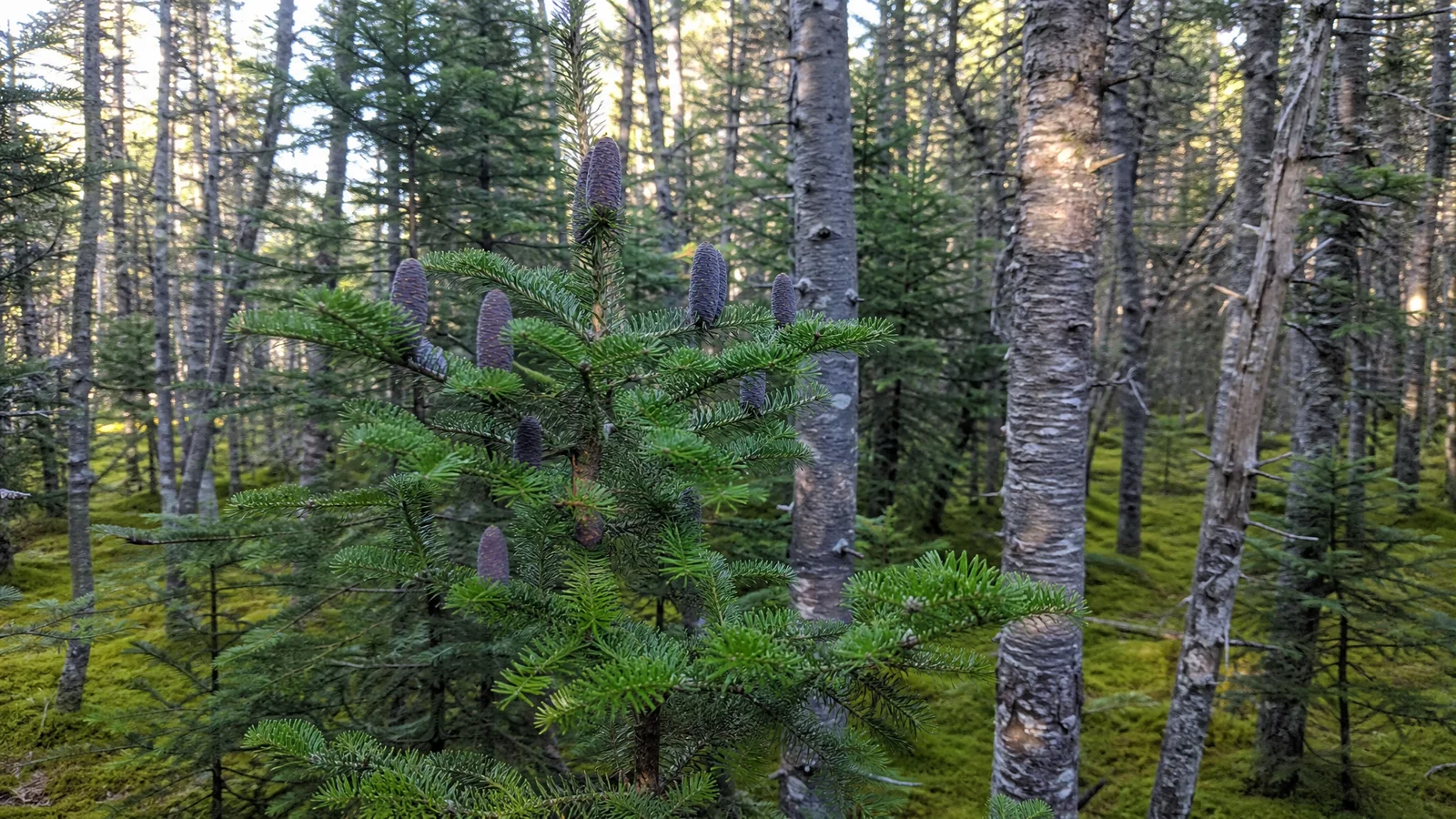
- Balsam fir (Abies balsamea) is the northern forest tree, growing from Newfoundland and Labrador west to northern Minnesota and through the Northeast, 12 to 18 m tall when mature. It is also the species named on the Certificate of Analysis we publish for one batch of our oil.
- Siberian fir (Abies sibirica) grows in the taiga east of the Volga, 30 to 35 m tall, with soft, flattened, strongly aromatic needles. A steam-distilled analysis of its branch tips found bornyl acetate at 30.63%.
- White fir (Abies concolor) lives in the mountains of western North America, from the southern Cascades to northern Baja California and east to Colorado and New Mexico. Its seed and cone oils have been measured directly, while needle oil is described only through earlier papers.
- Douglas fir (Pseudotsuga menziesii) is a western giant, 20 to 100 m tall. In a study of three Idaho trees, its oil ran 38.7% to 41.1% bornyl acetate.
The white fir gap
White fir shows how thin the data can be behind a familiar name. The one directly measured paper we could read analysed seeds and cones, not needles, from a roughly 40-year-old tree in a botanical garden in Poland. The seed oil was 47% limonene and 40% alpha-pinene. Reasoning from that, a bottle sold as white fir may not match any single published profile, and the same is true of other firs.
What the tree name tells you
Treat the name as a starting point and read three things next to it. The genus comes first: Pseudotsuga means Douglas fir, and Abies means a true fir. The plant part comes second, because needle, twig and branch-tip oils can differ; a paper on black spruce, a different genus, cites needle oil at 37% to 46.5% bornyl acetate against 1.3% in twig oil. Origin comes third: two subalpine fir trees from one Idaho site gave limonene at 20.3% and 34.6%.
That is why we put the Latin name and the plant part on every conversation about fir. We sell one product, a fir needle oil, and the batch certificate we publish names Abies balsamea. The other trees here are not ours. If your formula depends on a specific species or origin, contact us before ordering.
For how the oils of these trees compare, our species comparison picks up where this leaves off, fir versus pine covers the other look-alike, and our forest post covers the supply side.
Next time you walk past a Christmas tree lot, try the roll test on a needle: a flat one that stays put says fir, and you will feel like a forester.
Fir Needle Essential Oil
Fir Needle Essential Oil from our own shop, in sizes from 0.5 oz to bulk.
From $10.99
Shop Now →Sources & Further Reading
- Wikipedia: Abies
- Wikipedia: Douglas fir
- Wikipedia: Abies sibirica
- Wikipedia: Abies concolor
- Fine Gardening: Fir vs. Spruce vs. Pine, How to Tell Them Apart
- USDA Forest Service, Silvics of North America: Balsam Fir (Frank, 1990)
- Ayupova et al., Pharmaceutics 18(1):26, 2025
- Swor et al., Molecules 28(6):2477, 2023
- Wajs-Bonikowska et al., Molecules 2017
- Francezon and Stevanovic, BioResources 12(2):2635-2645, 2017