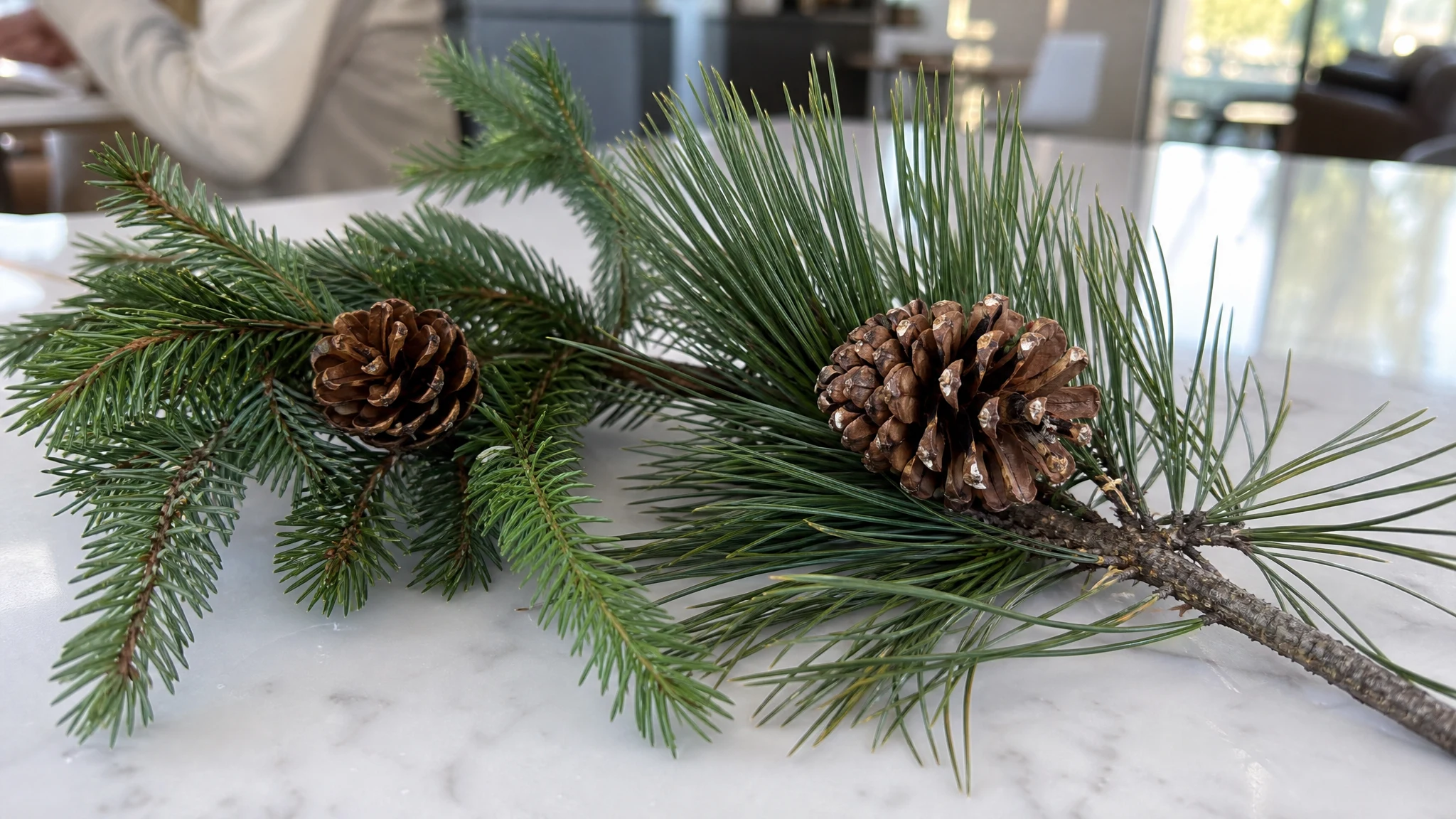
Fir or Pine? What Pine Oil Really Means on a Label
The word "pine" on a bottle does not always mean pine trees. In the cleaning aisle, "pine oil" is the name of a disinfectant ingredient, and it is a different material from an essential oil distilled from pine needles. Add the third meaning, a scent description on something with no pine in it, and you can see why it pays to sort the words out before choosing between pine and fir.

Fir Needle Essential Oil
Our own Fir Needle Essential Oil, in sizes from 0.5 oz to bulk.
From $10.99
Shop Now →Start with the tree
The trees are easy to separate by hand. According to a Fine Gardening guide, pine needles grow in bundles of two, three or five, while fir needles grow singly and are flat enough that they do not roll between your fingers. Pine is the genus Pinus and fir is Abies. Our fir needle oil is steam distilled from needles, and the certificate we publish for one batch names Abies balsamea.
What the two needle oils are made of
The fairest comparison uses one laboratory and one method. Swor and colleagues distilled foliage from Idaho conifers collected on the same day, including a subalpine fir and a lodgepole pine. The firs were led by bornyl acetate and limonene. The pine needles were led by beta-pinene and beta-phellandrene, with the order shifting between two trees on the same hillside.
That is a modest finding, and it supports "different" rather than "better". A pine needle oil is built on other leading compounds, so it is not a fir oil with a new label. We describe our fir as crisp, resinous and evergreen, softer and jammier than pine, which is how we would put it to a customer holding both bottles.
The "pine oil" on the cleaner shelf
In US regulation, pine oil is also a disinfectant active. The EPA's 2006 Reregistration Eligibility Decision for Pine Oil describes it as a terpene alcohol product built around alpha-terpineol, with registered uses as a disinfectant, sanitizer and virucide. That is a household-chemicals material, and it sits in a separate regulatory category from a fragrance ingredient.
The practical tip: if a listing says only "pine oil", with no species and no mention of needles, ask which of the two you are getting. If you want a conifer scent for your home, choose a needle oil that names its tree. And if you want a cleaner, our all-purpose cleaner post explains how to scent a surface spray without making disinfecting claims you cannot support.
Choosing between them
- You like a softer, balsamic evergreen. That is the direction we describe for fir, and it is the oil we sell, undiluted, in sizes from small bottles up to bulk.
- You want a pinene and phellandrene-led profile. The lodgepole samples suggest that is pine territory. We do not sell pine, so look for a supplier that names the species and can show a GC/MS report for the lot.
- You are building a forest accord. The two can sit together. Weigh them, trial three ratios on paper strips and write down what you used; the fir blending guide shows the method.
Handling either one well
Neither oil has a fir-specific or pine-specific skin limit in the sources we read, so general guidance applies. The Tisserand Institute gives ranges from 0.2% to 1% for sensitive skin up to 2% to 4% for wash-off products, and says undiluted oils should not go on skin. Our own guidance for the fir oil is 0.5% to 2% in a carrier, a patch test first, and keeping it away from eyes, children and pets; it is not for internal use.
Both oils are mostly terpenes, which react with air over time, so keep bottles capped, cool and dark; the storage guide has the detail. Pets, and cats and birds in particular, are best discussed with a veterinarian before you diffuse anything around them, and the same goes for pregnancy or breathing conditions with a physician or pharmacist.
The simplest habit when comparing two conifer bottles is to ask what the seller means by the word on the label. The same advice applies to the other tree people confuse with fir, covered in the spruce comparison.
Fir Needle Essential Oil
Fir Needle Essential Oil from our own shop, in sizes from 0.5 oz to bulk.
From $10.99
Shop Now →Sources & Further Reading
- Aitken S., 2006. Fir vs. Spruce vs. Pine: How to Tell Them Apart. Fine Gardening, issue 107. finegardening.com
- Swor K., Satyal P., Poudel A., Setzer W.N., 2023. Gymnosperms of Idaho: Chemical Compositions and Enantiomeric Distributions of Essential Oils. Molecules 28(6):2477. pmc.ncbi.nlm.nih.gov/PMC10057033
- US EPA, 2006. Reregistration Eligibility Decision (RED) for Pine Oil. archive.epa.gov/pineoil_red.pdf
- Tisserand Institute (R. Tisserand), undated. Recommended dilutions. tisserandinstitute.org/safety/dilution