Fir or Spruce Oil: Why the Label Needs a Second Look
Fir and spruce sit side by side in every supplier's conifer lineup, as if one could stand in for the other. They are different trees, and in the one laboratory comparison we like best they gave oils led by different compounds. The bigger surprise is on the spruce side of the shelf, where the name on the label can describe needles, twigs or bark.

Fir Needle Essential Oil
Our own Fir Needle Essential Oil, in sizes from 0.5 oz to bulk.
From $10.99
Shop Now →Two trees you can tell apart in your hand
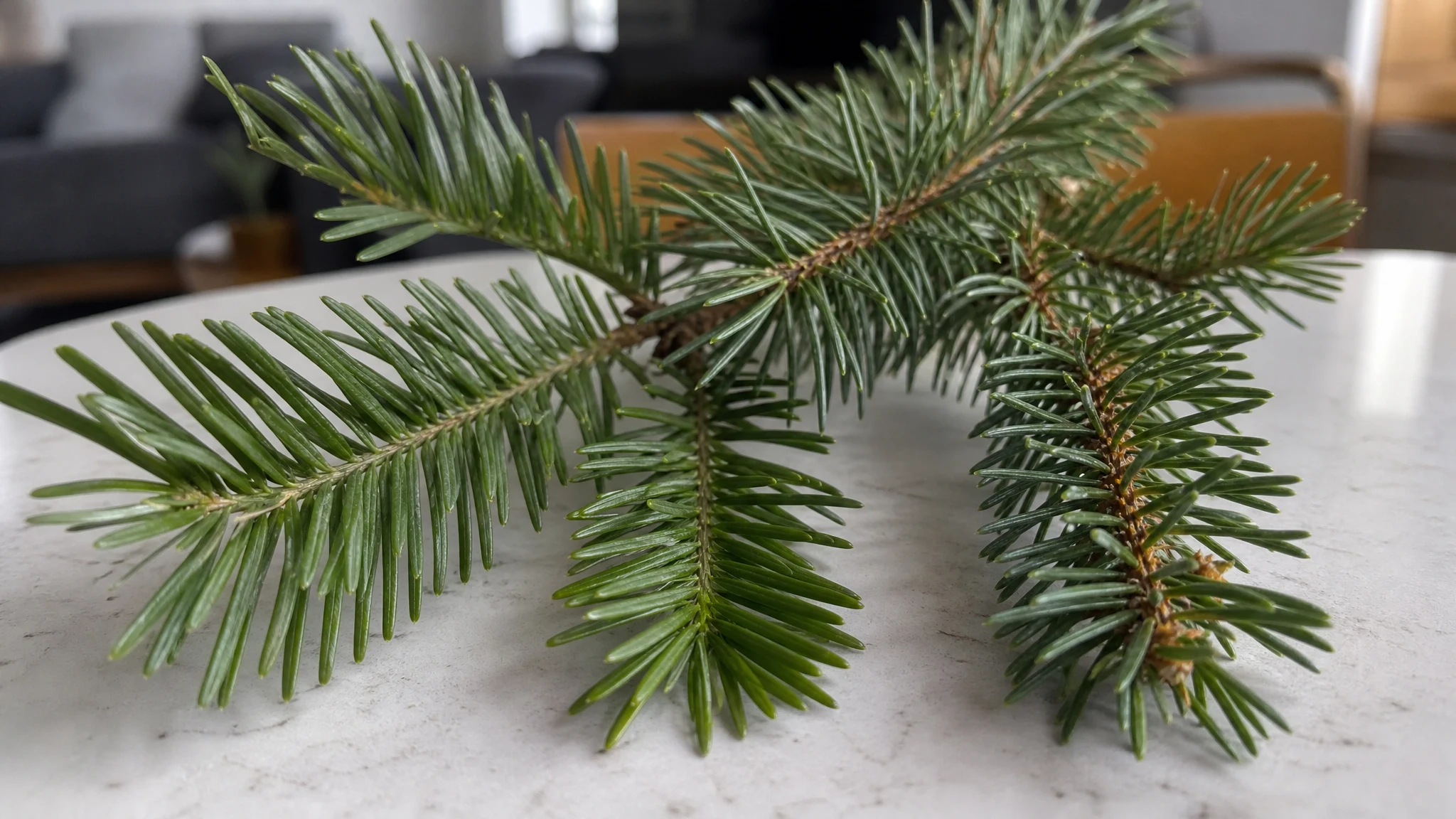
Fir is the genus Abies and spruce is Picea. A Fine Gardening identification guide gives the quick test: both carry their needles singly on the twig, but fir needles are flat and will not roll between your fingers, while spruce needles have four sides and roll easily. If you ever hold a fresh bough of each, you will know which is which in seconds.
Our fir needle oil is steam distilled from needles, and the certificate we publish for one batch names Abies balsamea, balsam fir. We describe the scent as crisp, resinous and evergreen, like freshly cut boughs.
Same lab, same day, different oils
Comparing oils from different papers mixes up species, season and method, so the cleanest evidence is a single study. Swor and colleagues distilled foliage from several Idaho conifers collected on one August day, and that included a subalpine fir and an Engelmann spruce.
The firs were led by bornyl acetate and limonene, which is the woody-sweet, slightly citrusy pairing many people picture when they think of a fir. The spruce was led by camphor, at about 23 percent, with bornyl acetate nowhere near the top. In other words, the idea that spruce is just fir with a different name does not hold up in this sample. Two fir trees from the same hillside even swapped the order of their top two compounds, a good reminder that a species name describes a family of oils rather than one recipe.
Why "spruce" needs a follow-up question
Black spruce is the species most often sold as spruce oil in North America, and a BioResources paper on its bark shows why the part matters. The authors cite earlier work putting bornyl acetate at roughly 37 to 46 percent of black spruce needle oil. Their own oil, distilled from bark collected at a Quebec sawmill, looked entirely different: mostly alpha-pinene and beta-pinene, only a trace of bornyl acetate, and a yield of about 0.05 percent.
So a bottle that says "black spruce" could be a needle oil, a twig oil or a bark by-product, and those can sit further apart than two fir species do. It is a fair question for any conifer oil, ours included, and the answer to look for is a named species, a named part and a lot number.
Can you swap one for the other?
Our advice is to treat a swap as a new recipe rather than a like-for-like substitute. Because the leading compounds differ, the balance of the scent shifts, and no side-by-side smell comparison of the two oils is on record that we know of, so ranking one above the other would be opinion. A few practical rules follow from that.
- Following a recipe that names one oil: buy that oil. If you do swap, make a small trial batch at a lower load first, using the formulating guide to set the number.
- Building a blend from scratch: pick one conifer, write down species, part and lot, and compare on paper strips. The blending guide walks through it.
- Making something to sell: spruce and fir are different ingredient names on a label, so keep them separate in your records. The labeling guide covers naming.
A short word on safety
For skin, our guidance is 0.5% to 2% in a carrier oil, a patch test on a small area first, and keeping the oil away from eyes, children and pets. It is not for internal use. The Tisserand Institute publishes general ranges, from 0.2% to 1% for sensitive skin up to 1% to 3% for body products, and neither of us gives a separate figure for spruce. Conifer oils also age with heat, light and air, so keep the cap tight and the bottle cool and dark. If you are pregnant, buying for a child or worried about a pet, a physician, pediatrician or veterinarian is the right person to ask.
We sell fir needle oil and no spruce. If spruce is what your project needs, look for a supplier that names the species and the plant part and can show a GC/MS report for the lot. For the other conifer people often confuse with fir, the fir and pine comparison picks up from here.
Fir or spruce is rarely the real question; which tree, which part and which lot almost always is.
Fir Needle Essential Oil
Fir Needle Essential Oil from our own shop, in sizes from 0.5 oz to bulk.
From $10.99
Shop Now →Sources & Further Reading
- Aitken S., 2006. Fir vs. Spruce vs. Pine: How to Tell Them Apart. Fine Gardening, issue 107. finegardening.com
- Swor K., Satyal P., Poudel A., Setzer W.N., 2023. Gymnosperms of Idaho: Chemical Compositions and Enantiomeric Distributions of Essential Oils. Molecules 28(6):2477. pmc.ncbi.nlm.nih.gov/PMC10057033
- Francezon N., Stevanovic T., 2017. Chemical composition of essential oil and hydrosol from Picea mariana bark residue. BioResources 12(2):2635-2645. bioresources.cnr.ncsu.edu
- Tisserand Institute (R. Tisserand), undated. Recommended dilutions. tisserandinstitute.org/safety/dilution