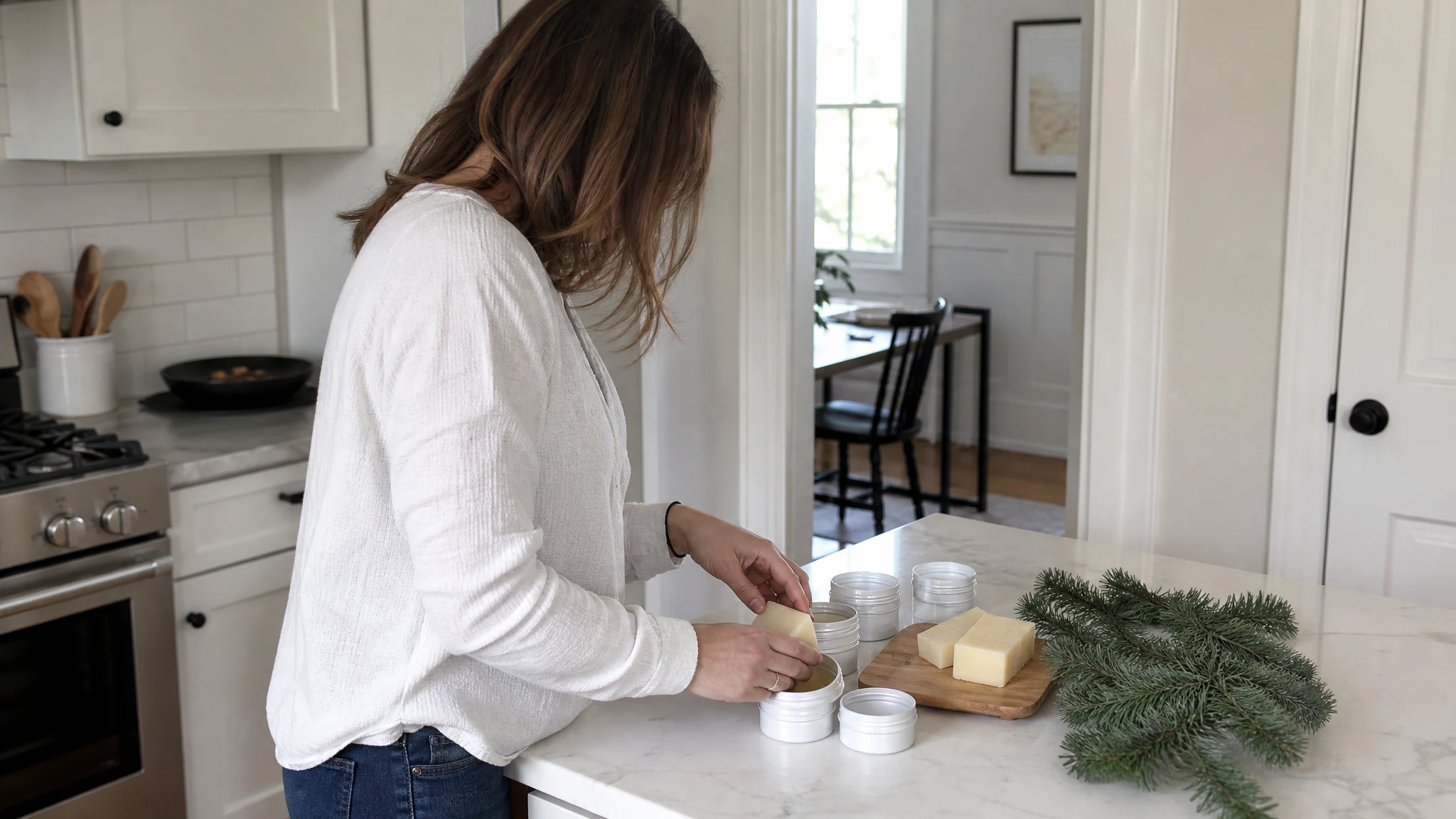
A Solid Fir Cologne You Can Make at the Kitchen Table
A solid cologne is a tin of wax and oil you can swipe on your wrist and slide into a pocket. With fir oil in it, it smells like a cold, clean hillside. The wax and carrier are forgiving. The fir oil is the one ingredient that sits on your skin at full strength all day, so we work the recipe backwards from the dose.

Fir Needle Essential Oil
Our own Fir Needle Essential Oil, in sizes from 0.5 oz to bulk.
From $10.99
Shop Now →Why we start at 1.5 percent
Recipes online use all sorts of scent loads. One supplier page, MySkinRecipes, gives 50 percent beeswax, 47 percent jojoba oil and 3 percent fragrance oil, and says loads run roughly 1 to 5 percent (Solid Perfume Formulation and Method). That is a fragrance-oil recipe, a compounded material, and a steam-distilled oil like ours is a different thing. So we looked at skin guidance instead.
The Tisserand Institute lists 0.5 to 1.2 percent for facial cosmetics, 1 to 3 percent for body oils and lotions, and 0.2 to 1 percent for sensitive or impaired skin. It does not name perfume, and calls its numbers guidelines (Recommended dilutions). A cologne is dabbed on the neck and wrists, so the body range is the closest fit. Our own guidance for fir oil on skin is 0.5 to 2 percent in a carrier, and where the two overlap is 1 to 2 percent. We take the middle, 1.5 percent by weight, and treat 2 percent as the ceiling for a first batch. That is our reasoning from two documents, not a measured result.
Who should sit this one out
Anyone with eczema, broken skin or a history of reacting to fragranced products, since a solid cologne stays on the skin. Anyone who wants to wear it on the face, which has a lower range; our beard oil post covers that case. And anyone planning to sell it: a scented balm is a cosmetic with its own labelling and safety duties. Our labelling guide and IFRA notes are where to begin.
The arithmetic for 30 g
Weigh everything, because a batch this small holds only a few drops. The Certificate of Analysis we publish for one batch gives a relative density of 0.924, so 1 ml of that batch weighs about 0.92 g. About 20 drops to a millilitre is a rough convention.
- 1.0 percent: 0.30 g, about 6 drops.
- 1.5 percent: 0.45 g, about 10 drops. Our starting point.
- 2.0 percent: 0.60 g, about 13 drops.
You need a scale that reads to 0.01 g. On a 1 g scale, 0.45 g does not exist, and a 0.1 g error on a batch this size shifts the load by a third of a percentage point.
The recipe
We sell only the fir oil, so the beeswax, jojoba and tins come from a craft or soap-making supplier, with the carrier available at a grocery or pharmacy too.
- Weigh 15.00 g of beeswax and 14.55 g of jojoba into a heatproof cup. That is 50 percent wax and 48.5 percent carrier, close to the 50:47 ratio on the supplier page.
- Melt it gently in a water bath until clear, and stop heating as soon as the wax is liquid.
- Take the cup off the heat and let it cool for a minute or two without setting. Because conifer oil is volatile, we add it to cooled wax rather than a hot cup.
- Weigh in 0.45 g of fir needle oil, stir well and pour into clean tins straight away.
- Leave the tins undisturbed for a few hours, then label with the date and the fir oil load.
The 50:47 ratio gives a firm balm. If you prefer a softer glide, make a second batch with 12.00 g of wax and 17.55 g of carrier, keep the 0.45 g of fir oil and compare the two.
Patch test, then wear it
Test the finished balm, not the neat oil: a dab the size of a fingernail on the inner forearm, left for a full day. Redness, itching or swelling means stop. The steps are in our dilution and patch test guide. Keep it away from eyes and mouth, and keep the tin where children and pets cannot reach it.
Then wear it once before you make ten. We describe fir as a top-to-middle note, which suggests it will soften and fade sooner than a woody base note, so judge it after an hour, not in the first minute.
Keep it fresh
Essential oils react with oxygen over time, and the Tisserand Institute says the oxides and peroxides that form tend to be slightly toxic and can raise the risk of skin reactions, with heat, light and moisture speeding the process (Is my bottle of essential oil oxidized or no longer good to use?). Our fir oil typically keeps one to two years tightly capped in a cool, dark place, and the same logic covers the finished tin: make a small batch, keep the lid on and replace one that smells flat or sharp. A half-ounce bottle holds about 13.7 g of oil, which is enough for roughly 30 batches at 0.45 g, so the smallest size is plenty to use up in time. See our storage guide for more.
It is a tidy little project with a lovely result, and a tin will happily live in a coat pocket all winter.
Fir Needle Essential Oil
Fir Needle Essential Oil from our own shop, in sizes from 0.5 oz to bulk.
From $10.99
Shop Now →