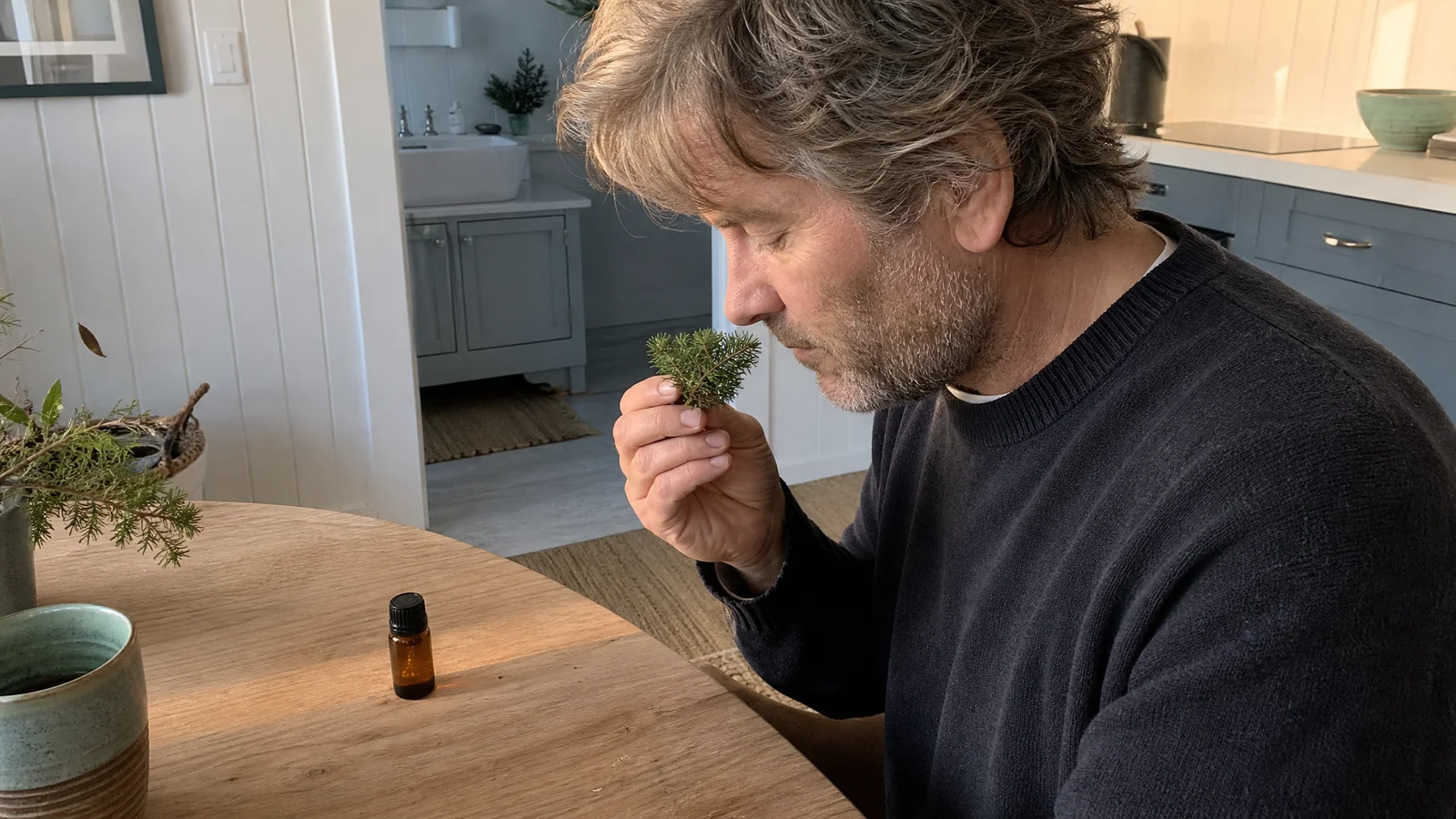
Fir Needle Oil: Straight Answers to Common Questions
These are the questions that come up most often before someone buys fir needle oil. The answers are short, with a link to a longer post wherever there is more to say. We sell one fir needle oil, undiluted, and nothing else, so for wax, soap base or carrier oils we will point you to a supplier who does.

Fir Needle Essential Oil
Our own Fir Needle Essential Oil, in sizes from 0.5 oz to bulk.
From $10.99
Shop Now →Which fir is your oil made from?
The Certificate of Analysis we publish for one batch names Abies balsamea, balsam fir, and lists the extraction as steam distilled. Our product pages describe the oil as steam distilled from needles, with fine twigs. If the species matters for your formula, write to us through the contact page before ordering.
Is fir the same as pine or spruce?
No, they are different trees and their oils are different materials. Steve Aitken's Fine Gardening guide gives the tree test: needles in bundles of two, three or five mean pine, single flat needles that do not roll between your fingers mean fir, and single four-sided needles that roll easily mean spruce. Our posts on fir versus pine and fir versus spruce go further.
How much should I dilute it for skin?
We recommend 0.5% to 2% in a carrier oil, roughly 3 to 12 drops per ounce, with a patch test on a small area first. The Tisserand Institute gives ranges by use: 0.2% to 1% for sensitive skin, 0.5% to 1.2% for the face, 1% to 3% for body products and 2% to 4% for wash-off products. Where ranges differ, use the lower one, and do not apply the oil undiluted. The dilution and patch test post has the drops.
What about pets?
Please keep the oil away from children and pets, and ask your veterinarian about your own animals. The Pet Poison Helpline says cats are at higher risk and that active diffusers release microdroplets that settle on fur, while the ASPCA suggests avoiding diffusers around birds and pets with breathing problems. Neither page names fir specifically, so a veterinarian's advice for your animal matters most.
Can I use it in candles, soap or cleaners?
Yes, as a fragrance, and each has its own post: candles, melt and pour soap, cold process soap and cleaners. Work out the dose by weight from your product maker's data, try a small batch first, and read our labeling guide if you plan to sell.
How long does it keep?
We say conifer oils typically keep 1 to 2 years if the bottle is tightly capped in a cool, dark place, and our oil comes in amber glass. Note the date you opened it, and use the freshest oil for anything that touches skin. The Tisserand Institute says oils react with oxygen over time and that heat, light and moisture speed it up, which is why those storage habits matter. More in our storage post.
Can I swallow it?
No. The oil is not for internal use, and it is a fragrance and household-scent material rather than a food or supplement. If someone has swallowed it, call poison control or your local emergency number.
What does your certificate show?
It is for one batch, and it lists the botanical name Abies balsamea, steam distillation, a relative density of 0.924 at 20 C against an accepted window of 0.888 to 0.958, and a refractive index of 1.468 against 1.445 to 1.488. If you need a GC/MS report or a safety data sheet, ask through the contact page or wholesale page before you order.
Which size should I buy?
It is the same oil in all nine sizes, from 0.5 oz to 400 lb, and we do not run a separate bulk grade. Since conifer oil typically keeps 1 to 2 years, buy what you will use in that time; the smallest bottle is a good start for a first project, and a half-ounce holds roughly 14 ml. For larger quantities, our bulk page and wholesale page describe samples and the enquiry form.
If your question is not here, write to us through the contact page and we will do our best to answer it.
Fir Needle Essential Oil
Fir Needle Essential Oil from our own shop, in sizes from 0.5 oz to bulk.
From $10.99
Shop Now →Sources & Further Reading
- Tisserand Institute, Essential oil dilution guidelines. https://tisserandinstitute.org/safety/dilution/
- Tisserand Institute, Oxidized essential oils. https://tisserandinstitute.org/learn-more/oxidized/
- Pet Poison Helpline, Updates on Essential Oils. https://www.petpoisonhelpline.com/uncategorized/updates-on-essential-oils/
- ASPCA, Essentials of Essential Oils Around Pets, June 2022. https://www.aspca.org/news/essentials-essential-oils-around-pets
- Aitken S, Fir vs. spruce vs. pine: how to tell them apart, Fine Gardening 107, 2006. https://www.finegardening.com/article/fir-vs-spruce-vs-pine-how-to-tell-them-apart